An Entrepreneur’s Conscience!

Toddler dressed like a businessman representing Kidpreneurs learning enterprise and generosity

Kidpreneurs can learn far more than how to make money. When children start small enterprises, they can also learn generosity, responsibility, confidence, persistence and the importance of using money wisely.

“`

This article began with a conversation I had with a dear friend. Her children were inspired by our Enterprise for Kids stories, but she raised a thoughtful question: should children be encouraged to make money for themselves, or should enterprise always be connected to giving?

“`

Child celebrating a Kidpreneurs enterprise lesson about making money and giving generously
Enterprise for Kids was created to inspire children to think bigger, take action and learn real-world money lessons.

Kidpreneurs: Can Kids Make Money and Still Be Charitable?

I was talking with a dear friend and asked what she thought of our Enterprise for Kids blog. She said it was very well done and that her kids were inspired by our children’s enterprise experiences.

Her children had read every blog post and watched every video. Then her nine-year-old daughter sat down and planned an enterprise of her own, following many of the lessons we had shared on the blog.

Wow!

That is exactly the kind of inspiration we hoped to encourage, especially with kids. We wanted children to see other children having ideas, taking action, learning from real experiences and discovering that they could create something of their own.

What Happened Next Surprised Me

Child frustrated while learning a Kidpreneurs money lesson about enterprise and generosity
Children can feel confused when adults send mixed messages about money, enterprise and giving.

My friend explained that she liked the idea of enterprise, but she was not comfortable with children having an enterprise where they make money for themselves.

I was a little taken aback when she said this. I had never really thought that some people might believe children should not make money from their own efforts unless it was all being given away.

I was also grateful that my friend was honest enough to share her belief. It helped me better understand her thinking, but it also helped me clarify my own.

Firstly, there is no right or wrong in what people believe or do. Everyone is entitled to their views, and I respect my friend’s view.

After this enlightening conversation, I came to realise how far our own mindset around money had changed since we started searching for economic and personal freedom. It also made me think deeply about something I now call the entrepreneur’s conscience.

Kidpreneurs Need a Healthy Money Mindset

If children are going to become confident, capable and generous, they need a healthy money mindset. That means they need to learn that money is not bad, enterprise is not selfish, and making money does not automatically make someone greedy.

Money is a tool. Like any tool, it can be used well or poorly.

A child who learns to earn money can also learn to save, give, invest, spend wisely and support causes they care about. In fact, earning their own money may give children a stronger understanding of generosity because they know the effort that went into creating it.

That is an important lesson for Kidpreneurs.

Money mindset quote for Kidpreneurs learning about enterprise and generosity

Wealthy entrepreneurs often think differently about money. Generally, I would also say that many are not selfish. Of course, some wealthy people are selfish, just as some people without wealth are selfish too.

But many successful entrepreneurial people have persisted with their goals, taken risks, created value, employed people and then used their wealth to support causes they believe in.

It is much easier to be charitable when you have resources. Many people who are struggling to make ends meet simply do not have the time, energy or money to make larger contributions to the world, even if they have a generous heart.

Entrepreneurs and Charitable Giving

Warren Buffett is one example of an entrepreneur and investor who has made philanthropy a major part of his life. On his Giving Pledge page, he states that more than 99% of his wealth will go to philanthropy during his lifetime or at death.

Sir John Templeton is another example. He created the John Templeton Foundation, which supports research and conversations around big questions connected to science, philosophy, theology, character, freedom and human purpose.


Warren Buffett as an example of charitable giving and entrepreneur conscience
Warren Buffett.
John Templeton as an example of philanthropy and values-based entrepreneurship
John Templeton.

These examples matter because they challenge the idea that enterprise and generosity are opposites.

In many cases, enterprise can actually make generosity possible on a much larger scale.

Can Making Money Help Children Become More Generous?

Only last week I was speaking with a new entrepreneur friend who lives in Perth. He had created tremendous wealth developing property, mostly in the Western Australian mining town of Port Hedland.

He explained that he no longer needed to work in the same way and could now channel his energy into his passion. He was planning to take his young family to America, where he had enrolled in a Theology university course. From there, he hoped to do mission work in Africa.

Being a successful entrepreneur was allowing him to follow his charitable dream.

That really stayed with me.

If we teach children that making money is selfish, we may unintentionally close their minds to the possibility that wealth can be used to serve, support, create and give.

However, if we teach Kidpreneurs that enterprise comes with responsibility, we can help them develop both capability and conscience.

The Entrepreneur’s Conscience

Entrepreneur conscience quote for Kidpreneurs learning about money and giving

It could be argued that entrepreneurs may have more freedom, more time, less stress, better health, more travel and more opportunities for their families than those of us tied tightly to a job and debt.

That is not always true, of course. Many entrepreneurs work extremely hard, especially in the early stages.

But successful enterprise can create options. It can create space. It can create time. It can create resources. And when people have more options, they are often in a better position to make a difference.

So, do successful entrepreneurs have an entrepreneur’s conscience?

Some do, and some do not. But the point for children is this: conscience can be taught alongside enterprise.

We can teach kids how to make money and how to think about others. Those two lessons belong together.

Teaching Kidpreneurs to Give

I would like to thank my friend for helping me consider my views on the entrepreneur’s conscience. I certainly value the importance of teaching kids enterprise, and I also strongly support the idea that enterprising kids should be taught to be charitable.

Our view is that children need to walk before they can run.

For us, it is okay for our kids to begin with a “selfish” goal, because that is often what motivates them at the time to take action and learn the entrepreneurial skills necessary to succeed.

A young child may first want to make money for a toy, a game, a bike, a computer or something else that excites them. That motivation gets them moving.

Then, once they begin learning the skill of earning money, we can help them think about where some of that money could go.

That is exactly the process we taught Chayse, who was four, and Kit, who was seven, when they reset their goals. Their enterprise journey became not only about making money, but also about learning to give.

A Simple Giving Plan for Kidpreneurs

One practical way to teach kids generosity is to create a simple money plan. This does not need to be complicated.

Children can divide their money into a few clear purposes:

  • Spend: money for something they want now.
  • Save: money for a bigger goal.
  • Grow: money for an asset, tool or future enterprise idea.
  • Give: money for charity, tithing, community support or someone in need.

This kind of plan teaches children that money has purpose. It is not just something to grab, spend or hoard.

It can be used to enjoy life, build future options and help others.

For Australian families, it can also be useful to talk to children about choosing causes carefully. The Australian Charities and Not-for-profits Commission provides a public charity register families can use when checking registered charities.

The More Values-Based Kidpreneurs We Create, the Better

The more values-based Kidpreneurs we create, the better our world can become.

As we revisit our own children’s entrepreneurial journeys on this blog, we will continue to share the lessons around their entrepreneur’s consciences and how we are teaching them to be charitable.

We do not want children to grow up thinking money is bad. We also do not want them to grow up thinking money is everything.

We want them to understand that enterprise can build confidence, creativity, responsibility and choice. We also want them to understand that with those opportunities comes the chance to contribute.

Key Takeaway: Kidpreneurs Can Earn and Give

Key takeaway: Kidpreneurs can learn to make money and still develop generosity. Enterprise does not have to replace charity. When taught well, it can help children become more capable, responsible and giving.

Where to Next?

What do you think? Should children be encouraged to make money for themselves, give some away, or both? We would love to hear your thoughts in the comments.

Teenage Entrepreneur Ideas from Cameron Herold

Child using a laptop with entrepreneur ideas on the wall for raising enterprising kids

Teenage entrepreneur ideas can come from the most unexpected places. Sometimes the very children who do not fit neatly into the traditional school mould are the ones with the energy, creativity and problem-solving ability to become enterprising adults.

“`

That is the powerful message I took from Cameron Herold, a successful entrepreneur and speaker who challenges parents and teachers to recognise entrepreneurial strengths in children.

“`

Cameron Herold sharing teenage entrepreneur ideas and advice for raising enterprising kids
Cameron Herold’s message challenges parents and teachers to recognise entrepreneurial strengths in children.

Teenage Entrepreneur Ideas from Cameron Herold

I was looking for conversations about raising enterprising kids when I came across a very inspirational entrepreneur called Cameron Herold.

Cameron Herold is a successful entrepreneur with an excellent message for parents who want to raise children with entrepreneurial skills. He shares his own life story and also refers to the book Young Bucks: How to Raise a Future Millionaire by Troy Dunn.

What really caught my attention was Cameron’s view that many children with entrepreneurial potential are sitting in classrooms right now, but their strengths are not always being recognised.

Some children do not naturally fit into the regular schooling mould. They may be energetic, intense, talkative, distracted, creative, restless, curious or constantly looking for a different way to do things.

In a traditional classroom, those traits can sometimes be seen only as problems. Cameron’s message is that some of those same traits may also be signs of entrepreneurial thinking.

This does not mean genuine learning, behavioural or health needs should ever be ignored. Parents, teachers and health professionals all have important roles to play. But it does mean we should be careful not to miss the strengths that can sit beside those challenges.

Are Some School Challenges Entrepreneurial Strengths?

Steve Jobs as an example of creative entrepreneurial thinking and innovation
Creative thinkers do not always follow the expected path.

In his talk, Cameron Herold speaks openly and provocatively about children who are labelled as difficult, distracted or different. He argues that some of these children may have the raw traits of future entrepreneurs.

He even uses the line, “Bipolar is the CEO disease,” to make his point that intensity, drive and unusual thinking can sometimes show up in successful entrepreneurs and leaders.

That statement is deliberately provocative, and it should not be taken as medical advice. But the deeper message is worth considering.

What if some children who struggle with the school system are not simply “naughty” or “lazy”?

What if some of them are actually wired to create, sell, lead, negotiate, build, question and solve problems?

As a teacher and parent, this made me think deeply. There are certainly children who love the school system, enjoy academic pathways and are happy to work towards a traditional career. That is wonderful.

But there are also children who do not fit so neatly. For those children, entrepreneurship may offer another pathway to confidence, purpose and success.

Schools Often Prepare Children for Jobs, Not Enterprise

Cameron Herold makes the point that schools rarely teach children how to think like entrepreneurs.

Schools often condition children to fit into jobs, follow instructions, complete tasks, wait for permission and work towards a salary. Those are useful skills in many parts of life, but they are not the only skills children need.

Enterprising kids also need to learn how to:

  • spot opportunities,
  • solve problems,
  • negotiate,
  • sell an idea,
  • communicate clearly,
  • take initiative,
  • manage money,
  • learn from failure,
  • and keep going when things become difficult.

Cameron’s view is that entrepreneurship is not simply an inherited trait. It can be taught, modelled, practised and encouraged.

That is very encouraging for parents. It means we do not need to wait and see whether our children are “born entrepreneurs.” We can help them develop the skills of enterprise through real-world learning.

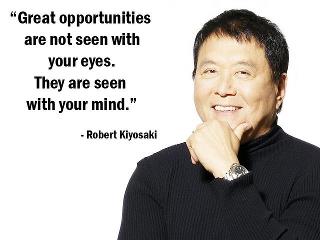
Robert Kiyosaki quote about entrepreneurship and learning outside the traditional school system

Teenage Entrepreneur Ideas Need Mentors

Entrepreneurs often learn through necessity, observation, family example or mentorship. Some children grow up around business owners and naturally absorb the language of enterprise. Others need someone outside the family to spark that thinking.

That is why mentors, books, videos, real-life stories and practical experiences matter so much.

If we want our children to learn about entrepreneurship, someone needs to teach it. That someone might be a parent, grandparent, teacher, coach, family friend, local business owner or online mentor.

This is one of the reasons we created Enterprise for Kids. We wanted our children to see that business, money, creativity and problem-solving were not only adult topics. They were life skills children could begin learning early.

Cameron Herold’s TED Talk on Raising Enterprising Kids

Cameron Herold TED talk about raising kids to be entrepreneurs
Cameron Herold’s TED talk is well worth watching if you are interested in raising enterprising kids.

Cameron Herold offers many excellent suggestions in his talk, “Let’s raise kids to be entrepreneurs”.

If you are following our blog, you are probably a parent who wants to give your children more opportunities and choices in life. That includes helping them develop enterprise skills, money skills and the confidence to think differently.

Cameron’s talk is a must-see. It goes for about 15 minutes, but it contains many ideas that can change the way you see children, schooling and entrepreneurship.

The “Gift of Want”

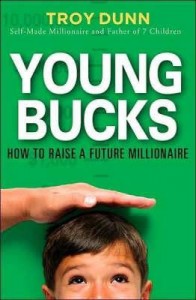
Young Bucks How to Raise a Future Millionaire book for parents raising entrepreneurial kids
Young Bucks: How to Raise a Future Millionaire.

In his talk, Cameron refers to the book Young Bucks: How to Raise a Future Millionaire by Troy Dunn.

Troy Dunn is also a self-made millionaire and successful entrepreneur. He also happens to be a father of seven children, just like us, so I found his perspective especially interesting.

In the book, Dunn explains that the first prerequisite for a young entrepreneur is the “Gift of Want.”

In other words, children need a real reason to pursue an enterprise idea. They need to want something badly enough to get started and to keep going when things become difficult.

This is such a practical insight for parents.

Many adults want children to be motivated by responsibility, discipline or long-term success. But children are often first motivated by something much more immediate: a toy, a bike, a game, a trip, a pet, an experience, a gift or a personal goal.

That desire can become the starting point for real learning.

From there, parents can guide children into lessons about planning, researching, marketing, pricing, negotiating, saving, giving and following through.

Practical Teenage Entrepreneur Ideas from Cameron Herold

Cameron Herold’s message is not only philosophical. It is also practical. He gives parents ideas for helping children develop entrepreneurial habits at home.

One of his strongest suggestions is to rethink pocket money.

Instead of simply giving children a regular allowance, he suggests teaching them to look for jobs that need doing around the house and then negotiate a fee for completing them.

That small shift teaches children several important enterprise skills:

  • looking for opportunities,
  • noticing problems that need solving,
  • putting forward an offer,
  • negotiating value,
  • completing work properly,
  • and understanding that money is connected to value creation.

That is a far more enterprising lesson than simply receiving a regular payment without needing to think, negotiate or act.

Teach Children to Save, Give and Buy Assets

Cameron also talks about teaching children strong money habits.

One simple idea is to use money boxes or jars with different purposes. For example, children can divide their money into:

  • Giving: money for charity, tithing, community support or helping others.
  • Spending: money for toys, treats or things they want now.
  • Assets: money for savings, investments, tools, equipment or future enterprise ideas.

This teaches children that money has choices attached to it. It is not only for spending. It can also be used to give, grow and create more opportunities.

This connects closely with our own family lessons around teaching children the difference between assets and liabilities.

Use Real Life as the Classroom

One of the most powerful ways to raise enterprising kids is to use real life as the classroom.

When you are in a restaurant, point out good customer service. When you see a strong salesperson, discuss what made them effective. When a business solves a problem well, talk about it. When a product is poorly designed, ask your children how they would improve it.

Encourage your children to:

  • sell unwanted toys,
  • make and sell something small,
  • build inventions,
  • tell stories,
  • practise speaking to people,
  • notice problems around them,
  • and think of ways to create value.

These activities may seem simple, but they build confidence. They help children see themselves as people who can create, solve, serve and earn.

Raising Enterprising Kids Means Seeing Children Differently

Cameron Herold has allowed me, as a school teacher, to see some children in schools differently.

I can see that there are children who love the system and are more than happy to work towards a traditional career. That pathway suits many children well.

But I can also see that there are other children who do not fit so easily into the system. Some of those children may be budding entrepreneurs without knowing it yet.

They need someone to recognise the entrepreneur within them and provide opportunities for those strengths to develop.

This does not mean every child needs to become a business owner. It simply means children deserve the chance to develop enterprise skills: initiative, communication, creativity, leadership, resilience, sales, money management and problem-solving.

Those skills will help them whether they become entrepreneurs, employees, artists, tradespeople, professionals, community leaders or something else entirely.

Key Takeaway: Teenage Entrepreneur Ideas Start With Strengths

Key takeaway: teenage entrepreneur ideas do not always start with a business plan. They often start with noticing a child’s strengths, interests, frustrations and natural ways of thinking. Cameron Herold’s message reminds us to look for the entrepreneur within the child and give that child real opportunities to practise enterprise.

Where to Next?

What entrepreneurial strengths do you see in your child, and how could you give them a real-world opportunity to practise those strengths?

Young Australian Entrepreneurs: Lessons from Dale Beaumont

Dale Beaumont presenting at Business Blueprint as an example of young Australian entrepreneurs

Young Australian entrepreneurs can be powerful role models for children. When kids see real people building businesses, creating freedom and using their success with purpose, enterprise becomes much more than an idea in a book.

“`

Dale Beaumont is one of those examples. His story reminded us that who we spend time with, who we learn from and who we allow to influence our thinking can shape what we believe is possible.

“`

Dale Beaumont as a young entrepreneur inspiring enterprising kids
Dale Beaumont began his entrepreneurial journey young, making his story a powerful example for enterprising kids.

Young Australian Entrepreneurs: Lessons from Dale Beaumont

Part of what we love about this blog is that we get to share the success of young entrepreneurs with not only our readers, but also our kids.

As we have been learning through Paul Counsel’s course, and as Dale Beaumont also reinforced for us, who you “hang with” is often who you become like.

That can be a scary thought, or it can be an inspiring thought, depending on your peers and the people you spend the most time with.

Luckily, we have wonderful family and friends. But for us, it is also important to include people who have achieved success in areas where we are still learning and growing.

Some of our family and friends fulfil those needs, but a sure way of increasing self-efficacy for us and our kids is to mix with other successful entrepreneurs, business owners and people who think differently.

Dale Beaumont as a Young Australian Entrepreneur

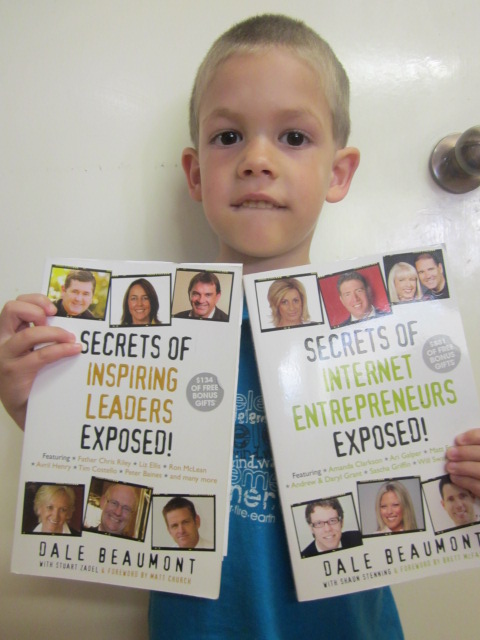
Dale Beaumont Secrets Exposed Series as an example of young Australian entrepreneurs creating books and business education
Dale Beaumont wrote the Secrets Exposed series.

Dale Beaumont is one such inspiring young Australian entrepreneur. He may not see himself as “young” anymore, but his success started at the tender age of 19.

Before developing his entrepreneurial skills, Dale was an accomplished gymnast and probably what many people would call an overachiever.

When Dale was 19, he co-authored a book called The World at Your Feet, which became the basis of his successful program, Tomorrow’s Youth. Through that program, he taught young people essential life skills.

From there, Dale went on to publish books, build relationships with other successful entrepreneurs, business owners and thought leaders, and eventually develop Business Blueprint.

His journey is a wonderful example for children because it shows that enterprise can begin young. It also shows that success is rarely about one single moment. It is built through learning, relationships, systems, action and persistence.

What Young Australian Entrepreneurs Teach Our Kids

One of the biggest lessons Dale Beaumont’s story teaches our children is that entrepreneurship is not just about making money.

It is about learning how to think. It is about developing skills, building useful systems, creating value, managing time, solving problems and making choices that can lead to more freedom.

Dale Beaumont with his family showing family freedom through entrepreneurship
Dale with one of his children.
Dale Beaumont and his wife travelling as a result of business systems and financial freedom
Inside the Sistine Chapel.

Dale is married and has two boys, and one of the things that really appealed to Trevor and me was that his focus was not only on business growth. It was also on creating time and freedom to travel with his young family.

He was able to do this because he had built systems within his business so that everything could keep ticking along with or without him.

You can imagine how appealing that was to us.

We did not want business success that simply created another job. We wanted to learn how business could create choice, flexibility and meaningful family experiences.

Lessons from Business Blueprint

I will not go through the whole workshop that my good friend Sally and I attended in Perth, but I do want to share a few highlights that really stuck with me as Dale spoke.

Dale Beaumont presenting at Business Blueprint as an example of young Australian entrepreneurs
Presenting at Business Blueprint.

Two sayings that stood out were:

“Empty bank accounts don’t feed the people.”

“The poor can’t help the poor.”

Those two sayings alone say a lot.

Some people want money purely for money’s sake — to have nice things and show others how well they are doing. Others want money so they can enjoy wonderful experiences, support their family, do good things in the world and make a difference in the lives of others.

We fall into that second category.

Dale’s example helped reinforce something important for our family: money with purpose can become a tool for freedom, contribution and service.

Money, Purpose and Making a Difference

One thing we found inspiring was Dale’s support for Hands Across the Water in Thailand. It was powerful to see an entrepreneur using his success and influence to make a difference in the lives of children.

This is an important message for enterprising kids.

We do not want our children to think that business is only about making money. We want them to understand that business can also create choices, opportunities and the ability to contribute.

That idea connects beautifully with our own reflections on whether having a money mindset can also be charitable.

The Internet Changed Business Forever

New Rules of Business seminar showing how the internet changed business for young Australian entrepreneurs
New Rules of Business seminar.

The internet has changed business forever.

If we do not embrace that change, our businesses can get left behind. A classic example was the way physical bookstores were challenged as online bookselling grew rapidly.

The point for our children is clear: the business world they are growing into is very different from the business world we grew up in.

Today’s young people need to understand technology, online marketing, digital systems, automation, websites, customer service, communication and content.

They do not need to master all of these skills as children, but they do need to grow up with the mindset that learning never stops.

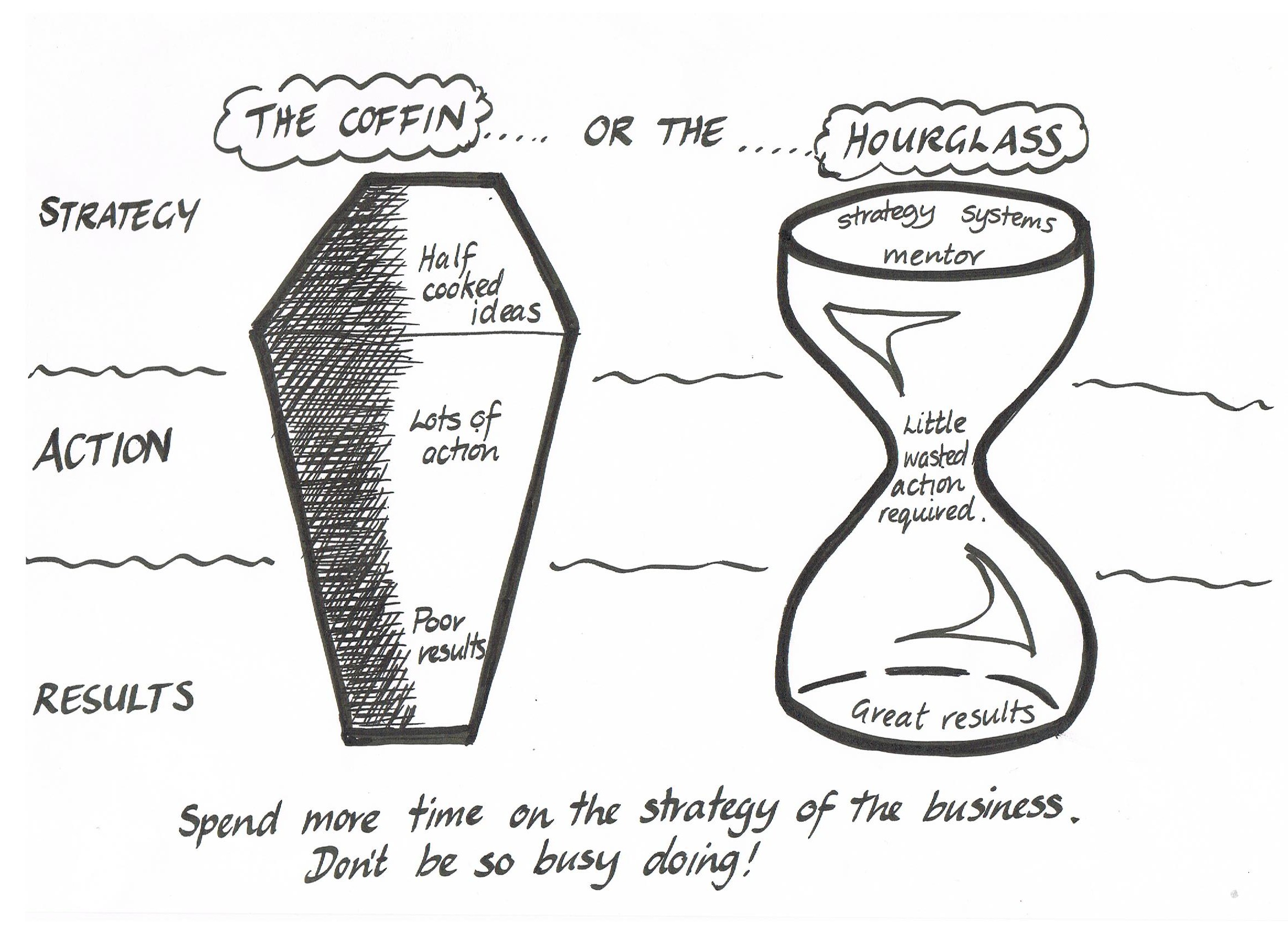
The Coffin or the Hourglass

Dale shared something he learnt when he was just starting out in business.

He called it the coffin or the hourglass.

The coffin or the hourglass business planning model taught by Dale Beaumont
The Coffin or the Hourglass.

Many people starting in business spend more time taking action than they do strategising or planning where they want their business to end up.

Taking action is important, of course. But you do not want your business to be like a coffin, where little time is spent thinking, planning and designing the right direction, while heaps of time is spent taking action that may not be very fruitful.

The hourglass, on the other hand, is about putting time into planning, strategising and thinking first.

With well thought-out plans in place, the action you take becomes more focused and the results are more fruitful.

So what would you prefer? A business with the coffin model, or one with the hourglass model?

Young Australian Entrepreneurs Need Systems

I think one of the reasons Dale became successful in a relatively short period of time was his ability to let go of things that could be done by someone else and focus on the things he needed to do to be effective within his business.

That is a major lesson for young Australian entrepreneurs.

Hard work matters, but systems matter too.

Business owners who try to do absolutely everything themselves can quickly become exhausted. Systems help free up time, improve consistency and allow business owners to focus on the areas where they can create the most value.

In the original version of this article, we talked in detail about a particular automation and CRM system we had started using at the time. Years later, the exact tools have changed, but the lesson remains the same.

Business systems can help with:

  • email follow-up,
  • customer records,
  • online payments,
  • memberships or subscriptions,
  • event management,
  • task management,
  • marketing follow-up,
  • and website processes.

The specific software will keep changing, but the mindset is timeless: build systems that help your business run more smoothly.

You can learn more about Dale Beaumont and his business education work through Business Blueprint.

What This Means for Enterprising Kids

So, how does all of this relate to enterprising kids?

For any business our kids choose to start, using the internet will be a given, especially as they grow into young adults.

If we want our kids to be competitive in today’s markets, we need to show them the way by continuing to learn ourselves.

They will follow our lead. They will absorb whether we are curious, whether we keep improving, whether we look for better systems and whether we are willing to adapt.

We want our children to have a mindset that says:

Get savvy. Learn. Improve. Keep going.

Bedtime Reading for Enterprising Kids

Chayse holding business books as bedtime reading for enterprising kids
Bedtime reading for enterprising kids.

Generation Y and the generations after them are already building and creating things that improve efficiency in their lives.

Why spend six hours on something if you can learn how to streamline it and do it in one?

That is the world our children are growing into.

We agree completely that life is not meant to be all about work. We want to work to live, not live to work, and we want our kids to understand that concept too.

At the same time, we want them to know that learning from successful entrepreneurs can expand their thinking.

Books, mentors, workshops, conversations and real-world examples can all help children see what is possible.

We no longer need a long list of affiliate-linked books here. The bigger message is simply this: expose children to inspiring people and ideas, then help them apply those ideas in age-appropriate ways.

Key Takeaway: Young Australian Entrepreneurs Can Inspire Kids

Key takeaway: young Australian entrepreneurs like Dale Beaumont can help children see what is possible. When kids are exposed to mentors, business systems, purpose-driven money lessons and real-world learning, they begin to understand that enterprise can create freedom, contribution and choice.

Where to Next?

Who are your children learning from, and what kind of thinking are those influences helping them develop?

Belief in Yourself: Jay Bennett’s Steps to Success

Energetic teens showing belief in yourself and confidence for success

Belief in yourself is one of the most important ingredients in success. Skills matter, goals matter and opportunities matter, but if a young person does not believe they are capable of growing, learning and following through, it becomes much harder to take action.

“`

That was one of the lessons we took from Jay Bennett’s “Steps to Success” talk. His message about dreams, attitude, belief and commitment applies not only to adults in business, but also to students, enterprising kids and young people learning how to build confidence.

“`

Jay Bennett teaching belief in yourself and steps to success
Jay Bennett’s Steps to Success message focused on dreams, attitude, belief and commitment.

Belief in Yourself: Jay Bennett’s Steps to Success

On our journey, we are finding many opportunities coming our way. Some of these opportunities involve speakers who have achieved enormous success in their chosen fields of endeavour.

What makes many of these speakers so inspiring is that, whatever company they represent or whatever industry they work in, the deeper principles of success are often the same.

One such speaker was an inspiring Californian man named Jay Bennett. Jay had achieved great success in network marketing and spoke with energy, humour, confidence and a genuine passion for helping others succeed.

He was also a very fit and healthy man, and his appearance could easily fool you into thinking he was many years younger than he actually was. He was a walking billboard for the health and wellbeing industry.

Jay spoke for two hours and had us captivated by his insights. His talk was titled “Steps to Success”, and I thought his message was powerful enough to share with our readers.

Step 1: Start With a Dream

If you have not really thought about what your dream is, Jay suggests that is where you should start.

Identify your real dreams and what you want in your life.

Where do you want to be in ninety days?

Where do you want to be in one year?

Where do you want to be in three years?

That simple act of looking ahead can be powerful for students and enterprising kids. Young people need to learn that goals do not have to stay vague. They can be named, pictured, written down and worked towards.

“You have to have a dream to make a dream come true.”

For children and teenagers, a dream might be connected to school, sport, creativity, enterprise, confidence, travel, friendships, money or contribution. The specific dream matters less than the process of learning how to imagine a future and then take steps towards it.

Step 2: Build the ABCs of Success

Jay Bennett explained the foundation for success using three simple ideas: Attitude, Belief and Commitment.

These are easy words to say, but they are powerful life skills to practise.

For enterprising kids, these three ideas connect directly to real-world learning. A child starting a small enterprise, learning a new skill or working towards a personal goal will need all three.

Attitude: Focus on the Solution

Jay’s first success principle was attitude.

He made the point that a great attitude often leads to better results. That does not mean life is always easy or that problems disappear. It means choosing to focus on the solution rather than becoming stuck in the problem.

Some of Jay’s key ideas around attitude included:

  • Having a great attitude leads to better results.
  • Focus on the solution, not only the problem.
  • Associate with positive people.
  • Attitude can influence success in every area of life.

This is such an important message for students.

A child with a poor attitude may see every challenge as proof that they cannot succeed. A child with a stronger attitude can begin to ask, “What can I try next?”

That shift matters.

Belief in Yourself: The Core Success Principle

The second principle was belief, and this is where the phrase belief in yourself becomes so important.

Jay spoke about believing in the industry, the company, the products and the opportunity. But he made it clear that the most important belief is the belief a person has in themselves.

For students and young people, this is a huge lesson.

Belief in yourself does not mean pretending you already know everything. It means believing that you are capable of learning, improving, asking for help, recovering from setbacks and becoming stronger through experience.

Jay’s key ideas around belief included:

  • Believe in the opportunity in front of you.
  • Most importantly, believe in yourself.
  • Believe that you are capable of success.
  • Believe that you deserve the chance to grow.
  • Build belief through positive learning, books, audios, events and mentors.

This is why personal development matters for children and teenagers. The books they read, the people they listen to, the events they attend and the conversations around them can all help shape what they believe is possible.

Commitment: Stay With the Journey

The third principle was commitment.

Jay reminded us that success is usually one step at a time. It is not a single moment. It is a journey.

Commitment means following through on your dreams, even when the first burst of excitement has worn off.

Some of Jay’s key ideas around commitment included:

  • Success is one step at a time.
  • Follow through on your dreams.
  • Success is a journey, not only a destination.
  • Commit to the journey.
  • Success often means hanging on when others have let go.

This is a powerful message for enterprising kids.

Many children have ideas. Fewer children follow those ideas long enough to learn from them. Commitment teaches young people to keep going, adjust, improve and continue after the easy part is over.

Positive Association and Success

Jay Bennett and family showing success principles built around belief attitude and commitment
Jay Bennett and family.

Jay Bennett made a big point about mixing with the right people and keeping yourself focused and motivated.

The best way to do that, he suggested, is to regularly place yourself in environments where you can learn from people who are positive, motivated and moving in the direction you want to go.

That might include seminars, talks, training events, books, audios, mentors, coaches or simply spending more time with people who lift your thinking.

For students, this does not have to mean attending business seminars. It might mean choosing friends carefully, joining a positive team, listening to encouraging podcasts, reading books that stretch them or spending time around adults who model persistence and confidence.

Belief in yourself is easier to build when you are surrounded by people who also believe growth is possible.

Jay Bennett’s Message for Enterprising Kids

Although Jay’s talk was aimed at adults pursuing success, the principles apply beautifully to young people.

Students need dreams.

They need a positive attitude.

They need belief in themselves.

They need commitment.

They also need positive people around them who help them stay motivated and focused.

These are the same qualities that help children develop an entrepreneurial mindset. Whether a child is starting a small business, improving at school, building confidence, learning a sport or working towards a personal goal, the principles remain the same.

You can learn more about Jay Bennett’s training background through his Jay Bennett trainer profile.

How Students Can Practise the Steps to Success

Here is a simple way to turn Jay Bennett’s message into a practical student activity.

1. Name the dream

Ask the student to write down one dream or goal they genuinely care about.

2. Choose the attitude

Ask them to write one problem they might face, then one solution-focused response they could practise.

3. Strengthen belief in yourself

Ask them to write three pieces of evidence that show they are capable of learning, growing or improving.

4. Commit to one step

Ask them to choose one small action they can take this week.

5. Find positive association

Ask them to identify one person, book, video, team or environment that helps them feel encouraged and motivated.

This turns success from a motivational idea into something students can actually practise.

Key Takeaway: Belief in Yourself Builds Success

Key takeaway: belief in yourself is one of the foundations of success. Jay Bennett’s Steps to Success message reminds us that dreams, attitude, belief, commitment and positive association can help students and enterprising kids build confidence and keep moving towards their goals.

Where to Next?

Which part of Jay Bennett’s Steps to Success would help your child most right now: dream, attitude, belief or commitment?

Vision Board Goals for Kids: Enterprise, Money and Action

Kids writing down goals for a vision board about enterprise money and action

A vision board can help children turn a goal into something they can see, feel and act on. Visualising a goal, evoking the emotional response within, and then taking the necessary action are all important ingredients in achieving something meaningful.

“`

Whether the action involves acquiring knowledge, building skills, doing something physical or creating a small enterprise, children need a goal they can believe in before they are likely to follow through.

“`

Family writing goals in a notebook before creating a vision board
A vision board begins with clear goals, written down and connected to action.

Vision Board Goals for Kids: Enterprise, Money and Action

In fact, many leading sports men and women use visualisation as part of their preparation.

I remember reading about one of Australia’s very best runners, Cathy Freeman, who won gold in the 1994 Canadian Commonwealth Games in both the 200m and 400m races.

Cathy began her preparation for the 200m race two years earlier.

Every day she trained and visualised the race in her mind. Her visualisation included every detail of the race, from what she was wearing, to the lane she was in, and how she would run the race from start to finish.

She even pictured the time she would get and how much it would take to beat the second-place getter.

She was so mentally prepared that she had no doubts at all that she had the gold in the bag.

Cathy Freeman showing the power of visualising a goal
Cathy Freeman showed the power of visualising a goal and preparing with belief.
Cathy Freeman winning gold as an example of goal setting and visualisation
Cathy Freeman winning gold.

She had already won in her mind.

As it turned out, she ran the race beautifully. She is a living legend.

Why a Vision Board Can Help Kids Believe in a Goal

Imagine if our kids were able to muster up that sort of determination and self-belief.

It would make anything possible for them.

So our kids needed to see a real purpose in the kids enterprise project they were embarking on. Without a real purpose they could believe in, they would not have the steam to see it through.

Before we even considered kids enterprise ideas, I asked them to think of something they would like to buy with the profits they were going to make from their enterprise businesses.

It had to be something they really wanted.

It also had to be something they realistically believed they would be able to achieve.

From Dream to Dollar Amount

Coming up with ways to spend the money was easy, even though at this stage they still had no idea what enterprise project they would be doing.

But that didn’t matter.

The important part was that the kids established a realistic goal they could believe in with certainty.

If the kids wanted their goal badly enough, and focused on what they needed to do to get that money, then the enterprise had a much better chance of becoming fruitful.

Once the kids had a visual picture of what they wanted, the next stage was to convert it into a dollar amount.

I made a stipulation that their first enterprise idea may not completely reach the whole monetary target they had set for themselves, but it had to at least be able to pay my $100 back, plus $1.

This we called ROI, or Return On Investment.

Future enterprise ideas could contribute to the children realising the rest of their financial goal.

Finally, they needed to set an end date for the completion of their enterprise.

Vision Boards for Kids and Enterprise Goals

The kids jumped onto the computer to find images of the things they wanted to buy when they had made the money.

These images were printed, and each of the kids constructed a vision board.

I laminated the vision boards to make them special and long-lasting.

The vision boards were then stuck on their bedroom walls, where our little enterprising team could look, dream, think and evoke the visual pictures into their subconscious.

Amber's vision board showing goal setting and enterprise goals for kids
Amber’s vision board helped her picture what she wanted to achieve.
Flynn's vision board showing money goals and enterprise ideas for kids
Flynn’s vision board helped him connect his enterprise idea with a goal he cared about.
Chayse and Kit using a vision board for enterprise goals
Chayse and Kit used their vision boards to focus on what they wanted to achieve.

Why This Goal-Setting Activity Worked

This simple vision board activity helped our children connect their enterprise ideas to something personal.

It was no longer just about “starting a business”.

It was about creating money for a goal they could see.

That made the project more meaningful.

The process gave the kids:

  • a clear picture of what they wanted,
  • a reason to stay motivated,
  • a dollar amount to work towards,
  • an end date,
  • and a practical reason to create an enterprise idea.

For children, this is powerful.

They can begin to understand that goals are not achieved by wishing alone. They are achieved by combining belief, focus, planning and action.

Vision Boards Need Action

A vision board is not magic on its own.

It works best when it is connected to action.

That is why we linked the children’s vision boards to their enterprise projects.

They could look at the pictures on their walls, but they also had to ask:

  • How much money do I need?
  • What can I do to earn it?
  • What skills do I need to learn?
  • Who can help me?
  • What is my deadline?
  • How will I know if my enterprise idea worked?

This moved the activity from dreaming into doing.

For a broader reflection on vision boards, visualisation and action, you can also read our article on Vision Board Ideas for Students.

Enterprise Goals for Kids

In the next blog, we’ll take you through the process of how the kids came up with each of their kids’ enterprise ideas.

See you then!

Key Takeaway: A Vision Board Helps Kids Focus

Key takeaway: A vision board can help children picture a goal, believe it is possible and connect that goal to action. When children turn a dream into a dollar amount, an end date and an enterprise idea, goal setting becomes real-world learning.

Where to Next?

What goal would your child be excited enough to picture, plan and work towards?

Learning by Doing: The $100 Family Enterprise Project

Chayse holding a fifty dollar note for the $100 Family Enterprise Project

Learning by doing is one of the best ways for children to develop enterprise skills. At some point, they need to stop only talking about ideas and begin testing them in the real world.

“`

For our family, that beginning became the $100 Family Enterprise Project. We gave each of the kids start-up capital, asked them to choose an enterprise idea, and decided we would refine the process as we went.

“`

Goal setting for the $100 Family Enterprise Project and learning by doing
Goal setting for Enterprise for Kids.

Learning by Doing: The $100 Family Enterprise Project

For our kids to develop the skills and habits of an entrepreneur, they needed to begin somewhere.

But where?

The beauty of Cathy and I having a wealth creation mentor at our disposal was that we could take the invaluable information we had been learning and apply it in small pieces to developing the mindset of our kids.

This process also involved us having a good, hard look at how we operate in our own lives in regards to planning, organising and taking action.

Cathy loves to plan things out in her head and on paper before starting a task. Once satisfied, she will start when all structures are in place.

I, on the other hand, like to dive in and see where it leads.

So a happy compromise was met.

We decided that the kids just needed to come up with an enterprise idea and get started. We could refine the process later.

Learning by Doing Instead of Waiting for Perfect Conditions

Getting the kids to kick off with an enterprise project, when they had little idea where to even start, was easier said than done.

But I knew that one of the things that had held us back over the years was waiting until all conditions were right.

Waiting had seen us miss many great opportunities that were out there.

So we just started.

Admittedly, it was a bit like the blind leading the blind, but we went in with an open mind and decided to see what would happen and where it would lead.

That is the heart of learning by doing. You do not need to know every step before you begin. You need enough of a plan to start, and then the courage to learn from what happens next.

Chayse and Kit drawing their goals as part of learning by doing
Chayse and Kit drawing their goals.

The First Step in Our Kids Enterprise Project

Check out our very first videos.

The filming is pretty rough, as we had our 15-year-old daughter using her creative licence while filming, but you’ll get the gist of what our project is all about if you watch them.

For those of you who would prefer to read, I’ll give you the rundown.

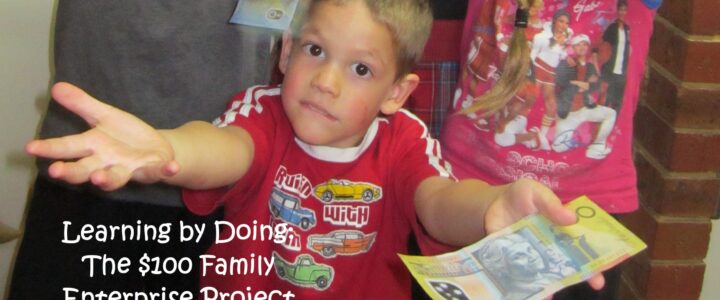
I presented each of the kids with $100 each, except the baby… as all she would do is try and eat it!

Kids receiving start-up capital for learning by doing through enterprise
The $100 Family Enterprise Project begins.
Kids catching fifty dollar notes as part of the $100 Family Enterprise Project
Raining $50 notes.
Children receiving start-up money for learning by doing through enterprise projects
And more start-up money for the family enterprise project.

“Wow!” was their first response.

An early Christmas present!

“Ohhhh,” was the next response. They were more sedate now that there seemed to be a catch.

But they listened to my proposal.

$100 Start-Up Capital for Kids

The kids were to use the money as start-up capital for an enterprise.

Much to their disappointment, they were not to spend it on themselves.

In fact, they were to pay me back once they had attained their business goal.

I was a bit soft on them though.

I also said that I would take the risk. If they were unsuccessful and were not able to pay back the $100, then I would accept that and absorb the loss.

I did this because I wanted them to give their enterprise a go.

I was conscious that if they were too hung up about having to pay me back, then they might worry about their loss and, as a consequence, not find the courage to even start to play the game.

Loaning the $100 was the first step in our elaborate plan to give our kids a shot at being entrepreneurial with their kids enterprise project.

Why Learning by Doing Matters for Kids

Giving the children $100 did not magically make them entrepreneurs.

What it did was make the project real.

Suddenly they had money in their hands, a challenge in front of them and a reason to think differently.

They needed to ask:

  • What could I do with this money?
  • What could I buy, make or sell?
  • Who might want what I offer?
  • How could I pay the money back?
  • What would make the project worthwhile?
  • What would I learn if it did not work?

These are real business questions.

The Australian Government’s MoneySmart guide to teaching kids about money is a useful reminder that parents can start early and make money part of everyday life.

For us, the $100 Family Enterprise Project became exactly that — an everyday, real-world way to teach money, initiative, risk, responsibility and action.

From Goal Setting to Enterprise Action

This article sits at the beginning of our early Enterprise for Kids journey.

First, the children needed goals they cared about.

Then they needed a reason to act.

Then they needed the courage to try.

The goal-setting process helped them imagine what they wanted. The $100 start-up money helped them move into action.

That is why learning by doing became such an important part of the family project.

Follow the $100 Family Enterprise Project

Follow the early Enterprise for Kids journey: This article shows how the $100 Family Enterprise Project began. The next posts show how the children set goals, chose ideas and started learning through real enterprise projects.

The Biggest Lesson: Just Start

Check out our next blog for the subsequent steps in our entrepreneurial quest.

At this stage, we did not know exactly where it would all lead.

But that was the point.

The children were going to learn by doing.

And so were we.

Key Takeaway: Learning by Doing Builds Enterprise Skills

Key takeaway: learning by doing helped our kids begin their first enterprise projects. The $100 Family Enterprise Project gave them start-up capital, a real challenge, and the chance to develop money skills, confidence and entrepreneurial thinking through action. This is a great project to give kids a financial education.

Where to Next?

What could your child learn by doing if they were given a small enterprise challenge?