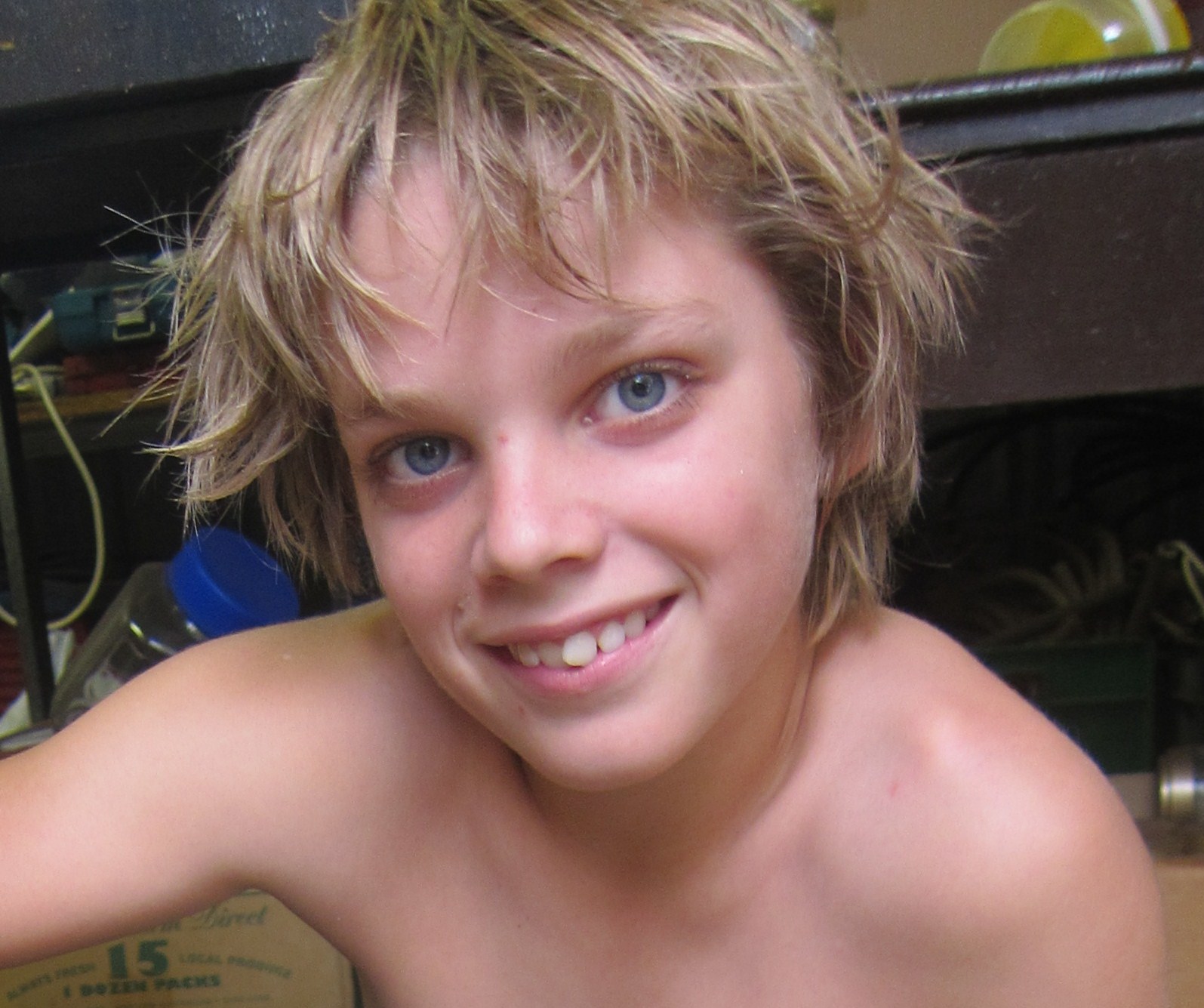
Would you believe it has been nearly four years since our last post?
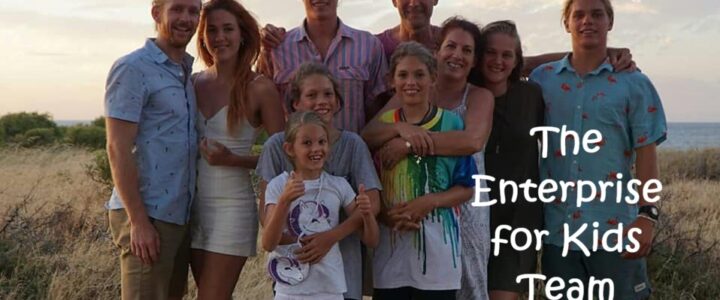
Our “little” kids are not so little anymore. Kaitlin and Jai are 20 and 18 and have left school. Flynn and Amber are 16 and 14 and are studying at high school, and our three babies — Kit, Chayse and Akaisha — are 10, 8 and 5.
The Enterprise for Kids team — the Howitt family, still learning, growing and continuing their entrepreneurial journey.
The Howitt clan household is intact and, would you believe it, still on our entrepreneurial journey.
There is so much to catch up on with our family’s activities. Too much for one small update post.
Over time, we will revisit each of our children and look at what they have been doing and what they have learnt. We will share their successes, but we will also share the tough lessons, because that is where so much of the real learning happens.
We are also excited to share our latest enterprising projects and continue building this collection of real family stories about children learning enterprise, money, responsibility, creativity and confidence.
This has always been at the heart of Enterprise for Kids. We believe children learn a great deal through real conversations, small projects, family enterprise, money lessons and opportunities to have a go. That links closely with the kind of everyday money conversations encouraged by MoneySmart’s guide to teaching kids about money.
So stay tuned for the next chapter in the Howitt clan’s entrepreneurial journey.
You might enjoy looking back at little Amber from five years ago when she embarked on her Money Bunny enterprising project.
Key takeaway: The Enterprise for Kids team is back. Our children are growing, our family is still learning, and the next chapter of our entrepreneurial journey is ready to unfold.
Business ideas for young entrepreneurs come alive when children have the chance to prepare products, talk to customers, handle money and experience the excitement of making real sales.
The day of the Burekup Country Fair started with a mad rush. Seven enterprising kids needed to be ready and set up down at the Burekup Country Club grounds by 8.30am. It required four trips with a trailer carrying tables, pram, signs, eskies, TV, banners and all the products we planned on selling.
Amber and Flynn with their Fish in a Bottle idea.
Business Ideas for Young Entrepreneurs at the Burekup Fair
On arriving at the Burekup Fair, we discovered that someone else had set up in our designated spot. We milled around waiting until the problem was sorted, and once a new space was allocated, we busied ourselves with setting up.
A very strong easterly wind challenged us with erecting banners and keeping tablecloths on the tables. It was obviously going to be a hot day. Thankfully, the red gum trees overhead would keep us in shade all day.
Bargain hunters were quick to do the rounds of the stalls well before we were ready. While we were still trying to set things up, people were already asking questions and making purchases. We will have to be better prepared for this next time round!
Amber and her succulents.
…and making a sale.
The kids’ anticipation and the joyful growing crowd created an air of excitement. It was a real country fair without all the commercial jazz that you see at many fairs today.
Visitors and locals first joined in with the Australia Day barbecue breakfast. Following the brekky, the crowd moved on to all the stalls and activities. There were old machinery displays, a free bouncy castle and water slide, a dunk tank, fairy floss, pat-the-animals, thong-throwing contests, face painting, and people selling their wares — from homemade fudge, plants and toys to live pigs, chickens and crafts.
Other enterprising kids were also selling their toys, bikes, clothes and things they had made. It was the perfect place to see business ideas for young entrepreneurs being tested in a real community setting.
Setting Up Business Ideas for Young Entrepreneurs at a Kids Market Stall
A market stall is a wonderful way for children to test their ideas in the real world. It gives them the chance to see whether people are interested, practise talking to customers, learn how to display products, and understand that business is about far more than simply having something to sell.
The Australian Government’s business.gov.au page on market stalls explains that a market stall is a temporary structure used to sell products or services, and that stallholders may need to think about registrations, permits, food safety, insurance and other requirements. Read more about setting up a market stall here.
For children, the lesson can start simply:
What are we selling?
Who might want to buy it?
How should we display it?
What price should we charge?
How do we speak confidently to customers?
How do we count money and work out profit?
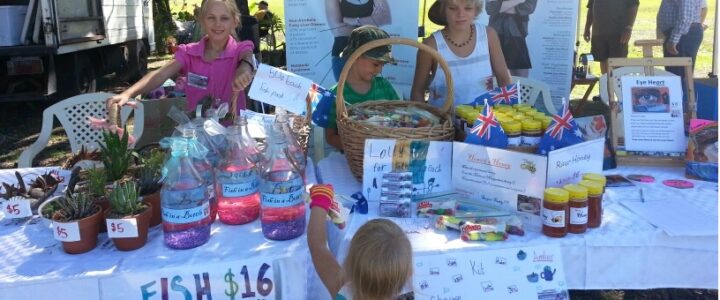
All set ready for the customers!
Novelty Products and Business Ideas for Young Entrepreneurs
Having a novelty product is one of the keys to drawing interest, and we had the perfect product.
Flynn and Amber’s “Fish in a Bottle” were an absolute hit. Kids came from everywhere dragging their parents over to look at the fish. Once at our stall, we were able to show them our other items too.
This was a powerful business lesson. Sometimes one unusual product can bring people closer, start conversations and help customers notice the rest of what is on offer.
Products waiting to be sold.
Learning to Ask for the Sale
Chayse soon got the hang of it. Whenever a customer wandered past, he would hold up a lolly bag and ask if they would like to buy one.
Many people bought lollies from him simply because he had asked. How can you refuse a little five-year-old?
There was another little boy walking around selling his mum’s homemade fudge. He was not shy in coming forward and asking customers if they would like to make a purchase. Talking to his dad later in the day, he said that his son had sold more fudge walking around than they had sold at their stall.
I guess there is a lesson in that.
For young entrepreneurs, learning to politely ask is powerful. It builds confidence, communication skills and resilience. It also teaches children that customers often need a friendly invitation before they buy.
Customers, Money and Confidence
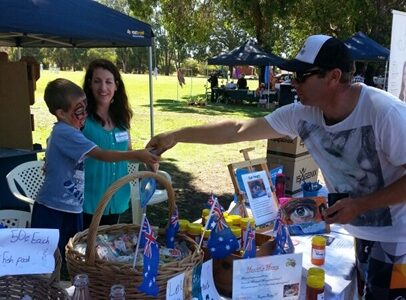
It was not long before we had customers coming in their droves. Talking with customers, handling money and recording on a pad what was sold all kept the kids on their toes.
Taking turns to man the stall allowed each of us time to catch up with friends and also spend some of the takings at the fair.
Kaitlin’s EYE heART on display.
…customers admiring her work!
Our enterprising kids were very happy with their results. Each was able to sell products and make a profit.
Flynn’s Howitt’s Honey was very popular and sold very well. Kit and Chayse sold about half their lolly bags and, due to the hot day, Jai’s icy-poles also sold well. Jai made a profitable sale with his exercise equipment. Amber sold succulents. Kaitlin received commissions for her Eye heART artwork. And, of course, the Fish in a Bottle sold well.
Making Sales Turns Business Ideas for Young Entrepreneurs Into Real Learning
This is where business ideas for young entrepreneurs become real learning.
It is one thing to imagine a business. It is another thing entirely to prepare the product, take it to a fair, display it, speak to customers, handle money, record sales, pay back costs and work out profit.
Those are real lessons.
Jai manning the stall with his exercise equipment.
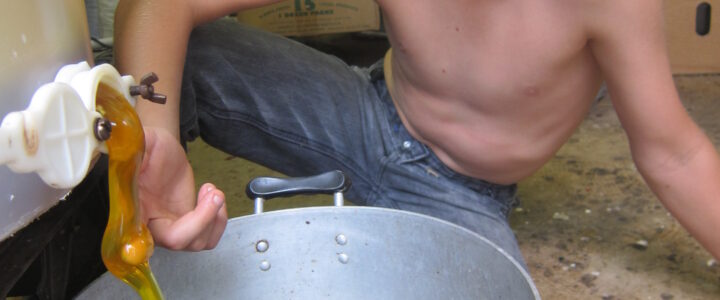
Flynn selling his unpasteurised honey.
Cath and I also had a terrific result with our own stall. This was the first time we had put ourselves out there with our new business in the local community, and it allowed us to develop our own self-efficacy too. We spoke with many interesting people and learned a lot about their lives and interests.
By the end of the day, we were exhausted.
Celebrating Success Builds Self-Efficacy
It was important to celebrate our success because this is vital in fostering self-efficacy around being entrepreneurial kids.
The kids counted the takings and divided the money up. They then paid any debts so they could work out their profits. Each received congratulations and a hug for being successful enterprising kids.
Akaisha enjoying one of Jai’s icy-poles, mittens and all!
Cathy explaining the health benefits of her product.
It is our hope that our kids continue to develop self-efficacy around being entrepreneurial, as we believe this will give them greater opportunities when they become adults.
Cathy talking with an interested customer.
Kit and Chayse selling lolly bags.
Finally, we would like to thank the Burekup Country Club, and in particular Sally and Jason Barnden and their team, for coordinating the fair.
Just as an added note, the day after the fair, five more Fish in a Bottle sold!
Have your children ever tried a market stall, fair stall or small business idea? We would love to hear what they sold and what they learned along the way.
Marketing lesson for kids sounds like something that belongs in a classroom, but for our family it came alive through fire, publicity, product preparation and the Burekup Australia Day Fair.
Last week there was both fear and excitement in the small township of Burekup. The Burekup Country Club had been on fire, and for a moment it looked as though the Burekup Australia Day Fair might even be cancelled. Thankfully, the fire crew put the fire out before it caused too much damage or anyone was hurt.
What followed became a very real lesson in marketing, attention and opportunity for our enterprising kids.
Amber showing one of her products ready for the Burekup Country Fair.
A Marketing Lesson for Kids at the Burekup Country Fair
Once a year for Australia Day, Burekup hosts a fun family fair. Everyone in town usually comes along, together with people from the surrounding areas.
This year, the fair had a little more publicity than normal.
The local Burekup Country Club, which helps organise the event, had a fire that threatened to burn down the old wooden clubhouse and town hall. The newspaper heard about the near disaster and ran a story about the fire that almost sabotaged the Burekup Australia Day Fair.
Burekup Country Club Hall.
The newspaper story created concern and interest, and it also meant that many more people heard about the Burekup Fair.
Marketing a product, service or brand can be challenging, especially when you are still learning how to attract attention and explain its value. Even a very good product may struggle to sell if people do not know about it, understand what makes it useful or feel interested enough to buy it.
That is why this became such a useful marketing lesson for kids. Our children were not just making products. They were preparing to put those products in front of real people.
What Our Kids Learned About Marketing Their Products
Our enterprising kids have all been challenged with marketing their products and brands. Cathy and I have also been challenged with marketing when promoting events or selling our own products.
The Howitt family booked two stalls for the Burekup Australia Day Fair. One stall was for our enterprising kids to display and sell their products. The other was for Cathy and me to share information about our home business, as well as promote the Enterprise for Kids brand and blog.
Putting ourselves out there in our small community for the first time was a little confronting. Some people knew what we had been up to, but for many it was going to be a surprise.
Despite the challenge, we saw this as a chance to practise in readiness for bigger and better things to come.
Kids Business Ideas Prepared for the Burekup Fair
The fair gave each child a real opportunity to prepare, promote and sell something of their own. That is where a simple family event becomes powerful real-world learning.
Flynn had been preparing his raw, unprocessed honey under his brand, Howitt’s Honey. He had a fresh batch ready to sell, and he had also bought a good set of golf clubs for a very good price, which he intended to resell at the fair.
Flynn showing his honey pots.
All bottled awaiting labels!
Kit and Chayse were preparing their lolly bag business. They bought, sorted and bagged lollies to sell. Chayse also had a small fish tank to sell, along with colourful guppies he had bred.
Kit and Chayse sorting lollies.
Lolly bags all set to be sold!
Amber’s Products and a Creative Marketing Lesson for Kids
Amber had been busy all year collecting succulents from people’s gardens. She artistically potted these up into all kinds of unusual pots, including large seashells, kettles and ceramic plant pots.
Amber watering her succulents ready to be sold.
She and Flynn also planned to sell aquarium fish they had bred. They salvaged and cleaned large glass wine flagons, which made terrific fish bowls. They decided to market this product under the brand name “Fish in a Bottle”.
Fish in a Bottle.
Can you see the fish?
Amber also planned to sell selected items from her New from Old business, and she was putting together a Lucky Dip.
Jai and Kaitlin Prepare Their Own Enterprise Ideas
Jai was preparing to promote his “Hire a Teenager” service. He already had clients in Burekup who hired him to do work on their properties, such as mowing and window cleaning.
Jai also prepared a batch of frozen juice ice cups on sticks. He came up with some creative ideas to add value to his product. He was also considering promoting “Rent Exercise Equipment”, although this business idea was still in its infancy and may not have been quite ready to run.
Lastly, Kaitlin was preparing to promote her new brand, “Eye heART”. Akaisha was still a little young to have an enterprise of her own, but Kaitlin was ready to share her creative skills.
Being the creative one in the family, Kaitlin planned to sell her skills by painting the eye of clients from a photograph. Around the eye, she would also paint three things dear to them.
Jai showing his icy poles.
Kaitlin’s Eye heART.
This opportunity for us all to market our brands, services and products helped the Howitt clan develop self-efficacy around being entrepreneurial.
What Children Can Learn From a Real Marketing Plan
A good marketing lesson for kids does not need to be complicated. Children can begin by learning that marketing is about understanding who might want your product, why they might want it, and how you can show them its value.
The Australian Government’s business.gov.au marketing planning guidance explains that a marketing plan can help define a target market, choose messages and channels, set goals and evaluate whether marketing activities were successful. That is exactly the kind of thinking children can begin to practise with a simple market stall. Read more about developing a marketing plan here.
For our kids, the Burekup Fair raised practical questions:
Who would want to buy this product?
How should we display it?
What makes it interesting or different?
How much should we charge?
What story does the product tell?
How can we speak confidently to customers?
These questions are useful for any young entrepreneur.
Marketing, Emotion and Real-World Learning
Our mentor, Paul Counsel, had plenty to say about marketing. One of the ideas he shared was that people often respond to emotion before they respond to logic.
In simple terms, customers usually want to move away from a problem and toward a better result. A product, service or experience becomes more interesting when people can clearly see the difference it might make.
For children, this can be taught in a practical and age-appropriate way.
If they are selling honey, they can show that it is fresh, local and real.
If they are selling lolly bags, they can make them colourful, tidy and fun.
If they are selling succulents, they can show how each one has been creatively potted and cared for.
If they are selling a service, they can explain clearly how they can help someone.
This is where marketing becomes much more than advertising. It becomes communication.
A Fire, a Fair and a Marketing Lesson for Kids
Just need the right ship to get them there!
Luckily, the fire did not burn down the club or spoil the Burekup Australia Day Fair.
But it certainly woke people up.
The fear that the fair might be cancelled created attention. The newspaper story created discussion. The near disaster gave people another reason to talk about the event. In an unexpected way, it became publicity.
That is not something anyone would wish for, of course. But it did show our kids something important: people pay attention when a story matters to them.
For our family, the fair became more than a day out. It became a real-world lesson in product preparation, branding, confidence, customer communication and marketing.
We would love to hear from our readers. What marketing lesson for kids have you seen through a school fair, market stall or family business idea? Share your thoughts in the comment box below.
Young Australian entrepreneurs can be powerful role models for children. When kids see real people building businesses, creating freedom and using their success with purpose, enterprise becomes much more than an idea in a book.
“`
Dale Beaumont is one of those examples. His story reminded us that who we spend time with, who we learn from and who we allow to influence our thinking can shape what we believe is possible.
“`
Dale Beaumont began his entrepreneurial journey young, making his story a powerful example for enterprising kids.
Young Australian Entrepreneurs: Lessons from Dale Beaumont
Part of what we love about this blog is that we get to share the success of young entrepreneurs with not only our readers, but also our kids.
As we have been learning through Paul Counsel’s course, and as Dale Beaumont also reinforced for us, who you “hang with” is often who you become like.
That can be a scary thought, or it can be an inspiring thought, depending on your peers and the people you spend the most time with.
Luckily, we have wonderful family and friends. But for us, it is also important to include people who have achieved success in areas where we are still learning and growing.
Some of our family and friends fulfil those needs, but a sure way of increasing self-efficacy for us and our kids is to mix with other successful entrepreneurs, business owners and people who think differently.
Dale Beaumont as a Young Australian Entrepreneur
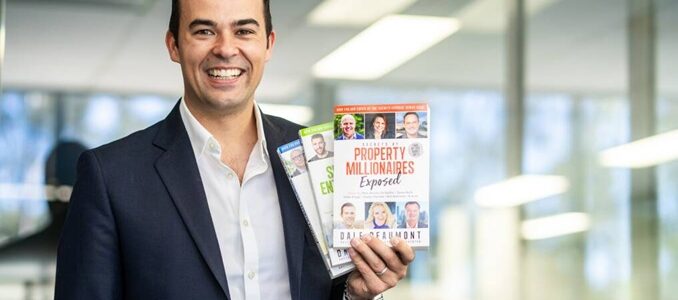
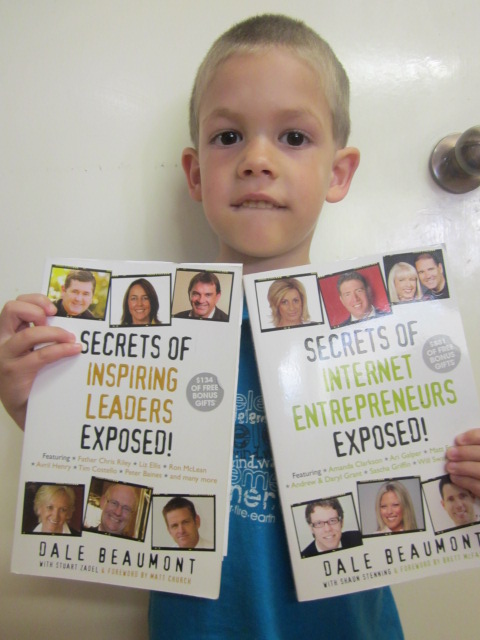
Dale Beaumont wrote the Secrets Exposed series.
Dale Beaumont is one such inspiring young Australian entrepreneur. He may not see himself as “young” anymore, but his success started at the tender age of 19.
Before developing his entrepreneurial skills, Dale was an accomplished gymnast and probably what many people would call an overachiever.
When Dale was 19, he co-authored a book called The World at Your Feet, which became the basis of his successful program, Tomorrow’s Youth. Through that program, he taught young people essential life skills.
From there, Dale went on to publish books, build relationships with other successful entrepreneurs, business owners and thought leaders, and eventually develop Business Blueprint.
His journey is a wonderful example for children because it shows that enterprise can begin young. It also shows that success is rarely about one single moment. It is built through learning, relationships, systems, action and persistence.
What Young Australian Entrepreneurs Teach Our Kids
One of the biggest lessons Dale Beaumont’s story teaches our children is that entrepreneurship is not just about making money.
It is about learning how to think. It is about developing skills, building useful systems, creating value, managing time, solving problems and making choices that can lead to more freedom.
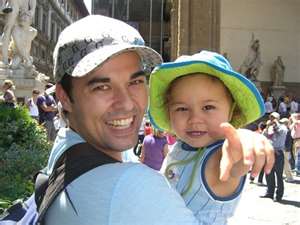
Dale with one of his children.
Inside the Sistine Chapel.
Dale is married and has two boys, and one of the things that really appealed to Trevor and me was that his focus was not only on business growth. It was also on creating time and freedom to travel with his young family.
He was able to do this because he had built systems within his business so that everything could keep ticking along with or without him.
You can imagine how appealing that was to us.
We did not want business success that simply created another job. We wanted to learn how business could create choice, flexibility and meaningful family experiences.
Lessons from Business Blueprint
I will not go through the whole workshop that my good friend Sally and I attended in Perth, but I do want to share a few highlights that really stuck with me as Dale spoke.
Presenting at Business Blueprint.
Two sayings that stood out were:
“Empty bank accounts don’t feed the people.”
“The poor can’t help the poor.”
Those two sayings alone say a lot.
Some people want money purely for money’s sake — to have nice things and show others how well they are doing. Others want money so they can enjoy wonderful experiences, support their family, do good things in the world and make a difference in the lives of others.
We fall into that second category.
Dale’s example helped reinforce something important for our family: money with purpose can become a tool for freedom, contribution and service.
Money, Purpose and Making a Difference
One thing we found inspiring was Dale’s support for Hands Across the Water in Thailand. It was powerful to see an entrepreneur using his success and influence to make a difference in the lives of children.
This is an important message for enterprising kids.
We do not want our children to think that business is only about making money. We want them to understand that business can also create choices, opportunities and the ability to contribute.
If we do not embrace that change, our businesses can get left behind. A classic example was the way physical bookstores were challenged as online bookselling grew rapidly.
The point for our children is clear: the business world they are growing into is very different from the business world we grew up in.
Today’s young people need to understand technology, online marketing, digital systems, automation, websites, customer service, communication and content.
They do not need to master all of these skills as children, but they do need to grow up with the mindset that learning never stops.
The Coffin or the Hourglass
Dale shared something he learnt when he was just starting out in business.
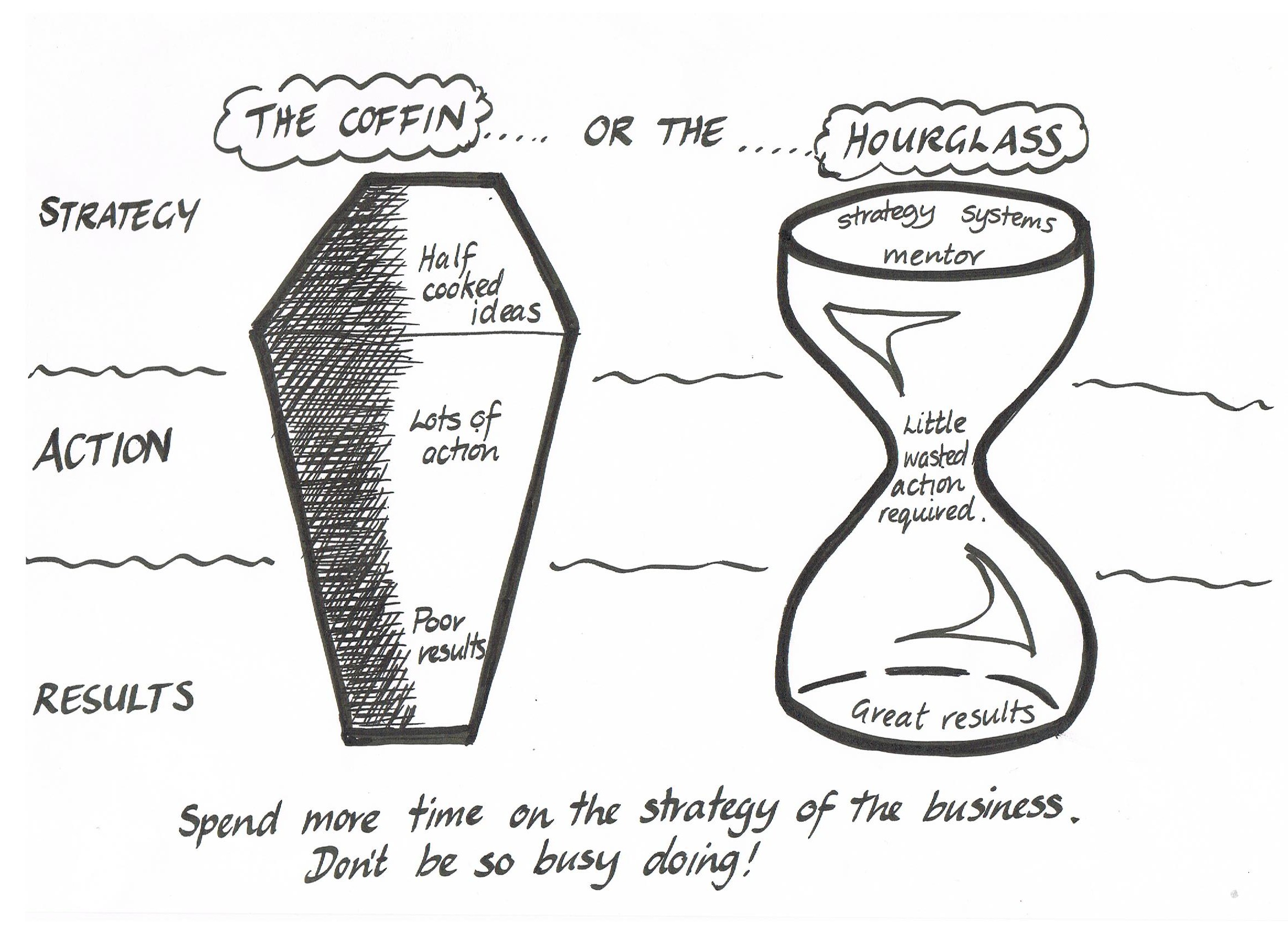
He called it the coffin or the hourglass.
The Coffin or the Hourglass.
Many people starting in business spend more time taking action than they do strategising or planning where they want their business to end up.
Taking action is important, of course. But you do not want your business to be like a coffin, where little time is spent thinking, planning and designing the right direction, while heaps of time is spent taking action that may not be very fruitful.
The hourglass, on the other hand, is about putting time into planning, strategising and thinking first.
With well thought-out plans in place, the action you take becomes more focused and the results are more fruitful.
So what would you prefer? A business with the coffin model, or one with the hourglass model?
Young Australian Entrepreneurs Need Systems
I think one of the reasons Dale became successful in a relatively short period of time was his ability to let go of things that could be done by someone else and focus on the things he needed to do to be effective within his business.
That is a major lesson for young Australian entrepreneurs.
Hard work matters, but systems matter too.
Business owners who try to do absolutely everything themselves can quickly become exhausted. Systems help free up time, improve consistency and allow business owners to focus on the areas where they can create the most value.
In the original version of this article, we talked in detail about a particular automation and CRM system we had started using at the time. Years later, the exact tools have changed, but the lesson remains the same.
Business systems can help with:
email follow-up,
customer records,
online payments,
memberships or subscriptions,
event management,
task management,
marketing follow-up,
and website processes.
The specific software will keep changing, but the mindset is timeless: build systems that help your business run more smoothly.
You can learn more about Dale Beaumont and his business education work through Business Blueprint.
What This Means for Enterprising Kids
So, how does all of this relate to enterprising kids?
For any business our kids choose to start, using the internet will be a given, especially as they grow into young adults.
If we want our kids to be competitive in today’s markets, we need to show them the way by continuing to learn ourselves.
They will follow our lead. They will absorb whether we are curious, whether we keep improving, whether we look for better systems and whether we are willing to adapt.
We want our children to have a mindset that says:
Get savvy. Learn. Improve. Keep going.
Bedtime Reading for Enterprising Kids
Bedtime reading for enterprising kids.
Generation Y and the generations after them are already building and creating things that improve efficiency in their lives.
Why spend six hours on something if you can learn how to streamline it and do it in one?
That is the world our children are growing into.
We agree completely that life is not meant to be all about work. We want to work to live, not live to work, and we want our kids to understand that concept too.
At the same time, we want them to know that learning from successful entrepreneurs can expand their thinking.
Books, mentors, workshops, conversations and real-world examples can all help children see what is possible.
We no longer need a long list of affiliate-linked books here. The bigger message is simply this: expose children to inspiring people and ideas, then help them apply those ideas in age-appropriate ways.
Key Takeaway: Young Australian Entrepreneurs Can Inspire Kids
Key takeaway:young Australian entrepreneurs like Dale Beaumont can help children see what is possible. When kids are exposed to mentors, business systems, purpose-driven money lessons and real-world learning, they begin to understand that enterprise can create freedom, contribution and choice.
Family business ideas can start with something simple, practical and close to home. For Flynn, that opportunity came through raw honey, a family connection and a very enterprising plan that helped him learn real money lessons.
This is the beginning of Flynn’s honey business story — a family enterprise project where he learnt about opportunity, product value, buying wholesale, selling retail, confidence and taking action.
Flynn — a budding young entrepreneur with a family business idea.
Family Business Ideas: Flynn’s Honey Enterprise Begins
Flynn is a natural budding young entrepreneur and he is never afraid to chase an opportunity. He often comes up with brilliant enterprising ideas, and the idea he planned to take on with Enterprise for Kids was a definite money spinner.
Why Family Business Ideas Need a Different Money Mindset
Prior to us starting Enterprise for Kids, our children were following the same conditioning around money that we had: earn money, spend money, borrow money. Society encourages this greatly.
Whilst many people may not see anything wrong with this, many of us actually spend far more than we have coming in. The cycle never gets broken, and by the time we reach retirement age, we have very little to show for the many years of hard work we have put in.
That is why building an entrepreneurial mindset is so important. Breaking old conditioned habits is even more important. The younger you are, the less conditioning you have.
So while we want to develop in our children a great work ethos — working hard and with integrity — we also want to help them move beyond that. We want them to learn how to spot an opportunity, take action and then help others achieve success as well.
This system moves a person from being the worker, to seeing an enterprising opportunity, to switching on their entrepreneurial self, to finally becoming the expert in their field.
This is exactly why we care so much about raising entrepreneurial kids and helping them learn through real-life projects. Family business ideas give children a safe, practical way to begin that learning at home.
Entrepreneurial Thinking Behind Family Business Ideas
An entrepreneur’s focus is in the development of a great system and finding great people to run it. They use other people’s time and other people’s money to do the work for them.
Their systems can continue even after they pass from this world. A classic example is Thomas Edison’s formula for General Electric. He is no longer with us, but his empire continues.
That is one of the powerful lessons behind family business ideas. Children can begin to see that a business is not just a product. It is also a system, a process and a way of creating value for other people.
A Queen Bee Is Entrepreneurial
Enterprising Queen Bee.
A Queen Bee most definitely comes under the bracket of entrepreneur. She controls her entire empire from within her hive.
Thousands of honey bees — the workers — head out of her hive each morning collecting nectar, pollen and other resources for the hive, such as water. The worker bees will risk life and limb and literally work themselves to death. A worker bee only lives a few weeks.
The Queen Bee will have employees whose main job is to guard the hive from danger. Others clean the hive and many fan the hive to keep the temperature controlled. The queen will have workers who care for the nursery and for her own needs.
All she has to do is eat and lay eggs!
A beehive is a unique system consisting of many specialised individuals that each have a job to do. The system performs like it is one large living organism. If the Queen dies, then she will be replaced by another Queen Bee, the workers keep working and the hive goes on.
Not a lot different to General Electric, Apple or Ford Motor Company!
Flynn’s Honey Family Business Idea
Flynn negotiating a honey deal with his Grandad.
So what has Flynn’s idea got to do with a Queen Bee?
Flynn’s enterprising idea has everything to do with our Queen Bee and her empire.
In fact, his plan was to use her company’s product: honey.
Flynn intended to buy raw, unprocessed honey at wholesale in bulk and sell it in smaller jars at retail. He worked out his figures and could see excellent profit potential.
Once his business got underway, he could also see the potential for it to grow quite substantially.
This is one of those kids business ideas that starts small, but teaches a lot: product value, buying wholesale, selling retail, confidence, negotiation and understanding profit.
Why Raw Honey Was a Clever Family Business Product
Seeing as we are on the topic of honey, I thought I would share a few facts about honey, and in particular raw, unprocessed honey.
Raw, unprocessed honey is pure, natural, unpasteurised and unadulterated. It is extracted from the beehive in its natural form and bottled. It is not filtered or heated.
Unlike many processed honeys, raw honey can retain more of its natural qualities from the hive, including pollen, propolis, minerals and flavour.
Mmmm… appears to be a fantastic product!
For Flynn, the clever part was not just that honey was useful and delicious. The clever part was that he could understand the product, buy it in bulk, bottle it in smaller jars and sell it in a way that made sense to customers.
That is why this became such a useful example of family business ideas in action. It was simple enough for a child to understand, but rich enough to teach real lessons about value, pricing, supply, confidence and profit.
Flynn’s honey business also led to a deeper money lesson about assets and liabilities, which we explore in Financial Education for Kids.
Flynn’s Honey Business Series
This article is Part 1 in Flynn’s honey business series, a family enterprise story about family business ideas, product value, money lessons and learning by doing.
These family enterprise stories show how children can learn by doing, rather than just being told about business, money and opportunity.
Key Takeaway: Family Business Ideas Can Start Small
Key takeaway: Family business ideas do not need to be complicated. A simple product, a real opportunity and a child willing to take action can become a powerful lesson in entrepreneurship, confidence and money.
Where to Next?
If you enjoyed Flynn’s honey business story, you may also like:
So, what do you think? Is Flynn onto a real Enterprise for Kids success story? Follow along with the blog to see how he goes.
In our next blog, you’ll be inspired by another budding entrepreneur, four-year-old Chayse, as he showcases his business idea. It is as sweet as Flynn’s enterprising ideas!