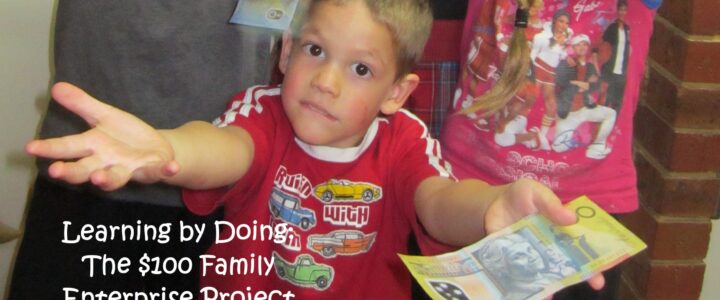
Learning by doing is one of the best ways for children to develop enterprise skills. At some point, they need to stop only talking about ideas and begin testing them in the real world.
“`
For our family, that beginning became the $100 Family Enterprise Project. We gave each of the kids start-up capital, asked them to choose an enterprise idea, and decided we would refine the process as we went.
“`

Learning by Doing: The $100 Family Enterprise Project
For our kids to develop the skills and habits of an entrepreneur, they needed to begin somewhere.
But where?
The beauty of Cathy and I having a wealth creation mentor at our disposal was that we could take the invaluable information we had been learning and apply it in small pieces to developing the mindset of our kids.
This process also involved us having a good, hard look at how we operate in our own lives in regards to planning, organising and taking action.
Cathy loves to plan things out in her head and on paper before starting a task. Once satisfied, she will start when all structures are in place.
I, on the other hand, like to dive in and see where it leads.
So a happy compromise was met.
We decided that the kids just needed to come up with an enterprise idea and get started. We could refine the process later.
Learning by Doing Instead of Waiting for Perfect Conditions
Getting the kids to kick off with an enterprise project, when they had little idea where to even start, was easier said than done.
But I knew that one of the things that had held us back over the years was waiting until all conditions were right.
Waiting had seen us miss many great opportunities that were out there.
So we just started.
Admittedly, it was a bit like the blind leading the blind, but we went in with an open mind and decided to see what would happen and where it would lead.
That is the heart of learning by doing. You do not need to know every step before you begin. You need enough of a plan to start, and then the courage to learn from what happens next.

The First Step in Our Kids Enterprise Project
Check out our very first videos.
The filming is pretty rough, as we had our 15-year-old daughter using her creative licence while filming, but you’ll get the gist of what our project is all about if you watch them.
For those of you who would prefer to read, I’ll give you the rundown.
I presented each of the kids with $100 each, except the baby… as all she would do is try and eat it!


“Wow!” was their first response.
An early Christmas present!
“Ohhhh,” was the next response. They were more sedate now that there seemed to be a catch.
But they listened to my proposal.
$100 Start-Up Capital for Kids
The kids were to use the money as start-up capital for an enterprise.
Much to their disappointment, they were not to spend it on themselves.
In fact, they were to pay me back once they had attained their business goal.
I was a bit soft on them though.
I also said that I would take the risk. If they were unsuccessful and were not able to pay back the $100, then I would accept that and absorb the loss.
I did this because I wanted them to give their enterprise a go.
I was conscious that if they were too hung up about having to pay me back, then they might worry about their loss and, as a consequence, not find the courage to even start to play the game.
Loaning the $100 was the first step in our elaborate plan to give our kids a shot at being entrepreneurial with their kids enterprise project.
Why Learning by Doing Matters for Kids
Giving the children $100 did not magically make them entrepreneurs.
What it did was make the project real.
Suddenly they had money in their hands, a challenge in front of them and a reason to think differently.
They needed to ask:
- What could I do with this money?
- What could I buy, make or sell?
- Who might want what I offer?
- How could I pay the money back?
- What would make the project worthwhile?
- What would I learn if it did not work?
These are real business questions.
The Australian Government’s MoneySmart guide to teaching kids about money is a useful reminder that parents can start early and make money part of everyday life.
For us, the $100 Family Enterprise Project became exactly that — an everyday, real-world way to teach money, initiative, risk, responsibility and action.
From Goal Setting to Enterprise Action
This article sits at the beginning of our early Enterprise for Kids journey.
First, the children needed goals they cared about.
Then they needed a reason to act.
Then they needed the courage to try.
The goal-setting process helped them imagine what they wanted. The $100 start-up money helped them move into action.
That is why learning by doing became such an important part of the family project.
Follow the $100 Family Enterprise Project
Follow the early Enterprise for Kids journey: This article shows how the $100 Family Enterprise Project began. The next posts show how the children set goals, chose ideas and started learning through real enterprise projects.
The Biggest Lesson: Just Start
Check out our next blog for the subsequent steps in our entrepreneurial quest.
At this stage, we did not know exactly where it would all lead.
But that was the point.
The children were going to learn by doing.
And so were we.
Key Takeaway: Learning by Doing Builds Enterprise Skills
Key takeaway: learning by doing helped our kids begin their first enterprise projects. The $100 Family Enterprise Project gave them start-up capital, a real challenge, and the chance to develop money skills, confidence and entrepreneurial thinking through action. This is a great project to give kids a financial education.
Where to Next?
- Read Vision Board Goals for Kids: Enterprise, Money and Action
- Read Amber’s New From Old Enterprise
- Read Flynn’s Honey Turns to Gold
- Read Kit’s Pocket Money Idea
- Read Jai’s Apple App Enterprise Idea
- Explore more Kids Business Ideas
What could your child learn by doing if they were given a small enterprise challenge?