Million Dollar Business Plan: Jai Coaches Chayse on a Road Trip

Jai Howitt coaching Chayse on a million dollar business plan during their Geraldton road trip

A million dollar business plan sounds like something created in a boardroom, but this one unfolded during a ten-hour road trip to Geraldton in Jai’s much-loved Land Rover.

Jai was travelling with his younger brother Chayse and their friend Flizzy to visit the boys’ grandparents. Along the way, Jai began coaching Chayse through a practical question: what would a realistic million dollar business plan look like for someone starting with limited money and experience?

It became much more than a business conversation. One brother’s experiences, successes and mistakes became a guide for another brother who is just beginning his own entrepreneurial journey.

The purpose of this million dollar business plan was not to promise overnight wealth. It was to help Chayse make better decisions, test ideas carefully and build evidence before investing too much time or money.

Jai and Chayse sitting on their grandparents’ front porch in Geraldton talking about business ideas

Editor’s note: This article shares Jai’s personal business framework and our family’s reflections on his journey. It is educational rather than financial advice, and no business plan can guarantee a particular result.

A Road Trip, Two Brothers and a Million Dollar Business Plan

Jai is nine years older than Chayse. He remembers clearly what it felt like to be Chayse’s age: ambitious, curious and convinced that there had to be a way to create a life on his own terms.

Chayse is now at that same stage. He has taught himself how to build websites and apps, work with artificial intelligence, create digital products, run marketing campaigns and pitch his skills to online businesses. He has experimented with NFTs and cryptocurrency, completed paid work for clients and recently secured an internship in digital content and user-generated content marketing.

He looks up to Jai, not because everything Jai has tried has worked, but because Jai has built, failed, adapted and built again.

That made the Geraldton trip an ideal opportunity for a longer conversation. There were no formal desks, presentation slides or classrooms. There was a long road, plenty of time and a younger brother ready to listen.

Jai’s Early Enterprise Lessons Began Long Before the Million Dollar Businesses

Jai, Chayse and Flizzy travelling in Jai’s Land Rover during their Geraldton road trip

For us, one of the most meaningful parts of this story is seeing how Jai’s current business thinking connects with the small enterprise experiences he had as a child.

Readers who followed Enterprise for Kids in the early years may remember Jai exploring technology, vlogging, media creation and app development. At around thirteen, he was already fascinated by the idea that technology could be used to create something valuable. His early Apple app enterprise idea did not become an instant success, but it taught him to think in terms of problems, products, technology and possibility.

Those childhood ideas were not wasted just because they did not immediately become profitable businesses. They were rehearsals. Jai was learning how to imagine an outcome, find information, ask for help, deal with roadblocks and keep moving.

This is one of the recurring themes in our family enterprise stories. The small experiments children try today may become the foundations of the work they do years later.

How Jai Learned the Lessons Behind His Million Dollar Business Plan

One of Jai’s most valuable early opportunities came when a successful businessman employed him to follow his work and family life with a camera.

Jai travelled with him, filmed his daily activities and recorded the business courses he delivered to clients in places including Bali and the Hunter Valley. He then spent hours editing the footage for social media and online course content.

On the surface, Jai was being paid to film and edit. In reality, he was receiving an unusually close education in business.

That kind of exposure is one reason we believe young entrepreneurs and business mentors can have such a powerful influence on children. Seeing how someone thinks, works and makes decisions can expand what a young person believes is possible.

He observed how the businessman communicated, taught, made decisions, served clients, structured offers and presented ideas. Jai was learning through proximity. He could see what business looked like from the inside rather than only reading about it from the outside.

Years later, the pattern came full circle. Flizzy was working with Jai, filming and creating content during the Geraldton trip, much as Jai had once done for his own mentor. Flizzy then shaped that footage into the YouTube video embedded below.

One young person had once learnt by carrying the camera. Now another young creator was doing the same while Jai passed his lessons to Chayse.

Watch Jai Coach Chayse Through His Million Dollar Business Plan

You can also watch Jai’s full video on YouTube.

What the Million Dollar Business Plan Teaches About Success and Failure

Jai’s advice did not come from theory alone. By the time of this conversation, he had already experienced several very different businesses.

One of his early ventures was a media agency called Brand Boostr. It grew quickly and, at one point, employed more than a dozen people. The business generated significant revenue, but rapid growth also exposed weaknesses. Jai discovered that sales and profit are not the same thing, and that poor cashflow management can place even a busy, successful-looking business under pressure.

These experiences also reinforce why financial education for kids needs to include more than earning money. Young people also need to understand value, expenses, assets, liabilities and the consequences of financial decisions.

Jai with products from his Naming This Later business

That experience was painful, but it became one of his most important lessons.

Jai later built Naming This Later with a business partner. They designed a versatile woven throw that could be used at the beach or in the home, had it manufactured in India and marketed it internationally through Facebook advertising. The business achieved more than one million dollars in sales. Jai eventually gifted his share to his business partner after recognising that his enthusiasm had moved elsewhere.

He also helped build Founder Sports Club, a membership community designed to help active entrepreneurs meet other founders through sport and real conversation. It now operates as part of Art of Mondays’ Founder Sports Club.

Today, Jai is building Art of Mondays with his business partner Evan. The business creates spaces and communities for ambitious people who want to build meaningful work while also creating a life they enjoy.

Across these businesses, Jai has experienced growth, pressure, excitement, loss of motivation, mistakes, reinvention and the consequences of moving too quickly. That is why his advice to Chayse is practical. He knows a good idea is not enough. A business must solve a meaningful problem, attract paying customers, manage money, deliver value and fit the life of the person building it.

Jai’s One-Page Million Dollar Business Plan

Jai describes this as the one-page playbook he has used when taking businesses from an idea towards the one-million-dollar-a-year level. His million dollar business plan is designed to keep the founder focused on evidence, customers and practical action rather than complicated forecasts or guesswork.
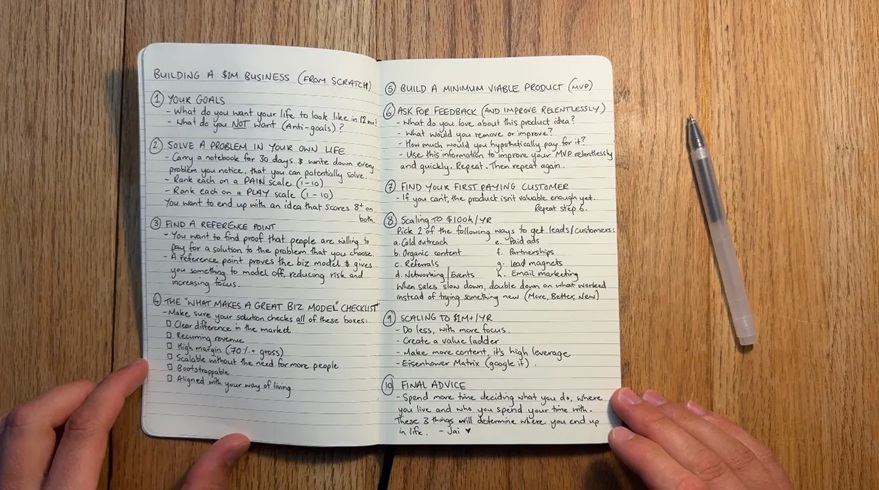
Jai’s handwritten one million dollar business plan in his notebook

It is not a traditional business plan filled with lengthy forecasts and formal documents. It is a decision-making framework. It helps a founder choose a worthwhile problem, test a solution quickly and build evidence before investing too much time or money.

For a simpler introduction suitable for younger students, our article on business plan ideas for students explores how training, tools, teamwork, time and clear goals can help turn an idea into action.

The strength of this million dollar business plan is that it begins with decisions and evidence rather than complicated forecasts or guesswork.

1. Begin With the Life You Want

Before choosing a business, Jai asks a bigger question:

What do you want your life to look like twelve months from now?

The answer should include more than an income target. It might include where you want to live, how you want to work, the people you want around you, the amount of freedom you want and the experiences you hope to create.

Jai also encourages Chayse to identify his anti-goals: the things he does not want his success to cost him.

  • I do not want to work twelve-hour days indefinitely.
  • I do not want to sacrifice my physical or mental health.
  • I do not want to build a business that makes travel impossible.
  • I do not want success to leave me isolated or lonely.

This is an important distinction. A business can look successful from the outside while creating a life the founder does not enjoy.
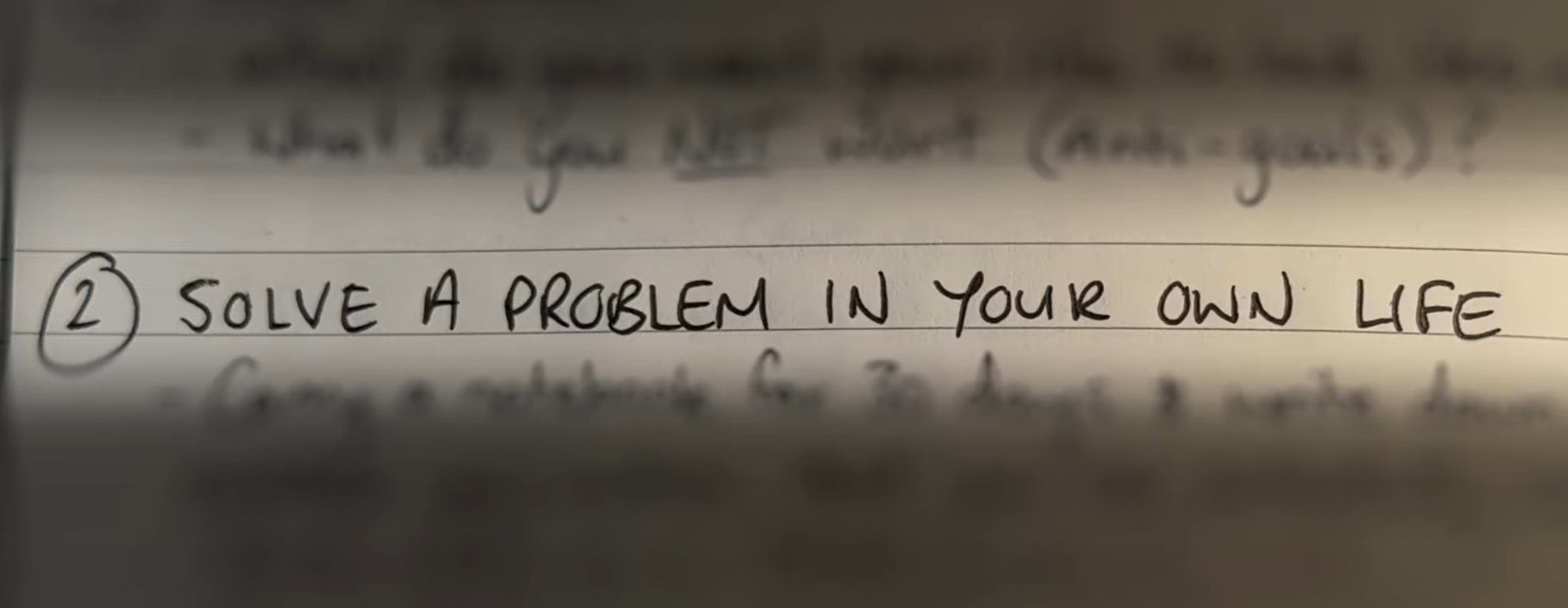
Handwritten note reading Solve a Problem You Understand

2. Solve a Problem You Understand

Jai’s next step is to carry a notebook for thirty days and record problems as they appear in everyday life.

Each problem can then be scored using two scales:

  • PAIN: How frustrating, expensive or difficult is this problem for the person experiencing it?
  • PLAY: How enjoyable and natural would solving this problem feel to you?

The most promising opportunities score highly on both. The customer genuinely wants relief from the problem, and the founder is interested enough in the solution to remain engaged when the work becomes difficult.

This is excellent advice for young entrepreneurs. Instead of beginning with, “How can I make money?”, begin with, “What problem can I solve well?”

This connects closely with our lesson on entrepreneurship for students, where we explore how young people can learn to notice opportunities, solve problems, create value and take action.

Handwritten note reading Find a Reference Point

3. Find a Reference Point

A completely original idea is not always an advantage.

Jai advises looking for another business that is already solving a similar problem. Its existence can provide evidence that customers recognise the problem and are willing to pay for a solution.

The goal is not to copy someone else. It is to understand the market, learn what customers already value and then create a clear difference.

4. Test the Business Model Before Falling in Love With the Idea

Jai talking to Chayse in the Land Rover about testing a business model before falling in love with the idea

Jai uses a simple checklist when assessing a possible business model:

  • Does it have a clear difference in the market?
  • Can it produce recurring revenue?
  • Can it achieve strong margins?
  • Can it scale without requiring an equally large increase in staff?
  • Can it be started without raising a large amount of outside capital?
  • Does it suit the founder’s desired way of living?

Not every worthwhile small business will meet every item perfectly. However, the checklist forces a young founder to think beyond whether the idea sounds exciting.

A strong business must work for both the customer and the person building it.

5. Build a Minimum Viable Product Quickly

Instead of spending months making a polished product in private, Jai encourages Chayse to build a minimum viable product, or MVP, within about three days.

The first version only needs to solve the central problem well enough for real people to try it.

His advice is:

  • Use the 80/20 rule.
  • Focus on the few features that create most of the value.
  • Aim to be meaningfully different rather than marginally better.
  • Offer the early version free when useful so people will test it.

This reduces the cost of being wrong. A founder learns from users before investing heavily in a product people may not want.

Within Jai’s million dollar business plan, speed matters because early testing can prevent months of work being invested in the wrong solution.

Handwritten note reading Ask for Feedback

6. Ask for Feedback and Improve Relentlessly

Once people begin using the product, Jai recommends asking direct questions:

  • What do you love about this idea?
  • What would you change or improve?
  • What is confusing or unnecessary?
  • How much would you realistically pay for it?

He suggests watching customers use the product, creating a simple group chat for suggestions and studying competitors’ one-star reviews. Complaints often reveal gaps that a new business can solve better.

At the same time, Jai warns against adding every requested feature. More does not always mean better. If removing a feature does not break the core solution, it may be noise rather than value.
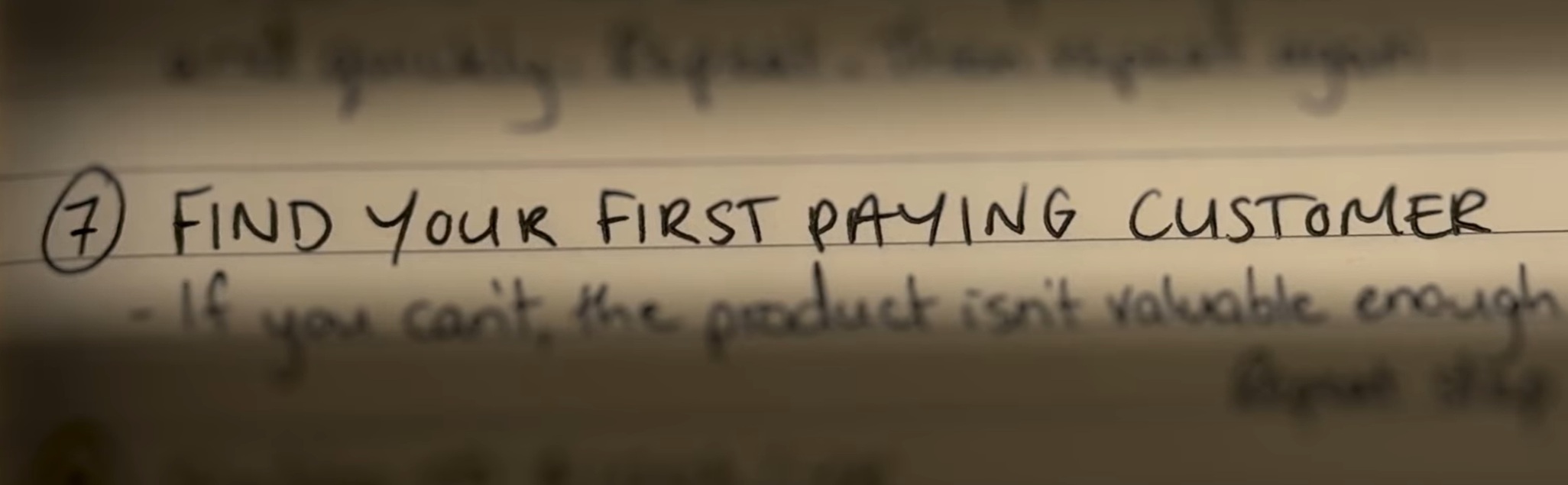
Handwritten note reading Find the First Paying Customer

7. Find the First Paying Customer

A compliment is encouraging, but a paying customer is evidence.

This is a crucial point in the million dollar business plan: interest is useful, but a real sale provides much stronger evidence that the business is solving something valuable.

The first sale proves that someone values the solution enough to exchange real money for it. If people like the idea but will not pay, the founder may need to improve the product, solve a more painful problem or communicate the value more clearly.

This stage is not failure. It is information.

8. Build a Predictable Path to $100,000 a Year

Once the product works and customers are willing to pay, the next challenge is creating a repeatable way to attract more of them.

Jai and Chayse walking in Geraldton with a basketball while talking about business

Jai encourages choosing two lead-generation methods rather than trying everything at once. Options include:

  • direct outreach through email, messages or calls;
  • organic content across social media platforms;
  • referrals from happy customers;
  • networking and events;
  • paid advertising;
  • partnerships;
  • lead magnets, webinars and workshops; and
  • email marketing and customer retention.

His advice when growth slows is often to do more of what has already worked before abandoning it for a completely new strategy.

More volume, better execution, then something new.

9. Scale Towards One Million Dollars With More Focus, Not More Chaos

At this stage, Jai’s advice becomes surprisingly simple: do less, but do it with greater focus.

He encourages founders to increase the value they provide and create a logical pathway for customers:

  • give away something genuinely useful to attract the right people;
  • offer an affordable first paid product;
  • develop a recurring product or membership;
  • create a higher-value offer for customers who need deeper support.

He also emphasises content. Strong businesses need demand, and useful content can educate customers, build trust and show people why the solution matters.

Finally, founders need to decide what should be automated, delegated or eliminated. Growth becomes difficult when the founder remains responsible for every small task.

This stage of the million dollar business plan is about creating focused, repeatable growth rather than simply adding more work for the founder.

10. Choose Your Work, Environment and People Carefully
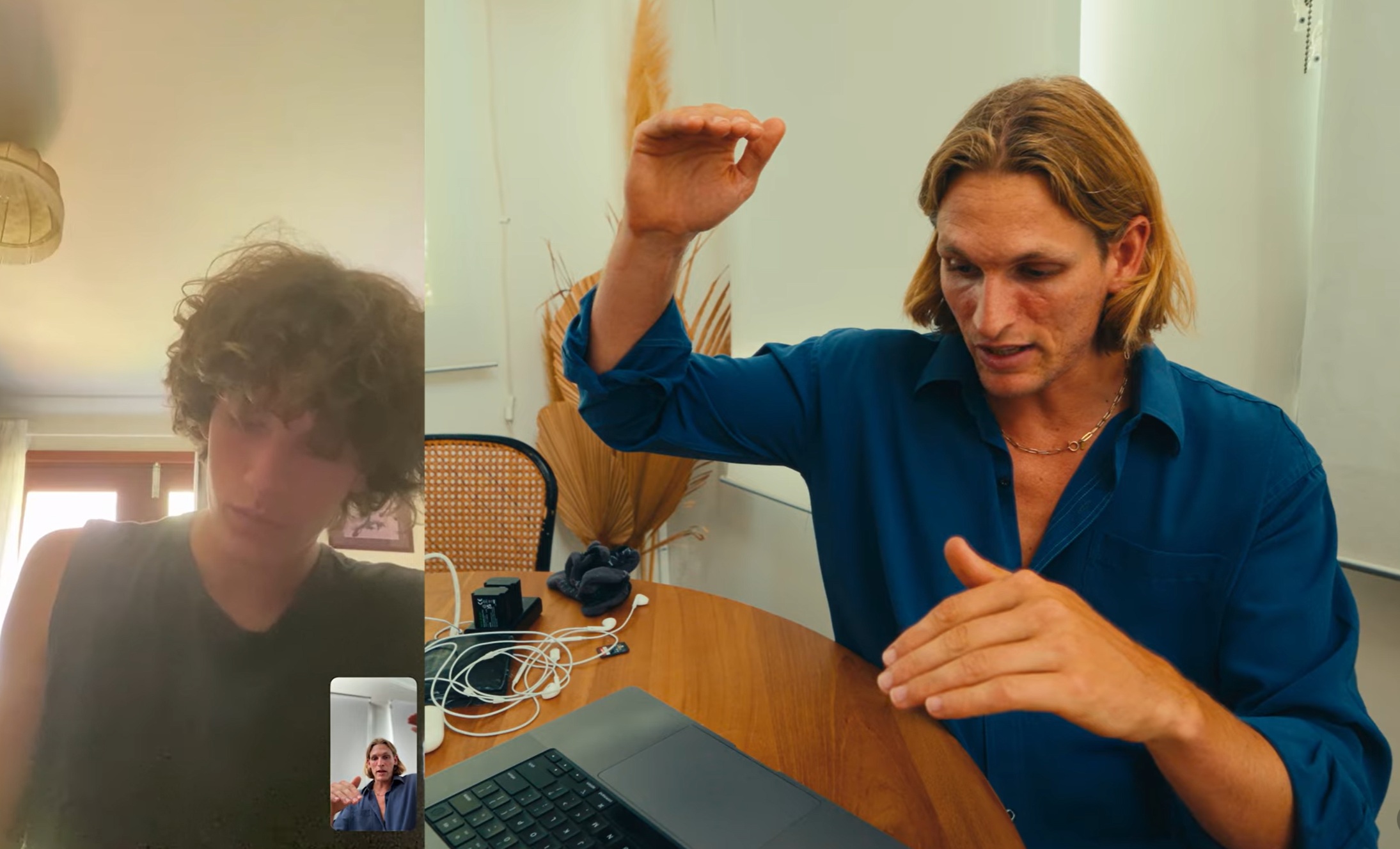
Jai and Chayse continuing their business conversation on a Zoom call after the Geraldton trip

Jai’s final lesson is not really about revenue.

He tells Chayse to spend more time deciding:

  • what he wants to do;
  • where he wants to live; and
  • who he wants to spend his time with.

Those three choices shape far more than a business. They shape a life.

“When I was young, a few people believed in me, and it changed what I believed was possible.”

This also connects with our article on limiting beliefs in children. Encouragement does not guarantee success, but it can help a young person believe they are capable of learning, trying and recovering when an idea does not work.

That belief is something Jai now wants to pass on.

Chayse Is Not Starting From Nothing

Although the video frames the challenge as building a business from scratch, Chayse is not beginning empty-handed.

Chayse looking into Jai’s Land Rover during the Geraldton trip

He already has years of self-directed learning behind him. He has built and sold digital assets, developed websites and apps, completed projects for paying clients and invested his own money in learning marketing skills. He understands online communities, content, artificial intelligence and the speed at which digital opportunities change.

Just as importantly, he has older siblings who can show him what success and failure actually look like.

When Chayse was four, we wrote about his little lolly business and the excitement of turning a small amount of start-up money into something more. Today, the products and platforms are different, but the foundation is familiar: notice an opportunity, make a plan, test the idea and learn through action.

You can follow more of his earlier and current journey through our Chayse Howitt stories.

The Mentorship Circle Comes Back Around

There is something especially powerful about the way this story connects three young men.

Jai once learnt by filming a businessman, listening to his teaching and observing how he worked. Flizzy was now working with Jai in a similar creative role. At the same time, Jai was mentoring Chayse and turning his own difficult business lessons into a clearer pathway for his younger brother.

This is how practical knowledge often moves between generations and peers. Someone opens a door, shares what they know and gives another person the confidence to begin.

It also reinforces why we continue to believe in raising entrepreneurial kids through real-world learning. We cannot predict which childhood project, family conversation, mentor or early failure will matter most. We can only create opportunities, encourage curiosity and help young people learn how to think.

Key Takeaway: A Million Dollar Business Plan Begins With Better Decisions

Key takeaway: Jai’s million dollar business plan is not a promise of quick wealth. It is a framework for making better decisions: choose the life you want, solve a painful problem, test the solution quickly, listen to customers, find a repeatable path to growth and stay focused on what creates real value.

For Chayse, the greatest advantage may not be the plan itself. It may be having a brother willing to share the wins, mistakes and hard-earned lessons behind it.

Jai and Chayse pointing at the camera while holidaying on the Cocos Islands

What is one problem you notice in your own life that could become the beginning of a useful business idea? Share your thoughts in the comments below.


Young Entrepreneurs: What Happened to Our 7 Enterprising Kids

The Howitt family together in a recent photo for their young entrepreneurs story

Young entrepreneurs can grow from the smallest real-life moments: selling honey at a market stall, selling lolly bags at a soccer match, repairing and upselling a rabbit hutch, having business conversations at the dinner table, or dealing with real-life responsibility in a range of settings.

“`

It has been a while.

If you have been with us since the early days of Enterprise for Kids, you will know this site has always been a reflection of our family’s real life — the projects, the lessons, the experiments, the conversations around the dinner table, and the belief that children learn most deeply when they are given real experiences and real responsibility.

“`

Jai Kit Chayse and Akaisha goofing around on holiday on the Cocos Islands
Jai, Kit, Chayse and Akaisha enjoying a family holiday on the Cocos Islands.

Young Entrepreneurs: What Happened to Our 7 Enterprising Kids

We started this blog back in 2012 when our seven children were young. We shared about market stalls and honey businesses, kerb painting, goal setting, the value of leadership camps and all types of money lessons. We wrote about mindset, mentors, purpose, business ideas and the kind of life we were trying to build together as a family.

As you can imagine with seven kids, life got full. The kids grew up. The blog went quiet.

But we never stopped living the journey.

So, Here We Are Again! But Who Are We Exactly?

For those of you who are new here, we are Cathy and Trevor Howitt, parents of a large family from Western Australia, who have spent the better part of two decades asking one big question:

How do we raise children who are confident, creative, capable and free?

Not just free financially, but free in the way they think. Free to pursue something meaningful in their lives. Free to take a risk on an idea they believe in. Free to design a life rather than simply fall into one.

We are not perfect parents. Far from it! We have made plenty of mistakes along the way.

But we were always intentional. We surrounded our kids with mentors, conversations, real-world experiences and the unshakeable belief that they could shape their own path. Looking back, these were the early foundations that helped shape them into young entrepreneurs in very different ways.

Now, all these years later, we get to watch the proof of that walking around in the world. These are not just entrepreneur stories from somewhere else. These are the stories that grew out of our own home, our own questions and our own family entrepreneurship journey.

Young Entrepreneurs Australia: Our Kids Are Grown Now

As mentioned earlier, we wrote regularly on this blog when our kids were young, ranging in age from 18 months to 17 years. We followed and documented their journeys.

Then life became busy with everyday parenting, working, living in beautiful locations and growing our own side hustles.

Again, the blog went quiet.

But we were always inspired by how our kids showed up as young people in this world, and as they grew, what they were up to in their professional and personal lives.

We picked up the pen briefly again in 2021. The last entry written was when Kaitlin was nearly in her mid-twenties working online, Jai was in his early twenties with a warehouse and big dreams, Flynn and Amber were looking into UGC content to generate extra income, Kit and Chayse were in high school, and our youngest, Akaisha, was in primary school.

Life became busy once again, so priorities changed. But the lessons didn’t. Our kids continued to grow and change, develop their own tastes in what life had to offer, pursue their own dreams, or push them aside until it was time to pick them up again.

And our blog was much the same. It has been a dream to document and share our family’s journey, and now is the time to pick it up again and share what has been happening in those intervening years.

And here we are.

Today, our seven children range in age from 15 to 29. The stories they are living now are better than anything we could have scripted. Not because they are all success stories living a true entrepreneurship lifestyle, but because our children are human, living in an unpredictable world, experiencing success, failure and everything in between.

Some are building businesses as young entrepreneurs in the entrepreneur space. Some are creating art, writing and music. Some are exploring digital entrepreneurship, content, apps, leadership and community. All of them are still learning, stretching, succeeding, failing, succeeding again, but most importantly, finding their own way.

That is the part we love the most. We did not raise seven identical children. We raised seven individuals. And each of them is showing us that young entrepreneurs do not all look the same. Some are loud and visible. Some are quiet and creative. Some build companies. Some build communities. Some build stories, songs and ideas, and some are building futures not even thought of yet.

The Short Version of Our Seven Young Entrepreneurs

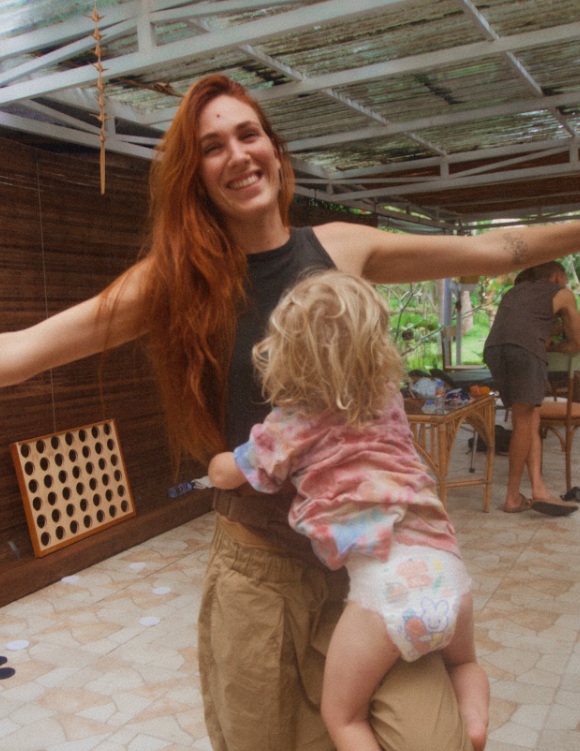
Kaitlin (29)

Kat Howitt as part of the Enterprise for Kids young entrepreneurs story
Kat has followed her own creative path through motherhood, community, writing, self-development and women’s connection.

Kaitlin has become a mother to two beautiful little boys, which makes us very proud grandparents. She has spent her adult life as an entrepreneur, running online courses, building communities, and pursuing her deep passion for creativity, women’s connection and self-development. She writes poetry, publishes on Substack, and her next chapter involves building retreats for women.

She has always followed her heart, no matter what that looks like to the outside world. She is deeply obsessed with finding out who she truly is in all the social constructs of our society and experiences it all — the good, the bad and the ugly.

Kaitlin was the child who walked to the beat of her own drum and, quite often, the drum we were beating as parents was a different rhythm to hers. But it is amazing how the rhythm of two drums can sound good together, and we can say with certainty, Kaitlin has also been one of our greatest teachers, and us hers.

Jai (28)

Jai Howitt as part of the Enterprise for Kids young entrepreneurs story
Jai has built Art of Mondays into a global community for entrepreneurs, founders and creative thinkers.

Jai has built something genuinely remarkable. His business, Art of Mondays, or AOM for short, is a multi-million-dollar community for entrepreneurs. He runs residencies in beautiful locations around the world where founders gather to connect, collaborate and grow together.

He has written a book, acquired businesses, and travelled the globe doing what he loves. He left school unsure of his direction. He has been wildly successful, failed miserably, shaken himself off and continued building success again on this entrepreneurial journey.

True to form, and never resting on his laurels, Jai has a burning desire to build something bigger than himself. His fuel is to make a positive difference to others. He has found his path and follows it. Much like a hummingbird searching for nectar, Jai is willing to change direction when needed and bring life’s lessons with him.

Flynn (26)

Flynn Howitt as part of the Enterprise for Kids young entrepreneurs story
Flynn has grown into a creative connector, working across community, content, crypto education, photography and videography.

Flynn is the connector and the creative. He works closely with Jai on AOM in the sales team, but also runs his own crypto trading and education community. He creates UGC content and teaches others to do the same.

Flynn’s passion for photography and videography has opened him to many opportunities, all involving brand deals and travel. He has always found a way to be involved in whatever is interesting, whatever is a growing trend and whatever is full of possibility.

But more importantly, Flynn does what makes him feel happy. In a world where so many are in jobs they hate, working in systems that don’t serve them, it is refreshing to see a young person full of life, willing to take on challenges, but not at the sacrifice of what brings him joy.

There’s a lesson in that for everyone.

Amber (24)

Amber Howitt as part of the Enterprise for Kids young entrepreneurs story
Amber is building a creative life through writing, poetry, music and quiet, consistent commitment to her craft.

Amber left school not really being clear on the direction she wanted to take, only that it would involve writing and being creative.

Making money has been a means to an end, allowing her time to grow into how she wants to show up in this world. She has dabbled in many pursuits whilst honing her craft as a barista. She has travelled Australia, created UGC content for extra income and is currently writing her first novel.

Amber also writes poetry on Substack and makes beautiful music when her soul feels inspired. She is working quietly and consistently on the creative life she has always wanted.

Amber reminds us that success does not have to look loud to be real. Sometimes the most important work happens quietly, consistently and with deep commitment.

Kit (20)

Kit Howitt as part of the Enterprise for Kids young entrepreneurs story
Kit’s path has been shaped by adventure, outdoor education, leadership, real-world learning and practical enterprise.

Kit loves adventures and pushing himself out of his comfort zone. It probably came as no surprise to us that he took on jobs that involved outdoor pursuits.

His certificates in Business, Outdoor Education and Sport and Recreation have all contributed to allowing him this lifestyle. He is currently in the United States in a leadership role at a summer camp in North Carolina.

He has always been someone who learns by doing and experiencing things firsthand. To earn money to get himself to America, he started his own window cleaning business where he quickly built up a client base.

His path shows how real-world learning can build confidence, adaptability and practical skill.

Chayse (18)

Chayse Howitt as part of the Enterprise for Kids young entrepreneurs story
Chayse has chosen a digital path, building websites, apps, AI projects and creative business opportunities.

Chayse finished high school last year with great ATAR results, and whilst others around him were gearing up for university, he has chosen a different path. He has barely paused for breath before building a range of digital products for clients.

Chayse has bought and sold websites, created apps, taught himself all about AI, and is currently being considered for a role managing a team of content creators at a startup doing serious numbers.

At 18, the Candy Man is growing up.

But what really impresses us about Chayse is his ability to back himself. Even if he hasn’t quite got the experience or know-how, he is resourceful enough to find out and upskill himself in his pursuit and journey of being a young entrepreneur.

Akaisha (15)

Akaisha Howitt as part of the Enterprise for Kids young entrepreneurs story
Akaisha is already finding her voice through writing, music, digital art, Substack and creative uses of AI.

Akaisha is still at school and is inspired daily by what she sees her siblings achieve and pursue in their lives. She was only a toddler when we created Enterprise for Kids, but the lessons in our blog are just as relevant today as they were all those years ago.

Fundamentals don’t change, but the opportunities and technology have expanded beyond anything we could have comprehended 15 years ago. In some ways, Akaisha will have opportunities the others could only dream of, but in that fast-paced world also lie challenges.

Navigating them all is a journey she is currently on.

Akaisha is already writing short stories, playing music, creating digital art in Procreate and exploring how AI might help her develop an app for writers to tell better stories. She also publishes on Substack.

Akaisha is fifteen and already finding her voice.

What Raising Young Entrepreneurs Really Taught Us

Looking back, the honey businesses, lolly bags, market stalls and money lessons were never only about money. They were about confidence. They were about courage. They were about helping children realise they could have an idea, take intentional action, solve a problem, communicate with people, handle mistakes and try again.

That is why Enterprise for Kids has always been about more than business. It is about raising children who can think, create, adapt and contribute. It is about helping children understand that they do not have to wait until adulthood to practise responsibility, leadership, creativity and initiative.

When people talk about young entrepreneurs, they often imagine a child making a lot of money or launching a flashy business. But for us, the deeper goal was always broader than that. We wanted our children to feel capable in the world. We wanted them to see opportunity. We wanted them to know that ideas matter, effort matters, relationships matter and courage matters.

That is the real story behind teaching our family entrepreneurship values. We were trying to raise kids who could meet life with imagination, confidence and purpose, and if it suited their nature, to do it in an entrepreneurial way.

For families wanting to start those conversations early, the Australian Government’s MoneySmart guide to teaching kids about money is a useful resource for making money part of everyday family life.

Why We Are Sharing These Young Entrepreneur Stories

We have been talking about relaunching this site for a while, and the timing finally feels right.

Trevor has been working hard behind the scenes rebuilding and updating the site, making it easier to navigate and better to read. That work is nearly done. And we have so much to share.

Over the coming months, we want to do something we have never quite done before: go back and connect the dots. We want to show you not just what we did with our kids when they were young, but what those early lessons actually led to today.

We want to tell each of their stories properly: the ventures, the mindset shifts, the failures, the wins, and the moments where you could see everything clicking into place.

We also have some new projects of our own to share when the time is right. But for now, this is us, saying hello again.

Where to Start If You Are New Here

Cathy and Trevor with their grandson Rafi as part of the Enterprise for Kids family story
Cathy and Trevor with grandson Rafi — a beautiful reminder that the Enterprise for Kids journey is now moving into the next generation.

If you are new here, welcome. A good place to begin is with our Family Enterprise Stories, where you can get a feel for where it all began.

You might also enjoy exploring our Kids Business Ideas, Money Lessons for Kids and Our Enterprising Kids Today sections, especially if you are interested in how young entrepreneurs grow through everyday family life.

If you have been here before, thank you for coming back. We have missed this.

The best chapters are still ahead.

— Cathy and Trevor

Key Takeaway

Key takeaway: Young entrepreneurs do not appear overnight. They grow through small, real-world experiences that build confidence, creativity, responsibility, resilience and the belief that their ideas matter.

Explore More Enterprise for Kids Stories

Keep exploring: These pages will help you follow the Enterprise for Kids journey from the early family projects through to where our children are today.

Entrepreneurial Family: What We Talk About Around the Dinner Table

Kaitlin, Jai, Flynn, Amber and Tully relaxing by the sea on Cocos Islands as part of an entrepreneurial family story

An entrepreneurial family does not always teach enterprise through formal lessons. Sometimes the most powerful learning happens around the dinner table.

In our family, dinner often began with gratitude, a few stories from the day, and a celebration of what people had achieved. But quite often, the conversation would shift into business, money, social media, investing, websites, ideas and opportunities.

Flynn developing photography and filmmaking skills as part of an entrepreneurial family story
Film making and photography helped Flynn build confidence, creativity and a social media following.

Editor’s note: This article was originally written during an earlier stage of our family’s Enterprise for Kids journey and has been refreshed with updated formatting, links and reflections. Some examples are historical, but the bigger lesson is still very relevant: children learn a great deal from the conversations, questions and opportunities they grow up around.

What Does an Entrepreneurial Family Talk About?

What do you think the Howitts talk about around the dinner table?

It always begins with each member of the family sharing a gratitude. Usually the events of the day are told, small wins are noticed, and achievements are celebrated. But what often happens next is that topics of business, enterprise, finance and investing begin to govern the conversation.

That might sound unusual, but for us it became part of family life. We were not trying to lecture the children. We were simply talking openly about ideas, opportunities, risks, mistakes and what people were learning.

This is one of the quiet strengths of an entrepreneurial family. Children begin to hear the language of possibility. They hear adults and siblings talk about ideas, value, money, creativity, customers, digital skills and problem-solving. Over time, those conversations can shape the way children see the world.

Some of the topics around our family table have included social media opportunities, digital assets, eCommerce and online business. Let’s look at how these conversations can present opportunities for kids and teens to think more entrepreneurially.

How Social Media Became a Learning Opportunity

Our older children, Kaitlin, Jai, Flynn and Amber, all discovered social media when they were in their mid-teens. It started with Facebook, then Instagram, and later platforms such as TikTok and Snapchat.

They learned how to grow a real following by posting regular, quality content about their lives, interests and adventures. It probably helped that we were living on a tropical island atoll in the middle of the Indian Ocean. Photos and videos from Cocos Islands always looked pretty fabulous, and those early creative skills helped shape things like Flynn’s photography and creative work.

Kaitlin creating inspirational workshops and enterprise opportunities through social media and connection
Creating workshops and connecting with people became part of Kaitlin’s enterprise journey.

As their following grew, so did their opportunities for enterprise. It began with simple things like shoutouts. Other people or companies would pay them to mention a product, page or service in a post. This helped those people grow their followers or promote what they were offering, and our enterprising kids were happy for the cash.

Next came real products. Companies sent clothing, watches, surf gear and jewellery for them to wear and share on their accounts. The kids were able to keep the gear, and in some cases they were also paid for the promotion.

Looking back, this was an early lesson in digital entrepreneurship. The children were learning that attention, trust, creativity and consistency could create opportunities. They were also learning that a following is not just about numbers. It is about connection, value and communication.

Turning Digital Skills Into Real Business

As time went by and their social media followings grew, their creative ideas began to grow as well. Bigger opportunities started to appear.

Jai beginning his digital enterprise journey from his bedroom as part of an entrepreneurial family
Jai building digital skills from his bedroom in the early days of his enterprise journey.

Kaitlin, along with Tully, began building multiple streams of income using social media, connection and online platforms. Their work included coaching, network marketing and online courses.

Jai took a few years to build momentum, but his early interest in social media and content creation eventually became a real business path. He began creating content for clients and using his digital skills to generate leads and opportunities.

That is one of the things I find interesting as a parent. The small things children play with, practise and explore as teenagers can become the early foundations for future work.

Jai standing in his warehouse after growing his digital content and media business
Jai’s early digital interests eventually grew into real business opportunities.

An entrepreneurial family does not need to have all the answers. What matters is creating an environment where children are allowed to explore ideas, test things, ask questions and see real examples of enterprise in action.

That connects closely with our broader reflections on how to raise entrepreneurial kids. Children do not only need theory. They need conversations, experiments, encouragement and real-world opportunities.

Talking About Crypto and Digital Assets Carefully

Another topic that entered our family conversations was crypto. You would have heard about Bitcoin, but many people still do not fully understand what it is, how it works, or why people are interested in it.

For our family, the useful part of the conversation was not “everyone should buy crypto”. It was the opportunity to talk about technology, risk, research, hype, long-term thinking and the difference between speculation and investing.

Important note: This section is not financial advice. Crypto assets are volatile and risky. This article is simply reflecting on how one family used the topic as a learning conversation about technology, money and decision-making.

In simple terms, Bitcoin is a digital asset built on blockchain technology. It was created in 2008 and has a limited supply. People are interested in it for many reasons, including decentralisation, borderless transactions, digital scarcity and the potential of blockchain technology.

But the more important family lesson was this: children and teens need to learn how to think, not just what to buy.

When topics like crypto come up, parents can ask useful questions:

  • What problem is this technology trying to solve?
  • Who benefits if people buy into it?
  • What could go wrong?
  • Is this investing, speculation, gambling or learning?
  • What would proper research look like?
  • How much risk is too much?

Those are powerful dinner table questions. They help children think about risk, evidence, emotions and decision-making. That is far more valuable than simply telling them something is good or bad.

This also links with our article on financial education for kids, where we explore how children can begin to think about assets, liabilities and wiser money choices.

eCommerce and Website Building at Home

Another topic we explored as a family was eCommerce and website building. We were learning how websites could be built, improved, monetised and sometimes bought or sold as digital assets.

Websites can be monetised in many ways. Some common methods include affiliate marketing, advertising, directory listings, services, digital products and online courses.

For enterprising kids and teens, the bigger lesson is not that every child should rush out and build a website. The lesson is that digital skills matter.

When a young person learns how websites work, they begin to understand:

  • how online businesses attract attention
  • how content can create value
  • how products and services are sold online
  • how audiences are built
  • how digital assets can be improved over time
  • how creativity, writing, design and technology can work together

At the time of the original article, some of the younger Howitt kids were building websites. Amber had started a site about sustainable period products. Chayse had bought a site called Baby Client and was working on improving it. Other projects were still a work in progress.

Some of those early projects worked. Some did not. But every one of them created learning.

That is the value of an entrepreneurial family. The goal is not to make every child successful at every idea. The goal is to build initiative, curiosity, problem-solving and the courage to keep learning.

What Parents Can Learn From an Entrepreneurial Family

Our dinner table conversations may be a little different to the average family. We gain inspiration from one another through these conversations and through mentors who support us on our entrepreneurial journeys.

We are building skills, gaining knowledge, creating assets and, most of all, strengthening a mindset for enterprise.

If you want to encourage more enterprise in your own family, you do not need to start with a big business idea. Start with better conversations.

You might ask your children:

  • What problem did you notice today?
  • What could make that easier, better or more useful?
  • What skill would you like to learn?
  • What do people already ask you for help with?
  • What could you create, sell, improve or share?
  • What does this teach us about money, value or responsibility?

Those questions help children see the world differently. They begin to notice opportunity. They begin to understand value. They begin to realise that enterprise is not just something adults do. It is a way of thinking.

Key takeaway: An entrepreneurial family can use everyday conversations about business, money, digital skills, investing and ideas to help children build confidence, curiosity and real-world enterprise. The dinner table can become one of the most powerful classrooms in the home.