Kids Biz Program- (by Amber)

Kids business ideas through a kerb painting program for children

Kids business ideas become much more powerful when children are given the chance to take action in the real world. This Kids Biz Program challenge gave our family a practical way to learn about entrepreneurship, confidence, problem-solving and making money through effort and initiative.

What started as a simple $20 challenge turned into a kerb painting business, more than 60 presold jobs, and a real-life lesson in enterprise.

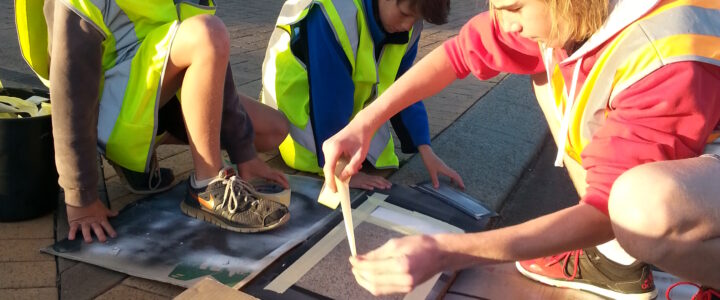
Kids business ideas in action with Flynn and Amber kerb painting
Flynn and Amber kerb painting as part of the Kids Biz Program.

Kids Business Ideas in Action

We are currently involved in a Kids Biz Program. The program teaches young people, and their parents, about the traits of successful entrepreneurs. It also helps children understand the practical methods and the mindset needed to become more successful, more confident and more open to new ideas.

This is exactly the kind of real-world learning we love at Enterprise for Kids. Children learn so much when they are given the chance to test ideas, solve problems, speak to people, handle money and take responsibility for a project.

A wise man once said:

“The most successful people in life are the ones who ask questions. They’re always learning. They are always growing. They are always pushing.”

This quote from Robert Kiyosaki, author of Rich Dad Poor Dad, best sums up what my family and I have been doing through the Kids Biz Program. You can learn more about his work through Rich Dad.

Kids Business Ideas Monthly Challenge

Every month, the program sets a challenge that encourages us to take the skills we have learnt and apply them to real-life situations.

In August, our challenge was to take $20 and create a business that would earn a profit. To win the challenge, we had to make the most money from our $20.

This made the challenge much more than a classroom activity. It became a real test of creativity, planning, teamwork and courage.

Our Kerb Painting Kids Business Idea

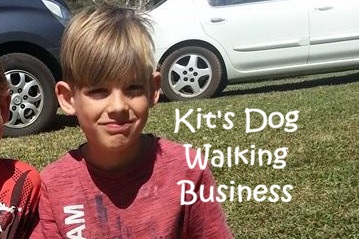
Kit painting a kerb number as part of a kids business idea
Kit putting the final touches on a kerb number.

Naturally, my family was slow to get started. We kept circulating ideas but not actually taking action. Eventually, we came up with one idea that stuck — and from there, it exploded.

Our idea was to paint house numbers on kerbs. This would help visitors, family members and even emergency services find homes more easily.

It was a simple idea, but that is often what makes the best kids business ideas work. The business solved a real problem, was affordable to start, and could be explained clearly to customers.

From a $20 Challenge to Real Profit

We did our fair share of research and planning, and then we took action.

In just five days, we presold over 60 kerb paintings, giving us a profit of about $1000.

Amazingly, we won the challenge for the month. We then spent September painting kerbs and completing the jobs we had sold.

It has been an awesome experience so far, and I swear my artistic ability has improved!

What Kids Can Learn from Business Ideas Like This

This kerb painting challenge taught us much more than how to make money. It helped us learn real enterprise skills, including:

  • coming up with a practical business idea
  • starting with a small amount of money
  • researching and planning before taking action
  • talking to customers
  • preselling a service
  • working as a team
  • following through and completing the job
  • building confidence through real experience

These are the kinds of lessons that help children grow into capable, resourceful and confident young people.

Why Real Kids Business Ideas Matter

When children are given the chance to run small businesses, they learn in a way that feels exciting and meaningful. They are not just reading about entrepreneurship — they are experiencing it.

Also, they learn that ideas need action. They learn that money is connected to service, value and effort. They learn that confidence grows when they step outside their comfort zone and try something real.

This is why family enterprise stories are such an important part of our website. They show how ordinary moments can become powerful lessons in initiative, responsibility and resilience.

You may also enjoy reading Honey Pot of Gold, another real family enterprise story about Flynn’s honey business, or Financial Education for Kids: Teaching Assets and Liabilities, which explores how children can learn about money through real-life experience.

More Kids Biz Program Adventures Coming Soon

I’m really excited to share our Kids Biz Program September challenge with you. I’ll tell you all about that in my next post.

We also invite you to like our Enterprise for Kids Facebook page.

Key takeaway: Kids business ideas do not need to be complicated. With a small amount of money, a practical idea and the courage to take action, children can learn powerful lessons about entrepreneurship, confidence and real-world responsibility.

Where to Next?

If you enjoyed this family enterprise story, you may also like:

Entrepreneurship for Students: How Do Entrepreneurs Think?

Jai Howitt discussing his entrepreneurial journey on The Pocket with Chris Griffen

Entrepreneurship for students is not just about starting a business. It is about learning how to think differently, spot opportunities, solve problems, take action and build confidence in the real world.

When children learn how entrepreneurs think, they begin to see that their ideas matter. They also begin to understand that money, work, creativity and contribution can be approached in a very different way.

Entrepreneurship for students shown through Jai Howitt coaching Chayse on business strategy
Jai coaching Chayse through business strategy and entrepreneurial thinking. Watch Jai coach Chayse.

Entrepreneurship for Students: How Do Entrepreneurs Think?

In an earlier article, we spoke of charitable entrepreneurs and successful business thinkers such as Richard Branson, Warren Buffett and John Templeton.

They, together with many other successful people, have extraordinary stories to tell about their entrepreneurial journeys. Some will tell you they struggled at school, dropped out, were dyslexic, or found reading and writing difficult. Others came from homes of poverty, while some were born into families where business and enterprise were already part of everyday life.

Although their backgrounds and circumstances differed, one thing often remained the same: they thought in a similar way.

It is not circumstance alone that creates an entrepreneur. It is mindset.

That is why entrepreneurship for students matters. Young people need more than information. They need the chance to develop the kind of thinking that helps them create opportunities, make decisions, solve problems and take responsibility for their future.

Why Entrepreneurial Thinking Matters for Families

What we have come to understand is that for our family to become economically and personally free, we need to question our conditioning around money and then reprogram our subconscious minds with a new success money mindset.

Many wealthy and successful people either developed this mindset from their upbringing, or they discovered it for themselves. Sometimes this happened consciously, through study and self-development. At other times, it happened unconsciously through experience, environment and action.

It is often said that only a small percentage of people live with real economic and personal freedom. The bigger question is this: what do they do differently?

More to the point: how do entrepreneurs think?

Before we look deeper into that, consider this.

Entrepreneurship for Students Starts with Money Mindset

Wealth creation and poverty mindset lesson for students
The way children think about money can shape the opportunities they see.

Whether we like it or not, we are being conditioned constantly to think a certain way about money. We are conditioned by our family, schools, advertising, politicians, television, social media and friends.

Many people become tied to jobs and debt because the conditioning they have received favours a money mindset of lack, rather than abundance.

Do any of the following sound familiar?

  • “Money doesn’t grow on trees.”
  • “Money is the root of all evil.”
  • “You’ve got to work hard for your money.”
  • “Get a good, well-paying job and you’ll be set for life.”
  • “Buy a home, it will be your best investment ever.”
  • “We can’t afford it.”
  • “What job do you want to do when you grow up?”
  • “Go for the cheaper ones.”

Only this morning, I was listening to a friend talking with his teenage sons. He told them they needed to get jobs. He explained that he had a job pushing shopping trolleys at their age. He even went down to the local IGA supermarket and picked up applications for them to apply for jobs.

When I was fifteen, I started out with a casual job working at a Target store. My hourly rate was $2.90 an hour.

All of the above are examples of conditioning. Much of our thinking about money, work and possibility is formed very early in life.

What Schools Often Teach About Work and Money

Our schools are largely designed to prepare workers for the workforce. Banks make money by selling debt. Governments collect taxes and often depend on people staying within predictable systems. Retail businesses make money by encouraging us to spend. Big businesses need workers to build their businesses.

There is definitely a design to much of this madness.

That does not mean jobs are bad. It also does not mean every child needs to become a business owner. However, it does mean young people should know there are other pathways.

They should understand that work, money, creativity and contribution can be approached in different ways.

This is why financial education for kids is so important. Children need to learn about money, value, assets, liabilities, work, enterprise and choice before they enter adulthood.

Entrepreneurial Mindset for Young People

What our family has discovered is that our money mindsets are changing. We are learning that it is okay to accept money and to have money. In fact, it is okay to offer something of value to others and receive payment in return.

Working hard in a job is not the only pathway for young people entering our big world.

There are other ways. These pathways can allow young people to follow their passions and dreams while making a meaningful contribution to whatever they consider important.

Wouldn’t it be fantastic if all our kids could achieve economic and personal freedom?

People who have achieved financial freedom through being entrepreneurial tend to have a mindset of abundance. Their habits differ. Their thinking differs. Their actions differ.

This is why we keep coming back to the bigger idea of raising entrepreneurial kids. It is not just about business. It is about helping children become confident, capable, creative and resourceful.

How Entrepreneurs Think: Lessons from Napoleon Hill

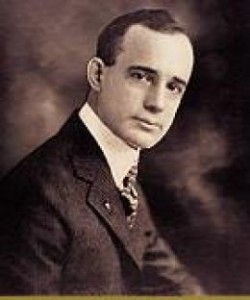
Napoleon Hill Think and Grow Rich entrepreneurial mindset lesson
Napoleon Hill studied how successful people think and act.

Rather than attempting to explain every detail of how entrepreneurs think, I will refer to one of the most influential books ever written on personal and financial achievement.

Think and Grow Rich by Napoleon Hill was originally published in 1937. Hill spent his life studying successful people and recording how they think and act. He became successful himself by following the distinctions in his own book and by modelling himself on his mentors.

Think and Grow Rich is essentially a book about what to do and how to do it. It explores ideas such as self-direction, organised planning, autosuggestion, mastermind association, self-analysis and the selling of personal services.

The thirteen steps to riches described in the book offer a philosophy of individual achievement that has influenced thousands of people’s lives.

This book could be worth a great deal to you and your kids, not simply because of the money ideas, but because of the thinking behind them.

At the time of this original article, Cathy was rewriting Napoleon Hill’s book in a way that would be suitable for kids to read, with simple explanations and modern examples they could better relate to. It was a work in progress, built around the idea that children should be able to understand powerful success principles in language that makes sense to them.

You can also learn more about Napoleon Hill’s work through the Napoleon Hill Foundation.

Entrepreneurship for Students in Real Life

For our family, entrepreneurship for students has never been just a theory. It has been something we have tried to encourage through conversations, real-life projects, mentoring and practical action.

Looking back now, we can see how these early conversations about entrepreneurial thinking have carried through into real life. The goal was never just to teach our children about business. It was to help them become confident, resourceful young people who could spot opportunities, solve problems and take action.

Today, we see that continuing as Jai shares business ideas and strategy with his younger brother Chayse, passing on what he has learnt through his own entrepreneurial journey.

Jai has gone on to build his own entrepreneurial path through creative work, content and business. You can see part of that journey through Art of Mondays.

Key Takeaway: Teach Students to Think Like Entrepreneurs

Key takeaway: Entrepreneurship for students is about far more than making money. It is about helping young people think differently, understand value, recognise opportunity, solve problems and take action in the real world.

Where to Next?

If you enjoyed this article about entrepreneurship for students and entrepreneurial thinking, you may also like:

We would love to hear your thoughts. How do you think entrepreneurs think differently, and how can we help children develop that mindset while they are still young?

Business Ideas for Kids: Finding Enterprise Ideas

kids entrepreneur ideas inspired by real family enterprise experiences

Business ideas for kids often begin with everyday problems, useful skills and a little creative thinking.

Coming up with an enterprise idea that makes money, solves a real problem and keeps a child motivated is a tall order for an adult, let alone a kid.

Children do not need a perfect idea to get started. In fact, many of the best ideas come from noticing what people need, thinking creatively and using the skills children already have.

business ideas for kids through real family enterprise experiences
Looking for enterprise ideas as a family.

Business Ideas for Kids: Finding Enterprise Ideas

Business ideas for kids are often found by looking closely at everyday life. Coming up with an enterprise idea that makes money, solves a real problem and keeps a child motivated can be a tall order for an adult, let alone a kid.

The trick is to spend time brainstorming ideas together and helping children notice the small problems around them.

What I explained to my entrepreneurial kids was that they needed to think about the problems in our small community town, then look for possible solutions.

By solving people’s problems, children begin to create real opportunities for enterprise.

Business Ideas for Kids Start with Solving Problems

In the original video for this post, I gave the kids a simple example. Winter was drawing near and people were chopping wood ready to fuel their fires.

Problem: No one likes scrambling around outside on a cold and rainy day gathering kindling to get their fire started.

Solution: Collect bundles of gum tree sticks, tie them up and sell them to people who need kindling ready to go.

Step one was finding the problem. Step two was finding the solution. Putting the idea into action would be step three.

What a great and simple enterprise idea.

After hearing this example, the kids had no trouble finding enterprise ideas of their own.

Using Skills to Create Kids Entrepreneur Ideas

Our mentor, Paul Counsel, often shares a great educational basis behind what it means to be entrepreneurial.

He encourages us to consider how we are an asset to others. What skills and knowledge do we have that could be of service to others? What are we good at?

For example, Kaitlin and Amber are very good with toddlers and babies. Every day they were helping with their baby sister Akaisha. They fed her, changed her nappy, bathed her and took her for walks.

Both girls were very skilled and had a natural ease with babies. Knowing when Akaisha was tired and how to soothe her when she was upset became second nature. These abilities could easily lead to real enterprise opportunities.

Everyday skills can become enterprise ideas:

kids helping younger siblings read as part of business ideas for kids
Reading with siblings
kids caring for younger siblings and developing enterprise skills
Looking after Akaisha

Turning Everyday Skills into Enterprise Ideas

The obvious enterprise would be babysitting, but other ideas include:

  • Homework Support — busy parents may need someone to listen to younger children read, practise spelling words or help with writing.
  • Toddler Playmate — after school, some parents may appreciate an older child entertaining and playing with their toddler or baby.
  • Walking Younger Children Home from School — busy parents may appreciate a responsible older child helping with the school run.
  • Sports, Dance, Music or Art Coaching — Amber and Kaitlin could teach other kids how to throw, catch, draw, dance or play music.
child who enjoys helping younger kids as a business idea for kids
Kaitlin loves kids.

These are not complicated ideas, but they are valuable and practical. Children can easily miss this point. Often, they do not realise that skills they use every day may be helpful to someone else.

Finding Business Ideas for Kids Through Imagination

All it requires, when finding enterprise ideas for kids, is a little imagination.

Take the time to identify problems and look at what assets you have that could help people. Helping people is the key to enterprise.

Many ideas are not new. However, children often need guidance to look at their existing skills and realise how valuable they already are.

young musician developing skills that could become business ideas for kids
Budding young musician

A tip for everyone: you can increase your value by up-skilling and becoming an expert in an area.

As your skill increases, your value increases too. Over time, people are more likely to seek your help and pay for your time and knowledge.

How Kids Can Start a Business by Increasing Their Value

For example, being a whiz at sorting computer glitches would make you valuable to people who have computer problems. Being an expert pianist could create opportunities to teach others how to play piano.

Many of these ideas are simple. The real lesson is helping children notice what they are already good at, then think about how those skills could help others.

For older children who are ready to take an idea further, Business.gov.au has helpful information for young people starting a business.

Business Ideas for Kids Are Everywhere

Finding enterprise ideas can be fun, and it isn’t that hard if you do a little thinking and brainstorming first.

Amber will reveal her enterprise idea in the next blog as she begins her quest to reach her goals, so stay tuned.

Key takeaway: Business ideas for kids often begin with simple problem-solving. When children learn to notice problems, use their skills and think about how they can help others, they begin to see enterprise opportunities everywhere.

Where to Next?

If you enjoyed this post about finding business ideas for kids, you may also like:

We would love to hear from you, so please leave a comment.