Kids Biz Program- (by Amber)

Kids business ideas through a kerb painting program for children

Kids business ideas become much more powerful when children are given the chance to take action in the real world. This Kids Biz Program challenge gave our family a practical way to learn about entrepreneurship, confidence, problem-solving and making money through effort and initiative.

What started as a simple $20 challenge turned into a kerb painting business, more than 60 presold jobs, and a real-life lesson in enterprise.

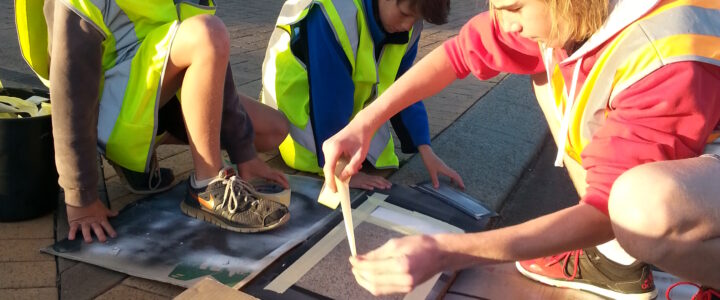
Kids business ideas in action with Flynn and Amber kerb painting
Flynn and Amber kerb painting as part of the Kids Biz Program.

Kids Business Ideas in Action

We are currently involved in a Kids Biz Program. The program teaches young people, and their parents, about the traits of successful entrepreneurs. It also helps children understand the practical methods and the mindset needed to become more successful, more confident and more open to new ideas.

This is exactly the kind of real-world learning we love at Enterprise for Kids. Children learn so much when they are given the chance to test ideas, solve problems, speak to people, handle money and take responsibility for a project.

A wise man once said:

“The most successful people in life are the ones who ask questions. They’re always learning. They are always growing. They are always pushing.”

This quote from Robert Kiyosaki, author of Rich Dad Poor Dad, best sums up what my family and I have been doing through the Kids Biz Program. You can learn more about his work through Rich Dad.

Kids Business Ideas Monthly Challenge

Every month, the program sets a challenge that encourages us to take the skills we have learnt and apply them to real-life situations.

In August, our challenge was to take $20 and create a business that would earn a profit. To win the challenge, we had to make the most money from our $20.

This made the challenge much more than a classroom activity. It became a real test of creativity, planning, teamwork and courage.

Our Kerb Painting Kids Business Idea

Kit painting a kerb number as part of a kids business idea
Kit putting the final touches on a kerb number.

Naturally, my family was slow to get started. We kept circulating ideas but not actually taking action. Eventually, we came up with one idea that stuck — and from there, it exploded.

Our idea was to paint house numbers on kerbs. This would help visitors, family members and even emergency services find homes more easily.

It was a simple idea, but that is often what makes the best kids business ideas work. The business solved a real problem, was affordable to start, and could be explained clearly to customers.

From a $20 Challenge to Real Profit

We did our fair share of research and planning, and then we took action.

In just five days, we presold over 60 kerb paintings, giving us a profit of about $1000.

Amazingly, we won the challenge for the month. We then spent September painting kerbs and completing the jobs we had sold.

It has been an awesome experience so far, and I swear my artistic ability has improved!

What Kids Can Learn from Business Ideas Like This

This kerb painting challenge taught us much more than how to make money. It helped us learn real enterprise skills, including:

  • coming up with a practical business idea
  • starting with a small amount of money
  • researching and planning before taking action
  • talking to customers
  • preselling a service
  • working as a team
  • following through and completing the job
  • building confidence through real experience

These are the kinds of lessons that help children grow into capable, resourceful and confident young people.

Why Real Kids Business Ideas Matter

When children are given the chance to run small businesses, they learn in a way that feels exciting and meaningful. They are not just reading about entrepreneurship — they are experiencing it.

Also, they learn that ideas need action. They learn that money is connected to service, value and effort. They learn that confidence grows when they step outside their comfort zone and try something real.

This is why family enterprise stories are such an important part of our website. They show how ordinary moments can become powerful lessons in initiative, responsibility and resilience.

You may also enjoy reading Honey Pot of Gold, another real family enterprise story about Flynn’s honey business, or Financial Education for Kids: Teaching Assets and Liabilities, which explores how children can learn about money through real-life experience.

More Kids Biz Program Adventures Coming Soon

I’m really excited to share our Kids Biz Program September challenge with you. I’ll tell you all about that in my next post.

We also invite you to like our Enterprise for Kids Facebook page.

Key takeaway: Kids business ideas do not need to be complicated. With a small amount of money, a practical idea and the courage to take action, children can learn powerful lessons about entrepreneurship, confidence and real-world responsibility.

Where to Next?

If you enjoyed this family enterprise story, you may also like:

Business Ideas for Young Entrepreneurs: Burekup Fair Success

Chayse making a sale at the Burekup Fair as one of the business ideas for young entrepreneurs

Business ideas for young entrepreneurs come alive when children have the chance to prepare products, talk to customers, handle money and experience the excitement of making real sales.

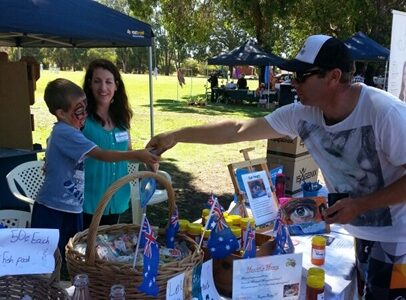
The day of the Burekup Country Fair started with a mad rush. Seven enterprising kids needed to be ready and set up down at the Burekup Country Club grounds by 8.30am. It required four trips with a trailer carrying tables, pram, signs, eskies, TV, banners and all the products we planned on selling.

Amber and Flynn with Fish in a Bottle showing business ideas for young entrepreneurs
Amber and Flynn with their Fish in a Bottle idea.

Business Ideas for Young Entrepreneurs at the Burekup Fair

On arriving at the Burekup Fair, we discovered that someone else had set up in our designated spot. We milled around waiting until the problem was sorted, and once a new space was allocated, we busied ourselves with setting up.

A very strong easterly wind challenged us with erecting banners and keeping tablecloths on the tables. It was obviously going to be a hot day. Thankfully, the red gum trees overhead would keep us in shade all day.

Bargain hunters were quick to do the rounds of the stalls well before we were ready. While we were still trying to set things up, people were already asking questions and making purchases. We will have to be better prepared for this next time round!

Amber with succulents as one of the kids business ideas at Burekup Fair
Amber and her succulents.
Enterprising kids making a sale at the Burekup Fair
…and making a sale.

The kids’ anticipation and the joyful growing crowd created an air of excitement. It was a real country fair without all the commercial jazz that you see at many fairs today.

Visitors and locals first joined in with the Australia Day barbecue breakfast. Following the brekky, the crowd moved on to all the stalls and activities. There were old machinery displays, a free bouncy castle and water slide, a dunk tank, fairy floss, pat-the-animals, thong-throwing contests, face painting, and people selling their wares — from homemade fudge, plants and toys to live pigs, chickens and crafts.

Other enterprising kids were also selling their toys, bikes, clothes and things they had made. It was the perfect place to see business ideas for young entrepreneurs being tested in a real community setting.

Setting Up Business Ideas for Young Entrepreneurs at a Kids Market Stall

A market stall is a wonderful way for children to test their ideas in the real world. It gives them the chance to see whether people are interested, practise talking to customers, learn how to display products, and understand that business is about far more than simply having something to sell.

The Australian Government’s business.gov.au page on market stalls explains that a market stall is a temporary structure used to sell products or services, and that stallholders may need to think about registrations, permits, food safety, insurance and other requirements. Read more about setting up a market stall here.

For children, the lesson can start simply:

  • What are we selling?
  • Who might want to buy it?
  • How should we display it?
  • What price should we charge?
  • How do we speak confidently to customers?
  • How do we count money and work out profit?
Kids market stall set up with business ideas for young entrepreneurs at the Burekup Country Fair
All set ready for the customers!

Novelty Products and Business Ideas for Young Entrepreneurs

Having a novelty product is one of the keys to drawing interest, and we had the perfect product.

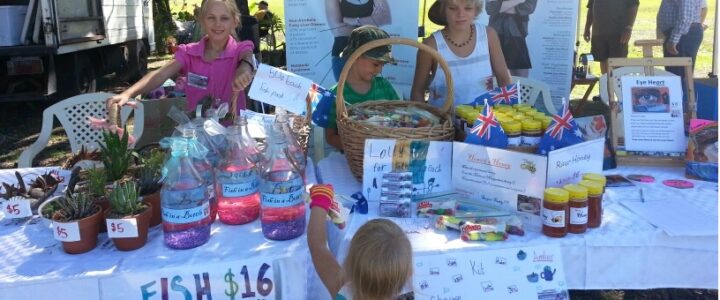
Flynn and Amber’s “Fish in a Bottle” were an absolute hit. Kids came from everywhere dragging their parents over to look at the fish. Once at our stall, we were able to show them our other items too.

This was a powerful business lesson. Sometimes one unusual product can bring people closer, start conversations and help customers notice the rest of what is on offer.

Fish in a Bottle products waiting to be sold at a kids market stall
Products waiting to be sold.

Learning to Ask for the Sale

Chayse soon got the hang of it. Whenever a customer wandered past, he would hold up a lolly bag and ask if they would like to buy one.

Many people bought lollies from him simply because he had asked. How can you refuse a little five-year-old?

There was another little boy walking around selling his mum’s homemade fudge. He was not shy in coming forward and asking customers if they would like to make a purchase. Talking to his dad later in the day, he said that his son had sold more fudge walking around than they had sold at their stall.

I guess there is a lesson in that.

For young entrepreneurs, learning to politely ask is powerful. It builds confidence, communication skills and resilience. It also teaches children that customers often need a friendly invitation before they buy.

Customers, Money and Confidence

It was not long before we had customers coming in their droves. Talking with customers, handling money and recording on a pad what was sold all kept the kids on their toes.

Taking turns to man the stall allowed each of us time to catch up with friends and also spend some of the takings at the fair.

Kaitlin's Eye heART display as a creative business idea for young entrepreneurs
Kaitlin’s EYE heART on display.
Customers admiring Kaitlin's artwork at the Burekup Fair
…customers admiring her work!

Our enterprising kids were very happy with their results. Each was able to sell products and make a profit.

Flynn’s Howitt’s Honey was very popular and sold very well. Kit and Chayse sold about half their lolly bags and, due to the hot day, Jai’s icy-poles also sold well. Jai made a profitable sale with his exercise equipment. Amber sold succulents. Kaitlin received commissions for her Eye heART artwork. And, of course, the Fish in a Bottle sold well.

Making Sales Turns Business Ideas for Young Entrepreneurs Into Real Learning

This is where business ideas for young entrepreneurs become real learning.

It is one thing to imagine a business. It is another thing entirely to prepare the product, take it to a fair, display it, speak to customers, handle money, record sales, pay back costs and work out profit.

Those are real lessons.

Jai manning the stall with his exercise equipment at the Burekup Fair
Jai manning the stall with his exercise equipment.
Flynn selling unpasteurised honey as a young entrepreneur
Flynn selling his unpasteurised honey.

Cath and I also had a terrific result with our own stall. This was the first time we had put ourselves out there with our new business in the local community, and it allowed us to develop our own self-efficacy too. We spoke with many interesting people and learned a lot about their lives and interests.

By the end of the day, we were exhausted.

Celebrating Success Builds Self-Efficacy

It was important to celebrate our success because this is vital in fostering self-efficacy around being entrepreneurial kids.

The kids counted the takings and divided the money up. They then paid any debts so they could work out their profits. Each received congratulations and a hug for being successful enterprising kids.

Akaisha enjoying one of Jai's icy poles at the Burekup Fair
Akaisha enjoying one of Jai’s icy-poles, mittens and all!
Cathy speaking with a customer at the Burekup Country Fair
Cathy explaining the health benefits of her product.

Many great lessons around financial education were learned on this day.

It is our hope that our kids continue to develop self-efficacy around being entrepreneurial, as we believe this will give them greater opportunities when they become adults.

Cathy talking with an interested customer at the Burekup Fair
Cathy talking with an interested customer.
Kit and Chayse selling lolly bags as a kids business idea Kit and Chayse selling lolly bags.

Finally, we would like to thank the Burekup Country Club, and in particular Sally and Jason Barnden and their team, for coordinating the fair.

Just as an added note, the day after the fair, five more Fish in a Bottle sold!

Where to Next?

Have your children ever tried a market stall, fair stall or small business idea? We would love to hear what they sold and what they learned along the way.

Marketing Lesson for Kids: Burekup Country Club Heats Up

Amber Flynn and Kit running a stall at the Burekup Country Fair as a marketing lesson for kids

Marketing lesson for kids sounds like something that belongs in a classroom, but for our family it came alive through fire, publicity, product preparation and the Burekup Australia Day Fair.

Last week there was both fear and excitement in the small township of Burekup. The Burekup Country Club had been on fire, and for a moment it looked as though the Burekup Australia Day Fair might even be cancelled. Thankfully, the fire crew put the fire out before it caused too much damage or anyone was hurt.

What followed became a very real lesson in marketing, attention and opportunity for our enterprising kids.

Amber showing her product during a marketing lesson for kids at the Burekup Country Fair
Amber showing one of her products ready for the Burekup Country Fair.

A Marketing Lesson for Kids at the Burekup Country Fair

Once a year for Australia Day, Burekup hosts a fun family fair. Everyone in town usually comes along, together with people from the surrounding areas.

This year, the fair had a little more publicity than normal.

The local Burekup Country Club, which helps organise the event, had a fire that threatened to burn down the old wooden clubhouse and town hall. The newspaper heard about the near disaster and ran a story about the fire that almost sabotaged the Burekup Australia Day Fair.

Burekup Country Club hall before the Australia Day Fair marketing lesson for kids
Burekup Country Club Hall.

The story stimulated fear and interest, which in turn created excellent publicity for the Burekup Fair.

Marketing a product, service or brand can be very challenging, especially if you are not naturally marketing savvy. A very good marketing campaign can sell even an ordinary product, while a very good product may not sell easily unless people know about it, understand it and feel interested enough to buy it.

That is why this became such a useful marketing lesson for kids. Our children were not just making products. They were preparing to put those products in front of real people.

What Our Kids Learned About Marketing Their Products

Our enterprising kids have all been challenged with marketing their products and brands. Cathy and I have also been challenged with marketing when promoting events or selling our own products.

The Howitt family booked two stalls for the Burekup Australia Day Fair. One stall was for our enterprising kids to display and sell their products. The other was for Cathy and me to share information about our home business, as well as promote the Enterprise for Kids brand and blog.

Putting ourselves out there in our small community for the first time was a little confronting. Some people knew what we had been up to, but for many it was going to be a surprise.

Despite the challenge, we saw this as a chance to practise in readiness for bigger and better things to come.

Kids Business Ideas Prepared for the Burekup Fair

The fair gave each child a real opportunity to prepare, promote and sell something of their own. That is where a simple family event becomes powerful real-world learning.

Flynn had been preparing his raw, unprocessed honey under his brand, Howitt’s Honey. He had a fresh batch ready to sell, and he had also bought a good set of golf clubs for a very good price, which he intended to resell at the fair.

Flynn showing honey pots for his kids business idea at the Burekup Fair
Flynn showing his honey pots.
Honey jars bottled and ready for labels before the Burekup Country Fair
All bottled awaiting labels!

Kit and Chayse were preparing their lolly bag business. They bought, sorted and bagged lollies to sell. Chayse also had a small fish tank to sell, along with colourful guppies he had bred.

Kit and Chayse sorting lollies for a kids business idea at the Burekup Fair
Kit and Chayse sorting lollies.
Lolly bags ready to sell as part of a kids market stall
Lolly bags all set to be sold!

Amber’s Products and a Creative Marketing Lesson for Kids

Amber had been busy all year collecting succulents from people’s gardens. She artistically potted these up into all kinds of unusual pots, including large seashells, kettles and ceramic plant pots.

Amber watering succulents for her kids business idea at the Burekup Country Fair
Amber watering her succulents ready to be sold.

She and Flynn also planned to sell aquarium fish they had bred. They salvaged and cleaned large glass wine flagons, which made terrific fish bowls. They decided to market this product under the brand name “Fish in a Bottle”.

Fish in a Bottle product prepared for a marketing lesson for kids
Fish in a Bottle.
Fish in a Bottle product showing how kids can create unusual market stall ideas
Can you see the fish?

Amber also planned to sell selected items from her New from Old business, and she was putting together a Lucky Dip.

Jai and Kaitlin Prepare Their Own Enterprise Ideas

Jai was preparing to promote his “Hire a Teenager” service. He already had clients in Burekup who hired him to do work on their properties, such as mowing and window cleaning.

Jai also prepared a batch of frozen juice ice cups on sticks. He came up with some creative ideas to add value to his product. He was also considering promoting “Rent Exercise Equipment”, although this business idea was still in its infancy and may not have been quite ready to run.

Lastly, Kaitlin was preparing to promote her new brand, “Eye heART”. Akaisha was still a little young to have an enterprise of her own, but Kaitlin was ready to share her creative skills.

Being the creative one in the family, Kaitlin planned to sell her skills by painting the eye of clients from a photograph. Around the eye, she would also paint three things dear to them.

Jai showing icy poles prepared for the Burekup Country Fair market stall
Jai showing his icy poles.
Kaitlin's Eye heART creative business idea for kids
Kaitlin’s Eye heART.

This opportunity for us all to market our brands, services and products helped the Howitt clan develop self-efficacy around being entrepreneurial.

What Children Can Learn From a Real Marketing Plan

A good marketing lesson for kids does not need to be complicated. Children can begin by learning that marketing is about understanding who might want your product, why they might want it, and how you can show them its value.

The Australian Government’s business.gov.au marketing planning guidance explains that a marketing plan can help define a target market, choose messages and channels, set goals and evaluate whether marketing activities were successful. That is exactly the kind of thinking children can begin to practise with a simple market stall. Read more about developing a marketing plan here.

For our kids, the Burekup Fair raised practical questions:

  • Who would want to buy this product?
  • How should we display it?
  • What makes it interesting or different?
  • How much should we charge?
  • What story does the product tell?
  • How can we speak confidently to customers?

These questions are useful for any young entrepreneur.

Marketing, Emotion and Real-World Learning

Our mentor, Paul Counsel, had plenty to say about marketing. One of the ideas he shared was that people often respond to emotion before they respond to logic.

In simple terms, customers usually want to move away from a problem and toward a better result. A product, service or experience becomes more interesting when people can clearly see the difference it might make.

For children, this can be taught in a practical and age-appropriate way.

If they are selling honey, they can show that it is fresh, local and real.

If they are selling lolly bags, they can make them colourful, tidy and fun.

If they are selling succulents, they can show how each one has been creatively potted and cared for.

If they are selling a service, they can explain clearly how they can help someone.

This is where marketing becomes much more than advertising. It becomes communication.

A Fire, a Fair and a Marketing Lesson for Kids

Pain Island to Pleasure Island drawing used in a marketing lesson for kids
Just need the right ship to get them there!

Luckily, the fire did not burn down the club or spoil the Burekup Australia Day Fair.

But it certainly woke people up.

The fear that the fair might be cancelled created attention. The newspaper story created discussion. The near disaster gave people another reason to talk about the event. In an unexpected way, it became publicity.

That is not something anyone would wish for, of course. But it did show our kids something important: people pay attention when a story matters to them.

For our family, the fair became more than a day out. It became a real-world lesson in product preparation, branding, confidence, customer communication and marketing.

In our next blog, we will share photos and experiences from the Burekup Australia Day Fair.

Where to Next?

We would love to hear from our readers. What marketing lesson for kids have you seen through a school fair, market stall or family business idea? Share your thoughts in the comment box below.

Learning by Doing: The $100 Family Enterprise Project

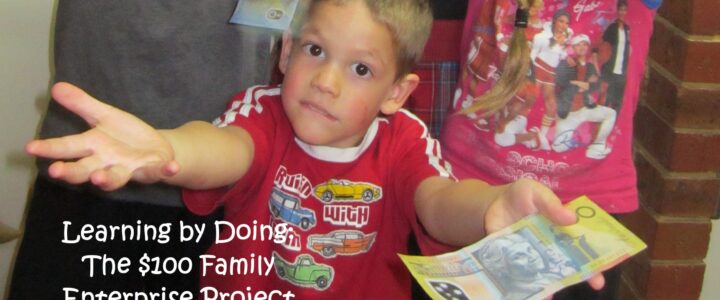
Chayse holding a fifty dollar note for the $100 Family Enterprise Project

Learning by doing is one of the best ways for children to develop enterprise skills. At some point, they need to stop only talking about ideas and begin testing them in the real world.

“`

For our family, that beginning became the $100 Family Enterprise Project. We gave each of the kids start-up capital, asked them to choose an enterprise idea, and decided we would refine the process as we went.

“`

Goal setting for the $100 Family Enterprise Project and learning by doing
Goal setting for Enterprise for Kids.

Learning by Doing: The $100 Family Enterprise Project

For our kids to develop the skills and habits of an entrepreneur, they needed to begin somewhere.

But where?

The beauty of Cathy and I having a wealth creation mentor at our disposal was that we could take the invaluable information we had been learning and apply it in small pieces to developing the mindset of our kids.

This process also involved us having a good, hard look at how we operate in our own lives in regards to planning, organising and taking action.

Cathy loves to plan things out in her head and on paper before starting a task. Once satisfied, she will start when all structures are in place.

I, on the other hand, like to dive in and see where it leads.

So a happy compromise was met.

We decided that the kids just needed to come up with an enterprise idea and get started. We could refine the process later.

Learning by Doing Instead of Waiting for Perfect Conditions

Getting the kids to kick off with an enterprise project, when they had little idea where to even start, was easier said than done.

But I knew that one of the things that had held us back over the years was waiting until all conditions were right.

Waiting had seen us miss many great opportunities that were out there.

So we just started.

Admittedly, it was a bit like the blind leading the blind, but we went in with an open mind and decided to see what would happen and where it would lead.

That is the heart of learning by doing. You do not need to know every step before you begin. You need enough of a plan to start, and then the courage to learn from what happens next.

Chayse and Kit drawing their goals as part of learning by doing
Chayse and Kit drawing their goals.

The First Step in Our Kids Enterprise Project

Check out our very first videos.

The filming is pretty rough, as we had our 15-year-old daughter using her creative licence while filming, but you’ll get the gist of what our project is all about if you watch them.

For those of you who would prefer to read, I’ll give you the rundown.

I presented each of the kids with $100 each, except the baby… as all she would do is try and eat it!

Kids receiving start-up capital for learning by doing through enterprise
The $100 Family Enterprise Project begins.
Kids catching fifty dollar notes as part of the $100 Family Enterprise Project
Raining $50 notes.
Children receiving start-up money for learning by doing through enterprise projects
And more start-up money for the family enterprise project.

“Wow!” was their first response.

An early Christmas present!

“Ohhhh,” was the next response. They were more sedate now that there seemed to be a catch.

But they listened to my proposal.

$100 Start-Up Capital for Kids

The kids were to use the money as start-up capital for an enterprise.

Much to their disappointment, they were not to spend it on themselves.

In fact, they were to pay me back once they had attained their business goal.

I was a bit soft on them though.

I also said that I would take the risk. If they were unsuccessful and were not able to pay back the $100, then I would accept that and absorb the loss.

I did this because I wanted them to give their enterprise a go.

I was conscious that if they were too hung up about having to pay me back, then they might worry about their loss and, as a consequence, not find the courage to even start to play the game.

Loaning the $100 was the first step in our elaborate plan to give our kids a shot at being entrepreneurial with their kids enterprise project.

Why Learning by Doing Matters for Kids

Giving the children $100 did not magically make them entrepreneurs.

What it did was make the project real.

Suddenly they had money in their hands, a challenge in front of them and a reason to think differently.

They needed to ask:

  • What could I do with this money?
  • What could I buy, make or sell?
  • Who might want what I offer?
  • How could I pay the money back?
  • What would make the project worthwhile?
  • What would I learn if it did not work?

These are real business questions.

The Australian Government’s MoneySmart guide to teaching kids about money is a useful reminder that parents can start early and make money part of everyday life.

For us, the $100 Family Enterprise Project became exactly that — an everyday, real-world way to teach money, initiative, risk, responsibility and action.

From Goal Setting to Enterprise Action

This article sits at the beginning of our early Enterprise for Kids journey.

First, the children needed goals they cared about.

Then they needed a reason to act.

Then they needed the courage to try.

The goal-setting process helped them imagine what they wanted. The $100 start-up money helped them move into action.

That is why learning by doing became such an important part of the family project.

Follow the $100 Family Enterprise Project

Follow the early Enterprise for Kids journey: This article shows how the $100 Family Enterprise Project began. The next posts show how the children set goals, chose ideas and started learning through real enterprise projects.

The Biggest Lesson: Just Start

Check out our next blog for the subsequent steps in our entrepreneurial quest.

At this stage, we did not know exactly where it would all lead.

But that was the point.

The children were going to learn by doing.

And so were we.

Key Takeaway: Learning by Doing Builds Enterprise Skills

Key takeaway: learning by doing helped our kids begin their first enterprise projects. The $100 Family Enterprise Project gave them start-up capital, a real challenge, and the chance to develop money skills, confidence and entrepreneurial thinking through action.

Where to Next?

What could your child learn by doing if they were given a small enterprise challenge?