Entrepreneurial Kids: How to Teach Purpose and Success

Natalie Cook diving for the ball at the Sydney Olympics beach volleyball final

Entrepreneurial kids need more than a good idea or a burst of enthusiasm — they need a strong sense of purpose that helps them keep going when the path becomes difficult.

This lesson became very clear to me after hearing Olympic gold medallist Natalie Cook speak in Perth. Natalie is a five-time Olympian and one of Australia’s most inspiring beach volleyball champions. Her message about success, purpose and the mindset of high achievers was powerful not only for athletes, but also for parents raising entrepreneurial kids.

Natalie Cook gold medallist sharing lessons for entrepreneurial kids
Natalie Cook, Olympic gold medallist, shared powerful lessons about purpose and success.

Why Entrepreneurial Kids Need a Strong Purpose

Natalie Cook is a wonderful example of the connection between sport, business and personal success. She won Olympic gold with Kerri Pottharst at the Sydney 2000 Olympic Games and went on to become a respected speaker, leader and businesswoman. You can read more about her Olympic journey on the Australian Olympic Committee’s Natalie Cook profile.

When Natalie spoke in Perth, she explained that professional athletes and successful business owners have many things in common. Both need discipline, courage, focus and the ability to keep moving towards a goal, even when the obstacles are real.

Her message was captivating, humorous and very useful for cultivating a mindset for success in entrepreneurial kids — and, just as importantly, in their adult counterparts.

Natalie Cook’s Five Ps for Success

Natalie built her talk around what she called the Five Ps. These were principles that could apply to children, athletes, families and business owners alike.

Over a series of posts, I wanted to share these Five Ps and connect them to the way we raise enterprising, confident and purpose-driven children. I will also be adding one extra “P” of my own at the end. After hearing Natalie’s five, I wonder if you can guess what mine might be.

For this first part, we begin with one of the most important foundations of all.

Entrepreneurial Kids and the Power of Purpose

A person who truly reaches for success has a mindset that carries with it a very strong “Why,” or purpose.

Your “Why” must be stronger than your “Why not?”

If it is not, you may not have enough purpose to muster up the will to make your goals happen when barriers appear. A strong purpose gives children something deeper to hold onto. It turns a vague wish into a reason to keep trying.

Your “Why” has to be specific and close to the heart. It does not need to be complicated.

A friend of mine is driven to succeed because she desperately wants her mum to be happy and not have to work anymore. Another wants to buy a villa in Tuscany so that she can reconnect with her Italian family roots and create a sense of belonging.

These “Whys” are very different from saying, “Why not?” They are clear purposes, not poor explanations.

Teaching Purpose to Kids Through Real Conversations

Your “Why” will often come from one of two emotions: pain or pleasure. Usually, pain is the stronger of the two.

Think about the rags-to-riches stories we often hear about well-known success mentors and creators such as JK Rowling, Colonel Sanders, Sylvester Stallone, Walt Disney, Steve Jobs, Susan Boyle and Richard Branson. Their difficult experiences helped shape a strong “Why,” and that purpose became part of what carried them forward.

For entrepreneurial kids, this does not mean they need to experience hardship before they can succeed. It means they need to understand what matters to them. They need to begin asking deeper questions about contribution, growth, family, freedom, creativity and the kind of life they want to build.

Cathy and Trevor with Natalie Cook after a talk about purpose and success
Amy, Cathy, Natalie, Tracey, Kym and Trevor after Natalie Cook’s inspiring talk.

I recently carried out a “Why” exercise with my son, Jai.

We had just returned from a career pathway meeting for his upcoming senior class. Every pathway the school presented seemed to end in landing a j-o-b — just-over-broke. Whether the route was through university, technical school or straight into the average 40-year career, the end result sounded much the same.

There was nothing for an enterprising teen to really grab hold of.

Worse still, because the students were nearing the end of high school, the pressure was on to make a choice. It felt like a limited choice, based on hastily presented ideas rather than a deeply considered purpose.

The result was confusion. Jai seemed torn between going to university with his mates because it sounded like fun, or leaving school with his cousin and going to make money in the mines.

This inconsistency told me that Jai’s “Whys” for both of these career paths were too vague.

Purpose quote for entrepreneurial kids learning their why

Questions That Help Entrepreneurial Kids Find Their Why

So, we got to work.

We discussed why these two ideas sounded interesting to him. We talked about the difference between a strong “Why” and a casual “Why not?” We also explored why “Why not?” is unlikely to carry a person through the hard parts of either choice.

Then I asked Jai to ponder three questions:

  1. How do you want to contribute to this world?
  2. How do you want to grow as a person?
  3. How do you want to be remembered when you pass?

These are big questions for a teenager. In fact, they are big questions for adults too.

But they matter.

If we want to raise entrepreneurial kids who can think for themselves, create opportunities and build meaningful lives, we need to help them move beyond surface-level choices. We need to help them understand what drives them.

Purpose Comes Before the Plan

Many children are asked what job they want before they are asked what kind of life they want.

They are asked what subjects they will choose before they are asked what they care about.

They are asked which pathway they will follow before they have had time to discover the purpose behind the pathway.

This is why purpose matters so much. A plan without purpose can become a list of tasks. Purpose gives the plan energy, direction and meaning.

For entrepreneurial kids, purpose is not just about making money. It is about knowing why they want to create, serve, solve, build, lead or contribute in the first place.

Next, we continue the journey in Part 2: People and Passion, where we explore how the right people and passions can help shape entrepreneurial kids and enterprising teens.

Natalie Cook’s Five Ps Series

This article is Part 1 in our series on Natalie Cook’s Five Ps for helping entrepreneurial kids and enterprising teens develop purpose, people, passion, perseverance, planning and a mindset for success.

Where to Next?

We are always looking for feedback on our entrepreneurial kids articles. What is your “Why”? Leave a comment and share the purpose that keeps you moving forward.

Enterprising Teens: People, Passion and Success

Jai thinking about people and passion as an enterprising teen

Enterprising teens need more than a career pathway or a good business idea — they need the right people around them and a passion strong enough to keep them moving forward.

After my son Jai and I discussed the first of Natalie Cook’s Five Ps, Purpose, I asked him to make a timeline of his life. I wanted him to focus on his surroundings, but more importantly, on the people who would be with him.

Jai thinking about the people and passions that support enterprising teens
Jai thinking about the people and passions that could help shape his enterprising teen journey.

Why Enterprising Teens Need the Right People

Natalie Cook’s second P is People.

Attracting the right people in life is key to building a successful young entrepreneur. But whether Jai chose to be an enterprising teen or follow a different path, what mattered most to me was his mindset for success in whatever direction he chose.

So, I asked him to imagine where he would like to be sitting five years from now — and with whom.

Then ten years from now.

Then forty years from now.

I asked him to picture what was around him, who his associates were, and what made those people so valuable to him that their presence would still be visible in his future decades later.

People quote for enterprising teens learning about success

What Natalie Cook Taught About People and Success

Natalie Cook’s career is a powerful example of what the right people, passion and support can help create. Her official Olympic profile describes her as a five-time Olympian and Olympic gold and bronze medallist in beach volleyball, making her a strong real-world role model for enterprising teens. Read more about Natalie Cook’s Olympic journey here.

Natalie discussed the value of surrounding herself with the right people while training to become an Olympic gold medallist. Around her were coaches, mindset mentors, professionals and peers whose encouragement lifted her up rather than criticism that tore her down.

This is a powerful lesson for enterprising teens.

The people around our children influence how they think, what they believe is possible, and the standards they quietly begin to accept for themselves. Friends, mentors, coaches, teachers, family members and business role models can all shape a child’s confidence and direction.

As parents, we cannot choose every influence our children will meet. But we can help them become more conscious of the people they allow close to them.

Helping Enterprising Teens Choose Positive Influences

It is important for enterprising teens to spend time with the sort of people they would like to learn from, grow with and, in some ways, emulate.

This goes beyond simple peer pressure. Children and teenagers absorb attitudes, habits, language, confidence and expectations from the people around them. If they are constantly surrounded by people who complain, criticise or limit possibility, that can become their normal.

But if they are surrounded by people who encourage, create, question, build, serve and keep learning, that can also become their normal.

This does not mean they need to abandon old friends or judge others harshly. It simply means they can learn to ask better questions:

  • Who encourages me to become better?
  • Who helps me believe more is possible?
  • Who lives with values I respect?
  • Who makes me feel more confident, creative and capable?
  • Who would I love to learn from?

These are not just business questions. They are life questions.

Enterprising Teens Learn Success by Helping People

One of the things I love about business and enterprise is that, at its heart, it is about people.

It does not matter whether the enterprise is large or small. It could be a child’s first market stall, a family business, a service project, a creative idea, or a future company. When young people learn to be genuinely helpful to others, their chances of success increase.

Helping people gives enterprising teens and adults an energy that attracts the right people into their lives. It teaches them that business is not only about making money. It is also about solving problems, creating value and building relationships.

This is a lesson children can begin learning very early.

Why Passion Matters for Enterprising Teens

Natalie Cook’s third P is Passion.

People are naturally attracted to those who have passion for what they do. Passion gives energy to an idea. It helps a young person keep going when the excitement wears off and the work begins.

Natalie has spoken about the importance of loving the process, not just the outcome. That is a valuable message for enterprising teens, because the process is where most of the growth happens.

Success is not only found in the final result. It is found in the practice, the learning, the mistakes, the conversations, the courage and the small daily decisions that eventually become a life.

Passion quote for enterprising teens developing a mindset for success

Jai wanted something he could stick with for the long term.

Having him visualise himself, his surroundings and his companions far into the future helped him reach a place that felt more connected to his own passion. It was something apart from what others were expecting of him. It was a desire that felt less likely to fade with time.

His spirit was guiding him, rather than the social conditioning of school, friends and family.

People and Passion Come Before the Pathway

This is one of the problems I see with the way many teenagers are asked to make career decisions.

They are often asked to choose a pathway before they have deeply considered the people they want around them, the kind of contribution they want to make, and the passions that might sustain them over time.

For enterprising teens, this matters.

A pathway without people can feel lonely.

A pathway without passion can become heavy.

But when a young person begins to understand who inspires them, who strengthens them, and what lights them up from the inside, their decisions become clearer.

That does not mean every choice becomes easy. It means the choices begin to come from a deeper place.

Natalie Cook’s Five Ps Series

This article is Part 2 in our series on Natalie Cook’s Five Ps for helping entrepreneurial kids and enterprising teens develop purpose, people, passion, perseverance, planning and a mindset for success.

Where to Next?

If you could enlist three people in the world to personally be your friend and mentor, who would they be? Mine would be Richard Branson, Robert Kiyosaki and Michael Clouse. Leave us a comment and share who would be on your list.

Business Ideas for Young Entrepreneurs: Burekup Fair Success

Chayse making a sale at the Burekup Fair as one of the business ideas for young entrepreneurs

Business ideas for young entrepreneurs come alive when children have the chance to prepare products, talk to customers, handle money and experience the excitement of making real sales.

The day of the Burekup Country Fair started with a mad rush. Seven enterprising kids needed to be ready and set up down at the Burekup Country Club grounds by 8.30am. It required four trips with a trailer carrying tables, pram, signs, eskies, TV, banners and all the products we planned on selling.

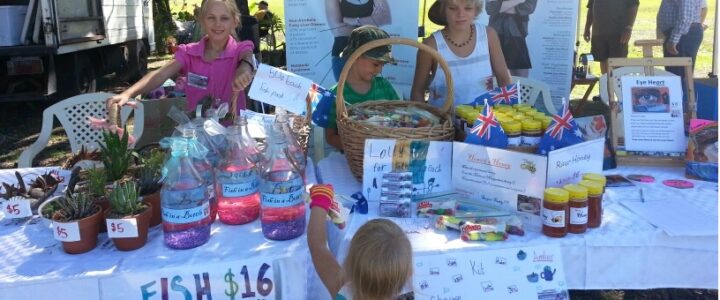
Amber and Flynn with Fish in a Bottle showing business ideas for young entrepreneurs
Amber and Flynn with their Fish in a Bottle idea.

Business Ideas for Young Entrepreneurs at the Burekup Fair

On arriving at the Burekup Fair, we discovered that someone else had set up in our designated spot. We milled around waiting until the problem was sorted, and once a new space was allocated, we busied ourselves with setting up.

A very strong easterly wind challenged us with erecting banners and keeping tablecloths on the tables. It was obviously going to be a hot day. Thankfully, the red gum trees overhead would keep us in shade all day.

Bargain hunters were quick to do the rounds of the stalls well before we were ready. While we were still trying to set things up, people were already asking questions and making purchases. We will have to be better prepared for this next time round!

Amber with succulents as one of the kids business ideas at Burekup Fair
Amber and her succulents.
Enterprising kids making a sale at the Burekup Fair
…and making a sale.

The kids’ anticipation and the joyful growing crowd created an air of excitement. It was a real country fair without all the commercial jazz that you see at many fairs today.

Visitors and locals first joined in with the Australia Day barbecue breakfast. Following the brekky, the crowd moved on to all the stalls and activities. There were old machinery displays, a free bouncy castle and water slide, a dunk tank, fairy floss, pat-the-animals, thong-throwing contests, face painting, and people selling their wares — from homemade fudge, plants and toys to live pigs, chickens and crafts.

Other enterprising kids were also selling their toys, bikes, clothes and things they had made. It was the perfect place to see business ideas for young entrepreneurs being tested in a real community setting.

Setting Up Business Ideas for Young Entrepreneurs at a Kids Market Stall

A market stall is a wonderful way for children to test their ideas in the real world. It gives them the chance to see whether people are interested, practise talking to customers, learn how to display products, and understand that business is about far more than simply having something to sell.

The Australian Government’s business.gov.au page on market stalls explains that a market stall is a temporary structure used to sell products or services, and that stallholders may need to think about registrations, permits, food safety, insurance and other requirements. Read more about setting up a market stall here.

For children, the lesson can start simply:

  • What are we selling?
  • Who might want to buy it?
  • How should we display it?
  • What price should we charge?
  • How do we speak confidently to customers?
  • How do we count money and work out profit?
Kids market stall set up with business ideas for young entrepreneurs at the Burekup Country Fair
All set ready for the customers!

Novelty Products and Business Ideas for Young Entrepreneurs

Having a novelty product is one of the keys to drawing interest, and we had the perfect product.

Flynn and Amber’s “Fish in a Bottle” were an absolute hit. Kids came from everywhere dragging their parents over to look at the fish. Once at our stall, we were able to show them our other items too.

This was a powerful business lesson. Sometimes one unusual product can bring people closer, start conversations and help customers notice the rest of what is on offer.

Fish in a Bottle products waiting to be sold at a kids market stall
Products waiting to be sold.

Learning to Ask for the Sale

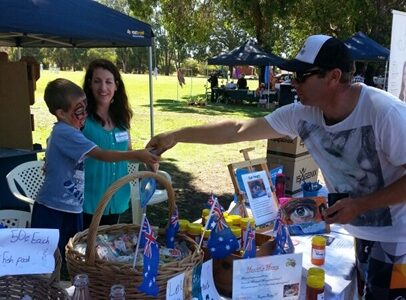
Chayse soon got the hang of it. Whenever a customer wandered past, he would hold up a lolly bag and ask if they would like to buy one.

Many people bought lollies from him simply because he had asked. How can you refuse a little five-year-old?

There was another little boy walking around selling his mum’s homemade fudge. He was not shy in coming forward and asking customers if they would like to make a purchase. Talking to his dad later in the day, he said that his son had sold more fudge walking around than they had sold at their stall.

I guess there is a lesson in that.

For young entrepreneurs, learning to politely ask is powerful. It builds confidence, communication skills and resilience. It also teaches children that customers often need a friendly invitation before they buy.

Customers, Money and Confidence

It was not long before we had customers coming in their droves. Talking with customers, handling money and recording on a pad what was sold all kept the kids on their toes.

Taking turns to man the stall allowed each of us time to catch up with friends and also spend some of the takings at the fair.

Kaitlin's Eye heART display as a creative business idea for young entrepreneurs
Kaitlin’s EYE heART on display.
Customers admiring Kaitlin's artwork at the Burekup Fair
…customers admiring her work!

Our enterprising kids were very happy with their results. Each was able to sell products and make a profit.

Flynn’s Howitt’s Honey was very popular and sold very well. Kit and Chayse sold about half their lolly bags and, due to the hot day, Jai’s icy-poles also sold well. Jai made a profitable sale with his exercise equipment. Amber sold succulents. Kaitlin received commissions for her Eye heART artwork. And, of course, the Fish in a Bottle sold well.

Making Sales Turns Business Ideas for Young Entrepreneurs Into Real Learning

This is where business ideas for young entrepreneurs become real learning.

It is one thing to imagine a business. It is another thing entirely to prepare the product, take it to a fair, display it, speak to customers, handle money, record sales, pay back costs and work out profit.

Those are real lessons.

Jai manning the stall with his exercise equipment at the Burekup Fair
Jai manning the stall with his exercise equipment.
Flynn selling unpasteurised honey as a young entrepreneur
Flynn selling his unpasteurised honey.

Cath and I also had a terrific result with our own stall. This was the first time we had put ourselves out there with our new business in the local community, and it allowed us to develop our own self-efficacy too. We spoke with many interesting people and learned a lot about their lives and interests.

By the end of the day, we were exhausted.

Celebrating Success Builds Self-Efficacy

It was important to celebrate our success because this is vital in fostering self-efficacy around being entrepreneurial kids.

The kids counted the takings and divided the money up. They then paid any debts so they could work out their profits. Each received congratulations and a hug for being successful enterprising kids.

Akaisha enjoying one of Jai's icy poles at the Burekup Fair
Akaisha enjoying one of Jai’s icy-poles, mittens and all!
Cathy speaking with a customer at the Burekup Country Fair
Cathy explaining the health benefits of her product.

Many great lessons around financial education were learned on this day.

It is our hope that our kids continue to develop self-efficacy around being entrepreneurial, as we believe this will give them greater opportunities when they become adults.

Cathy talking with an interested customer at the Burekup Fair
Cathy talking with an interested customer.
Kit and Chayse selling lolly bags as a kids business idea Kit and Chayse selling lolly bags.

Finally, we would like to thank the Burekup Country Club, and in particular Sally and Jason Barnden and their team, for coordinating the fair.

Just as an added note, the day after the fair, five more Fish in a Bottle sold!

Where to Next?

Have your children ever tried a market stall, fair stall or small business idea? We would love to hear what they sold and what they learned along the way.

Marketing Lesson for Kids: Burekup Country Club Heats Up

Amber Flynn and Kit running a stall at the Burekup Country Fair as a marketing lesson for kids

Marketing lesson for kids sounds like something that belongs in a classroom, but for our family it came alive through fire, publicity, product preparation and the Burekup Australia Day Fair.

Last week there was both fear and excitement in the small township of Burekup. The Burekup Country Club had been on fire, and for a moment it looked as though the Burekup Australia Day Fair might even be cancelled. Thankfully, the fire crew put the fire out before it caused too much damage or anyone was hurt.

What followed became a very real lesson in marketing, attention and opportunity for our enterprising kids.

Amber showing her product during a marketing lesson for kids at the Burekup Country Fair
Amber showing one of her products ready for the Burekup Country Fair.

A Marketing Lesson for Kids at the Burekup Country Fair

Once a year for Australia Day, Burekup hosts a fun family fair. Everyone in town usually comes along, together with people from the surrounding areas.

This year, the fair had a little more publicity than normal.

The local Burekup Country Club, which helps organise the event, had a fire that threatened to burn down the old wooden clubhouse and town hall. The newspaper heard about the near disaster and ran a story about the fire that almost sabotaged the Burekup Australia Day Fair.

Burekup Country Club hall before the Australia Day Fair marketing lesson for kids
Burekup Country Club Hall.

The story stimulated fear and interest, which in turn created excellent publicity for the Burekup Fair.

Marketing a product, service or brand can be very challenging, especially if you are not naturally marketing savvy. A very good marketing campaign can sell even an ordinary product, while a very good product may not sell easily unless people know about it, understand it and feel interested enough to buy it.

That is why this became such a useful marketing lesson for kids. Our children were not just making products. They were preparing to put those products in front of real people.

What Our Kids Learned About Marketing Their Products

Our enterprising kids have all been challenged with marketing their products and brands. Cathy and I have also been challenged with marketing when promoting events or selling our own products.

The Howitt family booked two stalls for the Burekup Australia Day Fair. One stall was for our enterprising kids to display and sell their products. The other was for Cathy and me to share information about our home business, as well as promote the Enterprise for Kids brand and blog.

Putting ourselves out there in our small community for the first time was a little confronting. Some people knew what we had been up to, but for many it was going to be a surprise.

Despite the challenge, we saw this as a chance to practise in readiness for bigger and better things to come.

Kids Business Ideas Prepared for the Burekup Fair

The fair gave each child a real opportunity to prepare, promote and sell something of their own. That is where a simple family event becomes powerful real-world learning.

Flynn had been preparing his raw, unprocessed honey under his brand, Howitt’s Honey. He had a fresh batch ready to sell, and he had also bought a good set of golf clubs for a very good price, which he intended to resell at the fair.

Flynn showing honey pots for his kids business idea at the Burekup Fair
Flynn showing his honey pots.
Honey jars bottled and ready for labels before the Burekup Country Fair
All bottled awaiting labels!

Kit and Chayse were preparing their lolly bag business. They bought, sorted and bagged lollies to sell. Chayse also had a small fish tank to sell, along with colourful guppies he had bred.

Kit and Chayse sorting lollies for a kids business idea at the Burekup Fair
Kit and Chayse sorting lollies.
Lolly bags ready to sell as part of a kids market stall
Lolly bags all set to be sold!

Amber’s Products and a Creative Marketing Lesson for Kids

Amber had been busy all year collecting succulents from people’s gardens. She artistically potted these up into all kinds of unusual pots, including large seashells, kettles and ceramic plant pots.

Amber watering succulents for her kids business idea at the Burekup Country Fair
Amber watering her succulents ready to be sold.

She and Flynn also planned to sell aquarium fish they had bred. They salvaged and cleaned large glass wine flagons, which made terrific fish bowls. They decided to market this product under the brand name “Fish in a Bottle”.

Fish in a Bottle product prepared for a marketing lesson for kids
Fish in a Bottle.
Fish in a Bottle product showing how kids can create unusual market stall ideas
Can you see the fish?

Amber also planned to sell selected items from her New from Old business, and she was putting together a Lucky Dip.

Jai and Kaitlin Prepare Their Own Enterprise Ideas

Jai was preparing to promote his “Hire a Teenager” service. He already had clients in Burekup who hired him to do work on their properties, such as mowing and window cleaning.

Jai also prepared a batch of frozen juice ice cups on sticks. He came up with some creative ideas to add value to his product. He was also considering promoting “Rent Exercise Equipment”, although this business idea was still in its infancy and may not have been quite ready to run.

Lastly, Kaitlin was preparing to promote her new brand, “Eye heART”. Akaisha was still a little young to have an enterprise of her own, but Kaitlin was ready to share her creative skills.

Being the creative one in the family, Kaitlin planned to sell her skills by painting the eye of clients from a photograph. Around the eye, she would also paint three things dear to them.

Jai showing icy poles prepared for the Burekup Country Fair market stall
Jai showing his icy poles.
Kaitlin's Eye heART creative business idea for kids
Kaitlin’s Eye heART.

This opportunity for us all to market our brands, services and products helped the Howitt clan develop self-efficacy around being entrepreneurial.

What Children Can Learn From a Real Marketing Plan

A good marketing lesson for kids does not need to be complicated. Children can begin by learning that marketing is about understanding who might want your product, why they might want it, and how you can show them its value.

The Australian Government’s business.gov.au marketing planning guidance explains that a marketing plan can help define a target market, choose messages and channels, set goals and evaluate whether marketing activities were successful. That is exactly the kind of thinking children can begin to practise with a simple market stall. Read more about developing a marketing plan here.

For our kids, the Burekup Fair raised practical questions:

  • Who would want to buy this product?
  • How should we display it?
  • What makes it interesting or different?
  • How much should we charge?
  • What story does the product tell?
  • How can we speak confidently to customers?

These questions are useful for any young entrepreneur.

Marketing, Emotion and Real-World Learning

Our mentor, Paul Counsel, had plenty to say about marketing. One of the ideas he shared was that people often respond to emotion before they respond to logic.

In simple terms, customers usually want to move away from a problem and toward a better result. A product, service or experience becomes more interesting when people can clearly see the difference it might make.

For children, this can be taught in a practical and age-appropriate way.

If they are selling honey, they can show that it is fresh, local and real.

If they are selling lolly bags, they can make them colourful, tidy and fun.

If they are selling succulents, they can show how each one has been creatively potted and cared for.

If they are selling a service, they can explain clearly how they can help someone.

This is where marketing becomes much more than advertising. It becomes communication.

A Fire, a Fair and a Marketing Lesson for Kids

Pain Island to Pleasure Island drawing used in a marketing lesson for kids
Just need the right ship to get them there!

Luckily, the fire did not burn down the club or spoil the Burekup Australia Day Fair.

But it certainly woke people up.

The fear that the fair might be cancelled created attention. The newspaper story created discussion. The near disaster gave people another reason to talk about the event. In an unexpected way, it became publicity.

That is not something anyone would wish for, of course. But it did show our kids something important: people pay attention when a story matters to them.

For our family, the fair became more than a day out. It became a real-world lesson in product preparation, branding, confidence, customer communication and marketing.

In our next blog, we will share photos and experiences from the Burekup Australia Day Fair.

Where to Next?

We would love to hear from our readers. What marketing lesson for kids have you seen through a school fair, market stall or family business idea? Share your thoughts in the comment box below.

Business Ideas for 6 Year Olds That Build Self Efficacy

Young children confidently performing together, representing self efficacy and business ideas for 6 year olds

Business ideas for 6 year olds can be simple, practical and incredibly powerful when they help children build self efficacy, confidence and generosity.

This family enterprise story follows Kit and little Chayse as they teamed up to grow their lolly bag business, give to a meaningful cause, and slowly become more confident young entrepreneurs. It also links strongly with our Candyman series, where Chayse first began learning how to make money through enterprise.

Two young entrepreneurs showing how business ideas for 6 year olds can build self efficacy
Two young entrepreneurs learning confidence, generosity and self efficacy through their lolly business.

Business Ideas for 6 Year Olds That Build Self Efficacy

Kit decided to form a partnership with Chayse in his lolly bag Enterprise for Kids business. He could see how well Chayse’s earlier lolly-selling adventures were going, and he realised that this was one of those business ideas for 6 year olds that was simple enough to begin, but rich enough to teach real-life lessons.

Together they visited the local supermarket and spent their capital on buying large bags of confectionery. This time they were very serious and bought around $230 worth of lollies.

Business ideas for 6 year olds shown through Kit and Chayse’s lolly production line
The production line begins.

Once again, the family pitched in around the dining table to sort and bag all the lollies. Before long, Kit and Chayse were ready to head out to the sporting grounds and sell their product. If you would like to see their production line in action, here is the original video link: Kit and Chayse’s production line.

Business Ideas for 6 Year Olds and the Power of Giving

This round of selling was a little different. Our children had already begun learning that enterprise is not only about making money. It is also about giving, gratitude and growing a generous mindset.

Kit and Chayse chose to donate a small portion of their profits to the Royal Flying Doctor Service. This cause felt meaningful to our family because the Flying Doctor had been such a great help to us when Kaitlin was born in the remote Kimberley town of Kalumburu.

Through this small act of giving, the boys were learning that business can be about contribution as well as reward. For children, this is a beautiful way to connect enterprise with compassion and build self efficacy through something bigger than themselves.

Children designing a sign for their lolly business and supporting the Royal Flying Doctor Service
Designing the for-sale sign with RFDS as the beneficiary.
Kids business ideas in action as Kit and Chayse sell lollies at the soccer grounds
All the soccer lads checking out their lollies.

Business Ideas for 6 Year Olds at the Sporting Grounds

The boys did the rounds of the sporting grounds and sold box after box of lollies. They were magnetic — attracting people from all over the place, a bit like a Mr Whippy van at a summer event.

At first, they needed some prompting to approach groups, speak clearly and say thank you. But after a while their confidence began to grow. They became more comfortable speaking with customers, answering questions and explaining that the lolly business was their own, and that some of the money was being donated to the Flying Doctor.

People were more than happy to support them. Some even bought lollies just to stop and chat with the boys. This is why small, supported business ideas for 6 year olds can create such strong learning moments.

Family enterprise story at the soccer fields where the boys sold their lolly bags
Watching Jai in action at the soccer fields.
Self efficacy for kids grows as the boys sell their wares confidently
…whilst the boys sold their wares.

How This Business Idea Built Self Efficacy

One later trip to the sporting fields gave me a big surprise. I suddenly noticed that the box of lollies had disappeared from under my feet and Chayse was nowhere to be seen. I looked around in alarm and spotted some commotion about fifty metres away. There was young Chayse, surrounded by a crowd of people buying his lollies.

I was very proud of the little fella. Through many weeks of shyly putting himself out there with customers, he had gradually built the confidence to go it alone. That was a real sign that he was developing self efficacy.

Self efficacy for kids grows through repeated real-world success
Self efficacy grows when children repeatedly stretch beyond their comfort zone.

If he keeps this up, he will be an awesome young entrepreneur when he grows up.

Cathy and I have been learning the importance of self efficacy in our own lives as well, especially through the teachings of Paul Counsel in our Money Mastery course. He explains that it is very difficult to simply switch and suddenly become an entrepreneur. Instead, we build up to it by stretching our upper limit again and again.

That means doing things that take us beyond our comfort zone, celebrating the success, and then doing it again. Eventually, we become comfortable with being uncomfortable. That, in turn, opens up new possibilities and attracts new opportunities. This is exactly what was happening with Chayse — and in truth, with all of us.

Building self efficacy in children through enterprise and confidence-building experiences
Confidence builds when children try, succeed and repeat.

Business Ideas for 6 Year Olds Can Build Real Confidence

Kit demonstrated his growing confidence only a few days later. He asked if he could take his lolly business down to the local skate park all by himself. We agreed, and Flynn quietly followed at a distance just to make sure everything was alright.

Kit sold a bunch of lolly bags and came back with a big grin, announcing, “A Granny gave me a big cuddle and kiss!” When we asked him what he meant, he explained that she was so happy to see him doing his business that she bought some lollies and then gave him a cuddle.

Moments like this are so powerful. A child does not just remember the sale. They remember the encouragement, the positive response and the feeling that they can do something brave and meaningful in the world. This is the real strength of business ideas for 6 year olds when parents provide safe support and encouragement.

Developing self efficacy through enterprise for young children
Self Efficacy!

Young Entrepreneurs Sharing Their Rewards

Another beautiful part of this family enterprise story was seeing the boys share some of their rewards and give back through the RFDS. Enterprise was not just helping them make money. It was helping them build character.

Young entrepreneurs sharing their rewards and giving back through their business
…share their rewards.

We believe our enterprising children are experiencing mindset shifts that are helping them think more and more like entrepreneurs. It all takes practice, confidence and repetition. And at the heart of it is self efficacy — the growing belief that, “I can do this.”

Candyman Series Links

This post links strongly with our Candyman series. Kit and Chayse’s lolly bag partnership grew from Chayse’s original Candy Man enterprise and shows how one small business idea can build money skills, confidence and self efficacy.

Key Takeaway: Business Ideas for 6 Year Olds Can Start Small

Key takeaway: One of the best business ideas for 6 year olds is a simple, supported enterprise that gives children the chance to practise courage, communication, generosity and persistence. That is how self efficacy grows.

Where to Next?

Have you seen a child’s confidence grow when they sell, create or contribute something of their own? We would love to hear your story in the comments.

Entrepreneurship for Students: How Do Entrepreneurs Think?

Jai Howitt discussing his entrepreneurial journey on The Pocket with Chris Griffen

Entrepreneurship for students is not just about starting a business. It is about learning how to think differently, spot opportunities, solve problems, take action and build confidence in the real world.

When children learn how entrepreneurs think, they begin to see that their ideas matter. They also begin to understand that money, work, creativity and contribution can be approached in a very different way.

Entrepreneurship for students shown through Jai Howitt coaching Chayse on business strategy
Jai coaching Chayse through business strategy and entrepreneurial thinking. Watch Jai coach Chayse.

Entrepreneurship for Students: How Do Entrepreneurs Think?

In an earlier article, we spoke of charitable entrepreneurs and successful business thinkers such as Richard Branson, Warren Buffett and John Templeton.

They, together with many other successful people, have extraordinary stories to tell about their entrepreneurial journeys. Some will tell you they struggled at school, dropped out, were dyslexic, or found reading and writing difficult. Others came from homes of poverty, while some were born into families where business and enterprise were already part of everyday life.

Although their backgrounds and circumstances differed, one thing often remained the same: they thought in a similar way.

It is not circumstance alone that creates an entrepreneur. It is mindset.

That is why entrepreneurship for students matters. Young people need more than information. They need the chance to develop the kind of thinking that helps them create opportunities, make decisions, solve problems and take responsibility for their future.

Why Entrepreneurial Thinking Matters for Families

What we have come to understand is that for our family to become economically and personally free, we need to question our conditioning around money and then reprogram our subconscious minds with a new success money mindset.

Many wealthy and successful people either developed this mindset from their upbringing, or they discovered it for themselves. Sometimes this happened consciously, through study and self-development. At other times, it happened unconsciously through experience, environment and action.

It is often said that only a small percentage of people live with real economic and personal freedom. The bigger question is this: what do they do differently?

More to the point: how do entrepreneurs think?

Before we look deeper into that, consider this.

Entrepreneurship for Students Starts with Money Mindset

Wealth creation and poverty mindset lesson for students
The way children think about money can shape the opportunities they see.

Whether we like it or not, we are being conditioned constantly to think a certain way about money. We are conditioned by our family, schools, advertising, politicians, television, social media and friends.

Many people become tied to jobs and debt because the conditioning they have received favours a money mindset of lack, rather than abundance.

Do any of the following sound familiar?

  • “Money doesn’t grow on trees.”
  • “Money is the root of all evil.”
  • “You’ve got to work hard for your money.”
  • “Get a good, well-paying job and you’ll be set for life.”
  • “Buy a home, it will be your best investment ever.”
  • “We can’t afford it.”
  • “What job do you want to do when you grow up?”
  • “Go for the cheaper ones.”

Only this morning, I was listening to a friend talking with his teenage sons. He told them they needed to get jobs. He explained that he had a job pushing shopping trolleys at their age. He even went down to the local IGA supermarket and picked up applications for them to apply for jobs.

When I was fifteen, I started out with a casual job working at a Target store. My hourly rate was $2.90 an hour.

All of the above are examples of conditioning. Much of our thinking about money, work and possibility is formed very early in life.

What Schools Often Teach About Work and Money

Our schools are largely designed to prepare workers for the workforce. Banks make money by selling debt. Governments collect taxes and often depend on people staying within predictable systems. Retail businesses make money by encouraging us to spend. Big businesses need workers to build their businesses.

There is definitely a design to much of this madness.

That does not mean jobs are bad. It also does not mean every child needs to become a business owner. However, it does mean young people should know there are other pathways.

They should understand that work, money, creativity and contribution can be approached in different ways.

This is why financial education for kids is so important. Children need to learn about money, value, assets, liabilities, work, enterprise and choice before they enter adulthood.

Entrepreneurial Mindset for Young People

What our family has discovered is that our money mindsets are changing. We are learning that it is okay to accept money and to have money. In fact, it is okay to offer something of value to others and receive payment in return.

Working hard in a job is not the only pathway for young people entering our big world.

There are other ways. These pathways can allow young people to follow their passions and dreams while making a meaningful contribution to whatever they consider important.

Wouldn’t it be fantastic if all our kids could achieve economic and personal freedom?

People who have achieved financial freedom through being entrepreneurial tend to have a mindset of abundance. Their habits differ. Their thinking differs. Their actions differ.

This is why we keep coming back to the bigger idea of raising entrepreneurial kids. It is not just about business. It is about helping children become confident, capable, creative and resourceful.

How Entrepreneurs Think: Lessons from Napoleon Hill

Napoleon Hill Think and Grow Rich entrepreneurial mindset lesson
Napoleon Hill studied how successful people think and act.

Rather than attempting to explain every detail of how entrepreneurs think, I will refer to one of the most influential books ever written on personal and financial achievement.

Think and Grow Rich by Napoleon Hill was originally published in 1937. Hill spent his life studying successful people and recording how they think and act. He became successful himself by following the distinctions in his own book and by modelling himself on his mentors.

Think and Grow Rich is essentially a book about what to do and how to do it. It explores ideas such as self-direction, organised planning, autosuggestion, mastermind association, self-analysis and the selling of personal services.

The thirteen steps to riches described in the book offer a philosophy of individual achievement that has influenced thousands of people’s lives.

This book could be worth a great deal to you and your kids, not simply because of the money ideas, but because of the thinking behind them.

At the time of this original article, Cathy was rewriting Napoleon Hill’s book in a way that would be suitable for kids to read, with simple explanations and modern examples they could better relate to. It was a work in progress, built around the idea that children should be able to understand powerful success principles in language that makes sense to them.

You can also learn more about Napoleon Hill’s work through the Napoleon Hill Foundation.

Entrepreneurship for Students in Real Life

For our family, entrepreneurship for students has never been just a theory. It has been something we have tried to encourage through conversations, real-life projects, mentoring and practical action.

Looking back now, we can see how these early conversations about entrepreneurial thinking have carried through into real life. The goal was never just to teach our children about business. It was to help them become confident, resourceful young people who could spot opportunities, solve problems and take action.

Today, we see that continuing as Jai shares business ideas and strategy with his younger brother Chayse, passing on what he has learnt through his own entrepreneurial journey.

Jai has gone on to build his own entrepreneurial path through creative work, content and business. You can see part of that journey through Art of Mondays.

Key Takeaway: Teach Students to Think Like Entrepreneurs

Key takeaway: Entrepreneurship for students is about far more than making money. It is about helping young people think differently, understand value, recognise opportunity, solve problems and take action in the real world.

Where to Next?

If you enjoyed this article about entrepreneurship for students and entrepreneurial thinking, you may also like:

We would love to hear your thoughts. How do you think entrepreneurs think differently, and how can we help children develop that mindset while they are still young?