Limiting beliefs in children can quietly shape the way they learn, take risks, make friends, handle failure and see their own future.
I was reminded of this recently while listening to Stephen Bartlett interview Marisa Peer on The Diary of a CEO. It made me think again about children, confidence, school, enterprise, and the stories young people quietly carry about themselves.
Marisa Peer has spent many years working with people around the subconscious mind, self-worth and the inner stories that shape behaviour. What fascinated me most was not only how this applies to adults, but how powerfully it applies to children, especially children we want to raise with confidence, creativity, resilience and an entrepreneurial mindset.
As a teacher, a parent, and someone who has spent years thinking about what helps children become capable and free-thinking, I found myself listening to that interview and thinking: this matters. This is not just personal development. This is family life. This is school life. This is enterprise education. This is the inner foundation that helps children believe they can have a go.
Important note: This article is a parent and teacher reflection, not medical or therapeutic advice. Hypnosis and clinical therapies should only be used by properly trained professionals with appropriate consent. The toolkit below is deliberately simple, practical and suitable for everyday family or classroom encouragement.
The Three Beliefs Behind Limiting Beliefs in Children
One of the ideas that stayed with me was Marisa Peer’s explanation that many adult struggles are connected to a few deep beliefs formed early in life. In the interview, she described three common inner patterns:
- I am different, so I do not truly belong or connect.
- What I want is not available to me, or in everyday language, I do not deserve it or it is not for people like me.
- I am not enough: not smart enough, good enough, organised enough, attractive enough, capable enough or worthy enough.
Those words are simple, but they are powerful. I have seen versions of them in children. A student who says, “I’m just bad at maths.” A child who avoids trying because they believe others are naturally better. A teenager who studies hard, does the homework, then performs below where they hoped and begins to think, “Maybe I’m not as smart as I thought.”
When we notice limiting beliefs in children, we can begin to help them separate a result from their identity. A disappointing mark, a mistake, a failed attempt or an awkward moment does not have to become a story about who they are.
I have also seen versions of this in myself. In futures day trading, for example, I can be disciplined and successful in practice mode. Yet when real money is involved, and I am in a live room with a professional trader and other traders around me, different behaviours can appear: fear of missing out, impatience, greed, revenge trading, the need to take action, or a lack of trust in the plan.
On the surface, that looks like a trading problem. But underneath, it may also be an identity and belief problem. If something in the subconscious is trying to prove I am not enough, escape discomfort, or force action so I feel in control, then no strategy will work properly until that inner pattern is addressed.
That links strongly with what we have written about before on Enterprise for Kids: success is never only about the external strategy. It is also about the inner story.
In our earlier article Money Mastery: Lessons from Paul Counsel’s Program, we reflected that financial freedom is not only about numbers. It is also about beliefs, choices, habits, values and identity. In Sean Rasmussen… Developing Self Esteem, we explored how self-image shapes behaviour, and how children can begin to act from the story they hold about themselves. And in Entrepreneurship for Students: How Entrepreneurs Think, we wrote about the conditioning young people receive around money, work and what is possible.
How Limiting Beliefs in Children Are Strengthened by Repetition
Another idea from Marisa Peer that struck me was her point that the mind learns by repetition. A belief is often just a thought we have thought over and over until it feels true.

That is a confronting idea, because children repeat thoughts all the time:
- I can’t do this.
- I’m not good at school.
- Everyone else finds this easier than me.
- I always mess things up.
- I am shy.
- I am not a maths person.
- I am not creative.
- People like them succeed. People like me do not.
When a child repeats those thoughts, the thoughts become familiar. Then familiarity starts to feel like truth. From there, the child may act in ways that confirm the belief. They avoid the task, perform nervously, give up early, or stop putting themselves forward. The result then becomes more “proof” that the belief was right.
This is where limiting beliefs in children can become a quiet pattern. The child is not trying to be difficult. They may simply be repeating a story that has started to feel true.
This is why the language we use around children matters so much. It is also why the language children use about themselves matters. If the subconscious mind responds strongly to repetition, then we need to be deliberate about the repeated words, repeated experiences and repeated identities we allow children to practise.
Limiting Beliefs in Children and the “I Am Enough” Message
At the end of the interview, Marisa Peer returned to a very simple phrase: “I am enough.”
I have been saying it often since listening to the podcast. I have also encouraged Akaisha, our fifteen-year-old daughter, to say it as well. She has had some recent assessment disappointments at school, despite doing homework and studying, and that can become a real knock to confidence.
When a child starts to come in below where they hoped, the danger is that the assessment result becomes an identity statement. Instead of “I did not get the result I wanted this time,” the child starts to hear, “I am not good enough.”
That is where “I am enough” is so important. It does not mean “I do not need to try.” It does not mean “I am perfect.” It means:
- I am enough to learn.
- I am enough to try again.
- I am enough even when I get feedback.
- I am enough before the result arrives.
- My worth is not determined by one mark, one trade, one business attempt, one friendship problem, or one mistake.
For me, this phrase is one simple way to soften limiting beliefs in children. It gives them somewhere steadier to stand before they try again.
Children who know they are enough can still aim high. In fact, they are often more able to aim high because they are not paralysed by the fear that failure will prove something terrible about who they are.
Why Limiting Beliefs in Children Matter for Enterprising Kids
Enterprise is not only about starting a business. It is about taking initiative, spotting opportunities, solving problems, serving people, handling money, communicating, recovering from setbacks and creating something useful in the world.
That kind of learning requires confidence. It requires a child to walk up to a customer, try a new idea, ask a question, receive a “no”, count money, make mistakes, adjust the plan and keep going.
We saw this with Kit and Chayse in their lolly business. In Kit and Chayse and a Lesson on Self Efficacy, we wrote about how repeated action helped build confidence. Kit was shy at first, but by putting himself out there over time, he began to develop self-efficacy: the belief that he could take action and influence the result.
That is what we want for children. Not fake confidence. Not empty praise. We want the deep inner belief that says, “I can learn. I can improve. I can solve problems. I can handle discomfort. I am enough to have a go.”
Seeing Limiting Beliefs Shift in Kit’s Journey
Looking at Kit now, I can see how much confidence can grow when a young person is given real responsibility and the chance to step into uncomfortable but meaningful experiences.
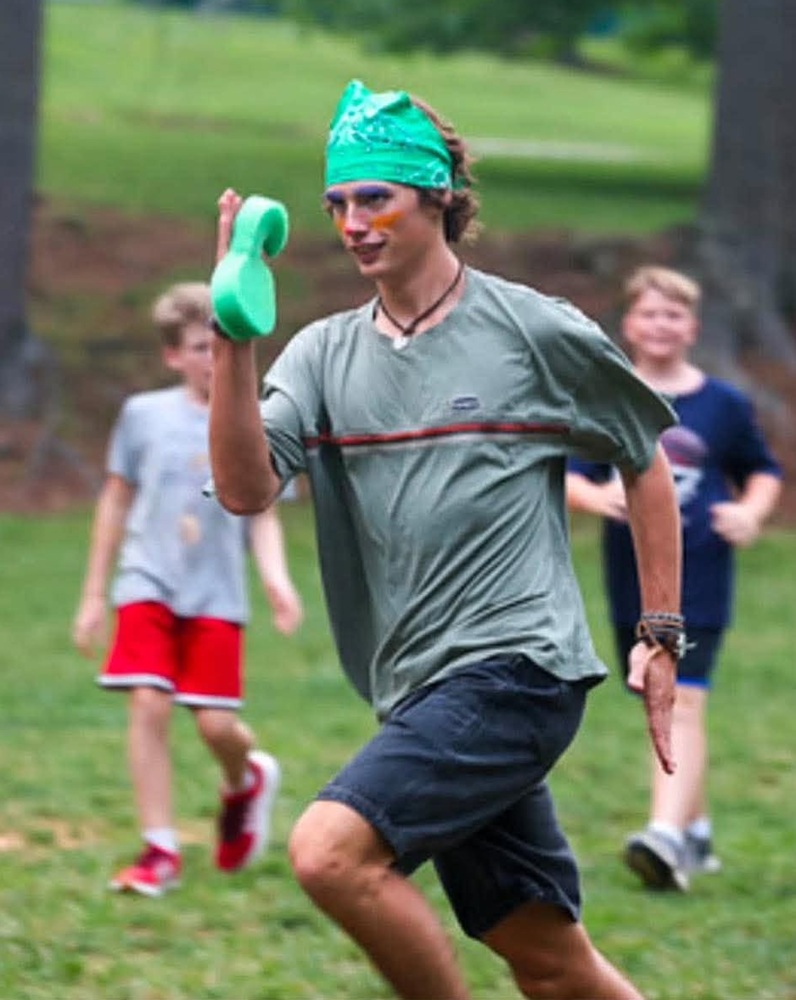
Kit is currently in the USA for the second time working at a summer camp for three to four months. He has been placed in a leadership role, responsible for a large group of children and teenagers. He has also been involved in trekking camps into the wilderness, helping facilitate a leadership program for 16 and 17 year olds through a range of practical activities and challenges.
That did not appear out of nowhere. Before these summer camp roles, Kit completed outdoor education courses, worked as an intern at Margaret River Senior High School, and facilitated school groups through camp activities with Dare Adventures in Dwellingup.
Kit loves travel, people and new experiences. He also loves helping children build confidence and step into leadership. To me, that is a beautiful example of what can happen when children grow through responsibility, self-belief and repeated chances to have a go.
You can read more of Kit’s earlier Enterprise for Kids journey in Kit’s Stories.
A Simple Toolkit for Limiting Beliefs in Children
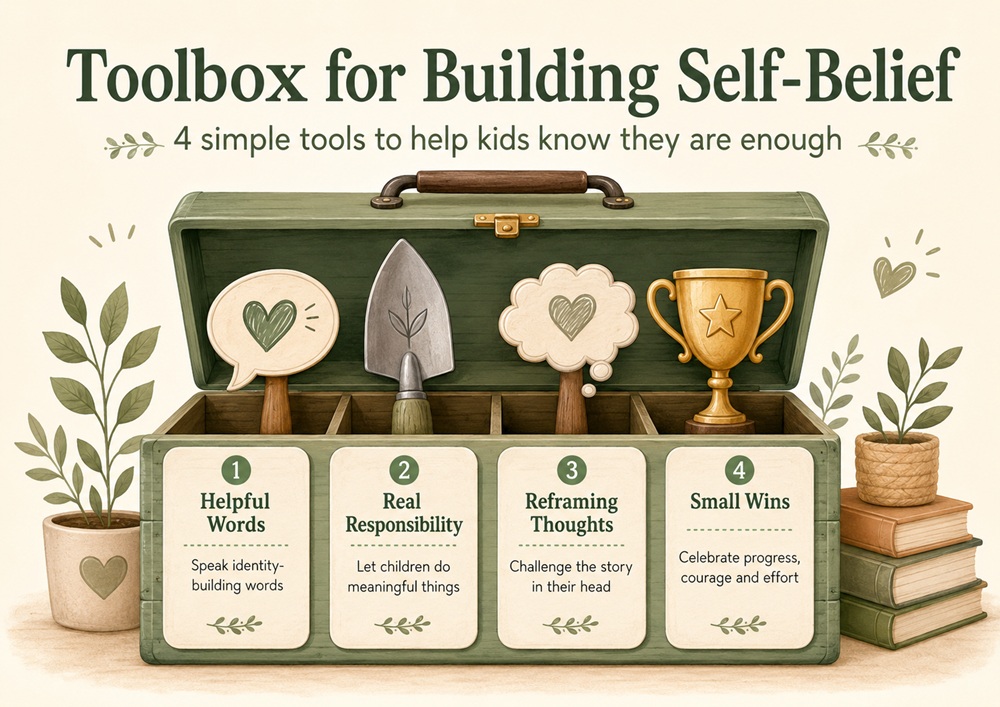
The following toolkit is not therapy. It is a practical set of family and classroom strategies inspired by Marisa Peer’s ideas, our own parenting journey, and the Enterprise for Kids philosophy.
These tools are not about pretending limiting beliefs in children do not exist. They are about helping children notice the old story, question it gently, and practise something more useful.
1. Become a Belief Detective
When a child says something limiting, do not rush too quickly to correct it. First, help them notice it.
You might ask:
- Where did that belief come from?
- Is it definitely true?
- Who told you that?
- Is it true all the time, or only sometimes?
- What would be a more useful belief?
For example, if a child says, “I’m just bad at writing,” we can gently reframe it: “You are learning to organise your ideas. That is different from being bad at writing.”
The aim is to help children separate the event from the identity. A result is feedback. It is not a life sentence.
2. Replace the Old Script With an “I Am Enough” Script
Children need simple words they can repeat until the new belief starts to feel familiar. The phrase “I am enough” is a powerful beginning, but it can be linked to the exact challenge the child is facing.
For assessments:
- I am enough, and I can learn this step by step.
- Everything I have studied is stored in my mind, and I can access it calmly.
- This test is a chance to show what I know, not a threat to who I am.
For enterprise:
- I am enough to speak to a customer.
- I am enough to receive a no and keep going.
- I am enough to solve problems and improve my idea.
For sport or performance:
- I am enough to have a go.
- My body knows what to do because I have practised.
- I can stay calm, focused and ready.
For parents, including myself, the same principle applies. A trader might say, “I am enough without needing to force the next trade. I can wait for my setup. I can follow my plan. Missing one trade does not mean missing my future.”
3. Build an Evidence Bank
The subconscious loves familiar evidence. If a child has practised looking for failure, they will keep finding it. So we can help children practise looking for evidence of capability.
Create an “evidence bank” with your child. This could be a notebook, a jar, a poster, a notes app or a small card on the fridge. Add evidence such as:
- A time they kept trying.
- A time they solved a problem.
- A time they were brave.
- A time they asked for help.
- A time they improved after feedback.
- A time they made a sale, spoke to someone, performed, finished a task or recovered from disappointment.
This connects beautifully with our earlier writing about self-image. Children need to dwell on successes, not only mistakes. They need repeated proof that they are capable.
4. Rehearse the Identity Before the Event
Before a test, performance, market stall, sports game or difficult conversation, help the child mentally rehearse who they are going to be.
This is not about pretending in a shallow way. It is about giving the mind a useful blueprint. Marisa Peer talks about the mind responding to the pictures and words we give it. We have also used similar ideas in earlier Enterprise for Kids articles around intention, vision boards and goal setting.
A simple three-step rehearsal might be:
- Close your eyes and see yourself walking into the situation calmly.
- Say the identity statement: “I am enough. I am calm. I am prepared. I can handle this.”
- Picture one small successful action: answering the first question, greeting the first customer, waiting for the right trade, serving the ball, or asking for help.
Children do not need long visualisations. Two calm minutes can be enough to shift their emotional state and give the subconscious a better script to follow.
Helping Children Move Beyond Limiting Beliefs at School
As a primary school teacher, I can see huge potential for this work in schools. Again, I am not suggesting hypnosis in classrooms. I am talking about simple, age-appropriate belief and confidence tools that support learning and wellbeing.
Imagine a class routine like this:
- Morning belief check: “What is one useful thought I want to practise today?”
- Before assessments: “I am prepared. I can stay calm. I can show what I know.”
- After feedback: “This is information. It helps me know what to practise next.”
- Weekly evidence bank: students write one example of effort, courage or improvement.
- Enterprise challenge reflection: “What problem did I solve? What did I learn about myself?”
Over time, students can begin to understand that their thoughts are not always facts. A thought can be questioned. A belief can be upgraded. A result can be learned from. A child can be more than the story they inherited.
Why “Fake It Until You Make It” Needs Careful Language
One part of Marisa Peer’s message that intrigued me was the idea of telling your mind a better story before you fully believe it. Some people call this “fake it until you make it”.
I understand what she means. If a child keeps saying, “I am going to fail,” the mind and body may begin to respond as if failure is already happening. If the child practises saying, “I can stay calm and remember what I have learned,” the body may respond differently.
However, with children, I would be careful not to make it feel false or forced. Instead of asking a child to say something they completely reject, we can build bridge statements:
- I am learning to believe I can do this.
- I am becoming more confident with practice.
- I do not know it yet, but I can learn it.
- This is hard, and I can take the next step.
- I am enough, even while I am still learning.
Bridge statements are powerful because they are believable enough for the conscious mind and useful enough for the subconscious mind.
The Enterprising Kids Mindset Starts Inside
The more I reflect on Marisa Peer’s interview, the more I see how closely it connects with the Enterprise for Kids message.
We can give children market stalls, money lessons, leadership camps, business ideas, mentors and opportunities. Those things matter. But if a child carries the belief “I am not enough,” they may still hold back from the very opportunities that could help them grow.
If a child believes they are different and cannot connect, they may avoid customers, teams and friendships. If they believe success is not available to them, they may not even try. If they believe they are not enough, they may interpret every mistake as proof they should stop.
Our job as parents and teachers is not to remove every struggle. It is to help children build the inner foundation that allows them to face struggle without losing themselves.
That foundation can begin with three words:
I am enough.
When children know that, they can learn, risk, create, fail, adjust, serve, sell, study, trade, perform and try again from a stronger place.
Key takeaway: Limiting beliefs in children can quietly shape confidence, learning and enterprise. When we help children notice the old story, repeat a better one, collect evidence of capability and rehearse who they are becoming, we give them a stronger foundation for success.
What limiting belief did you have to outgrow as a child? And what belief would you love your own children to grow up knowing? We would love to hear your thoughts in the comments.