Kids mindset for success begins with helping children turn their dreams, ideas and intentions into a clear plan they can actually follow.
During my career-path conversation with my son Jai, he was able to visualise himself, his surroundings and the companions he wanted in his adult future. The final step was to solidify the pathway that would take him to his version of a successful life: a plan, Natalie Cook’s fifth P.
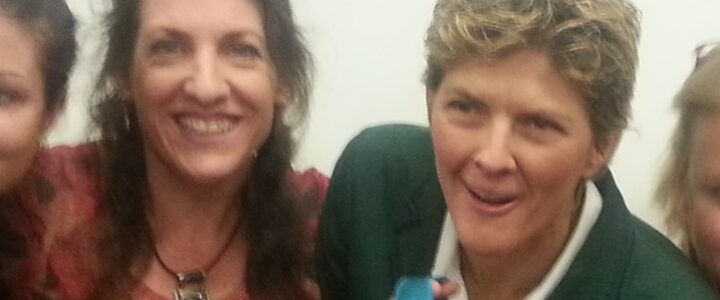
Natalie Cook stood on a chair for this photo!
Kids Mindset for Success Starts With a Plan
It is always a good idea to sit down and plot out short-term and long-term goals, especially for entrepreneurial kids who are cultivating a kids mindset for success.
On an adult level, well-made plans should be a natural component of what you perceive as your life’s purpose — your “Why” in life. Of course, children who are entrepreneurial may not have solidified their life purpose to this extent yet. But they can still begin learning how to set meaningful goals, create intentions and take practical steps forward.
A plan helps children move from vague wishing into purposeful action.
Write an intention on a small piece of paper, but do not use the future tense.
For instance, an adult might write:
“I have attracted a healthy, motivated business person to my business this month.”
That is much stronger than writing:
“I will attract…”
A child might write:
“I have kicked two goals at this Saturday’s soccer match.”
Place the written intention under your pillow, in your wallet, or somewhere you will view it regularly. The idea is to set a specific and realistic goal, then see it, believe it and feel it.
People who practise this mindset for success technique can go on to set bigger and grander intentions over time.
For children, this is not about pressure. It is about learning to direct their thoughts, language and energy toward something positive and achievable.
Having a Defined Goal Builds a Kids Mindset for Success
My friend Michael Clouse says that not having a clearly defined plan is like an archer who aims at a target with a blindfold on.
There is no chance of hitting the bullseye if you are unable to see it.
That image is a wonderful one for children. If they cannot see what they are aiming for, how can they know which direction to move? A clearly defined goal helps children understand what they are working toward and why their daily actions matter.
This is especially important for entrepreneurial kids, because business ideas can easily remain just ideas unless they are supported by a plan.
Vision Boards and a Kids Mindset for Success
Another technique is visualising goals using a vision board.
Select the experiences, goals and things that you would like to have in your life. Then make a poster board using images, words and graphics. Place the vision board somewhere you will see it daily.
The important part is not just making the board. The important part is seeing it often, visualising the items on the board, and imagining them as if they were real and already present in your life.
Facing your fears! Walking on broken glass!
A vision board can help children begin to connect their imagination with action. It gives them a visual reminder of what they care about and where they are heading.
For some kids, this might include sport, travel, family, creativity, business ideas, friendships, learning goals or ways they want to contribute to the world.
Positive Affirmations Lead to a Success Mindset in Kids
Speaking positive affirmations aloud two or three times a day is another way of setting your intention and belief. Again, these should be in the present tense.
Natalie Cook likes to declare her intentions and plans before a public audience, making herself accountable to a lot of people for achieving her aims. Her Olympic journey is a strong example of discipline, planning and follow-through. You can read more about her work and speaking through Natalie Cook’s official website.
So be bold.
Change your way of thinking.
Get rid of the negatives.
Affirm the positives.
Make sure that your plans are well aligned with your life vision. Set grand goals and follow your plan. This is a kids mindset for success.
Natalie Cook’s Five Ps Series
This article is Part 4 in our series on Natalie Cook’s Five Ps for helping entrepreneurial kids and enterprising teens develop purpose, people, passion, perseverance, planning and a mindset for success.
How do you help your children set goals and follow a plan? Leave a comment and share one strategy that has helped build a mindset for success in your family.
Teaching perseverance to kids is one of the most important parts of helping them develop a mindset for success, because every child will face setbacks, rejection and moments when things feel too hard.
A baby learns to walk by falling over many times. An entrepreneur learns to succeed after stumbling along the way. In this third part of Natalie Cook’s Five Ps series, we look at her fourth P: Perseverance — perseverance on our children’s part, and perseverance on ours as parents too.
Perseverance grows when children work through challenges, solve problems together and keep going when learning gets difficult.
Teaching Perseverance to Kids Through Real-Life Setbacks
One of the best ways to teach children perseverance is to let them see adults handle setbacks in a healthy way.
For example, Cathy and I have learned that in the business of referring people to an opportunity, many people will simply not be interested. With enterprising teens watching, how do parents set an example to persevere when people say “No”?
The mindset for success is to celebrate the “No.”
After enough “No” responses, a “Yes” will inevitably follow. One of my mentors, David Wood, says to do the Happy Dance whenever you get a “No,” because the rejection has only moved you one step closer to the “Yes.”
Perseverance for Kids Means Learning to Handle Rejection
Your kids, whether entrepreneurial or not, are going to like seeing that Happy Dance.
It becomes a practical, memorable way to help seal the behavioural pattern of success in their mindsets. Being able to overcome rejection in business, rejection from friends and even rejection from family is paramount when teaching perseverance to kids.
The lesson is simple but powerful: rejection is not the end of the road. It is part of the road.
For entrepreneurial kids and enterprising teens, this matters. A child who can hear “No” and still keep going has a much stronger foundation than a child who believes every “No” means they have failed.
Changing the Language Children Use About Perseverance
Our vocabulary also plays a huge part in our ability to persevere.
In our family, “Can’t” is a swear word and is not allowed to be used at any time. “Can” is encouraged.
Many people, including kids, are quick to give up when the going gets tough. They say, “I can’t,” rather than “I can.” The little kids in my family actually believe “can’t” is a swear word, right up there with the other big four-letter words!
This might sound funny, but it is also a powerful family rule.
When children repeatedly say “I can’t,” they begin training themselves to stop. When they learn to say “I can try,” “I can learn,” or “I can have another go,” they begin building the internal language of perseverance.
Teaching Perseverance to Kids With “That Was Easy”
Another phrase to abandon is, “It’s too hard.”
Natalie Cook showed us a little trick she used to change her perception of what is hard. She bought a toy button that calls out, “That was easy!” when you press it. Natalie would strap this toy button to her volleyball net pole.
Whenever she did something very well that was also very difficult, she would run up to press the button:
“That was easy!”
Try it for yourself. Press the button below.
Being the best in the world at your sport certainly has its challenges, and my kids would love to try out one of those buttons.
But whether or not you have the button, the point is not to keep telling yourself, “That was hard.”
A child’s brain listens carefully to repeated language. If the phrase is always “too hard,” the child begins to expect defeat. If the phrase becomes “I can try,” “I can learn,” or even “that was easy,” the child begins to rehearse a different identity.
Natalie Cook’s Example of Perseverance
Natalie Cook’s Olympic journey is a strong example of perseverance in action. Her official Olympic profile describes her as a five-time Olympian and Olympic gold and bronze medallist in beach volleyball, which makes her a powerful role model when teaching children about commitment, setbacks and long-term success. Read more about Natalie Cook’s Olympic journey here.
Children often see the medal, the success or the final moment of victory.
What they do not always see are the early mornings, the missed shots, the injuries, the disappointments, the training sessions and the moments when an athlete has to choose whether to keep going.
That is why perseverance is such an important lesson for kids. It teaches them that success is not just about talent. It is also about what they do after things become difficult.
Why Perseverance Belongs in the Mindset for Success
These tactics — celebrating the “No,” changing our language, and reframing hard things as achievable — can all increase the level of perseverance in kids and help keep them on a successful track.
But perseverance becomes easier when children also have direction.
That is where the next P comes in: Plan.
A plan gives perseverance somewhere to go. It helps children understand the next step, not just the final dream. Without a plan, perseverance can feel like pushing in the dark. With a plan, children can see that each effort is moving them forward.
Make sure you have a look at the short video above that we made of Natalie Cook giving a special message to our kids. Can you spot the blooper?
Natalie Cook’s Five Ps Series
This article is Part 3 in our series on Natalie Cook’s Five Ps for helping entrepreneurial kids and enterprising teens develop purpose, people, passion, perseverance, planning and a mindset for success.
Entrepreneurial kids need more than a good idea or a burst of enthusiasm — they need a strong sense of purpose that helps them keep going when the path becomes difficult.
This lesson became very clear to me after hearing Olympic gold medallist Natalie Cook speak in Perth. Natalie is a five-time Olympian and one of Australia’s most inspiring beach volleyball champions. Her message about success, purpose and the mindset of high achievers was powerful not only for athletes, but also for parents raising entrepreneurial kids.
Natalie Cook, Olympic gold medallist, shared powerful lessons about purpose and success.
Why Entrepreneurial Kids Need a Strong Purpose
Natalie Cook is a wonderful example of the connection between sport, business and personal success. She won Olympic gold with Kerri Pottharst at the Sydney 2000 Olympic Games and went on to become a respected speaker, leader and businesswoman. You can read more about her Olympic journey on the Australian Olympic Committee’s Natalie Cook profile.
When Natalie spoke in Perth, she explained that professional athletes and successful business owners have many things in common. Both need discipline, courage, focus and the ability to keep moving towards a goal, even when the obstacles are real.
Her message was captivating, humorous and very useful for cultivating a mindset for success in entrepreneurial kids — and, just as importantly, in their adult counterparts.
Natalie Cook’s Five Ps for Success
Natalie built her talk around what she called the Five Ps. These were principles that could apply to children, athletes, families and business owners alike.
Over a series of posts, I wanted to share these Five Ps and connect them to the way we raise enterprising, confident and purpose-driven children. I will also be adding one extra “P” of my own at the end. After hearing Natalie’s five, I wonder if you can guess what mine might be.
For this first part, we begin with one of the most important foundations of all.
Entrepreneurial Kids and the Power of Purpose
A person who truly reaches for success has a mindset that carries with it a very strong “Why,” or purpose.
Your “Why” must be stronger than your “Why not?”
If it is not, you may not have enough purpose to muster up the will to make your goals happen when barriers appear. A strong purpose gives children something deeper to hold onto. It turns a vague wish into a reason to keep trying.
Your “Why” has to be specific and close to the heart. It does not need to be complicated.
A friend of mine is driven to succeed because she desperately wants her mum to be happy and not have to work anymore. Another wants to buy a villa in Tuscany so that she can reconnect with her Italian family roots and create a sense of belonging.
These “Whys” are very different from saying, “Why not?” They are clear purposes, not poor explanations.
Teaching Purpose to Kids Through Real Conversations
Your “Why” will often come from one of two emotions: pain or pleasure. Usually, pain is the stronger of the two.
Think about the rags-to-riches stories we often hear about well-known success mentors and creators such as JK Rowling, Colonel Sanders, Sylvester Stallone, Walt Disney, Steve Jobs, Susan Boyle and Richard Branson. Their difficult experiences helped shape a strong “Why,” and that purpose became part of what carried them forward.
For entrepreneurial kids, this does not mean they need to experience hardship before they can succeed. It means they need to understand what matters to them. They need to begin asking deeper questions about contribution, growth, family, freedom, creativity and the kind of life they want to build.
Amy, Cathy, Natalie, Tracey, Kym and Trevor after Natalie Cook’s inspiring talk.
I recently carried out a “Why” exercise with my son, Jai.
We had just returned from a career pathway meeting for his upcoming senior class. Every pathway the school presented seemed to end in landing a j-o-b — just-over-broke. Whether the route was through university, technical school or straight into the average 40-year career, the end result sounded much the same.
Worse still, because the students were nearing the end of high school, the pressure was on to make a choice. It felt like a limited choice, based on hastily presented ideas rather than a deeply considered purpose.
The result was confusion. Jai seemed torn between going to university with his mates because it sounded like fun, or leaving school with his cousin and going to make money in the mines.
This inconsistency told me that Jai’s “Whys” for both of these career paths were too vague.
Questions That Help Entrepreneurial Kids Find Their Why
So, we got to work.
We discussed why these two ideas sounded interesting to him. We talked about the difference between a strong “Why” and a casual “Why not?” We also explored why “Why not?” is unlikely to carry a person through the hard parts of either choice.
Then I asked Jai to ponder three questions:
How do you want to contribute to this world?
How do you want to grow as a person?
How do you want to be remembered when you pass?
These are big questions for a teenager. In fact, they are big questions for adults too.
But they matter.
If we want to raise entrepreneurial kids who can think for themselves, create opportunities and build meaningful lives, we need to help them move beyond surface-level choices. We need to help them understand what drives them.
Purpose Comes Before the Plan
Many children are asked what job they want before they are asked what kind of life they want.
They are asked what subjects they will choose before they are asked what they care about.
They are asked which pathway they will follow before they have had time to discover the purpose behind the pathway.
This is why purpose matters so much. A plan without purpose can become a list of tasks. Purpose gives the plan energy, direction and meaning.
For entrepreneurial kids, purpose is not just about making money. It is about knowing why they want to create, serve, solve, build, lead or contribute in the first place.
Next, we continue the journey in Part 2: People and Passion, where we explore how the right people and passions can help shape entrepreneurial kids and enterprising teens.
Natalie Cook’s Five Ps Series
This article is Part 1 in our series on Natalie Cook’s Five Ps for helping entrepreneurial kids and enterprising teens develop purpose, people, passion, perseverance, planning and a mindset for success.
We are always looking for feedback on our entrepreneurial kids articles. What is your “Why”? Leave a comment and share the purpose that keeps you moving forward.
Enterprising teens need more than a career pathway or a good business idea — they need the right people around them and a passion strong enough to keep them moving forward.
After my son Jai and I discussed the first of Natalie Cook’s Five Ps, Purpose, I asked him to make a timeline of his life. I wanted him to focus on his surroundings, but more importantly, on the people who would be with him.
Jai thinking about the people and passions that could help shape his enterprising teen journey.
Why Enterprising Teens Need the Right People
Natalie Cook’s second P is People.
Attracting the right people in life is key to building a successful young entrepreneur. But whether Jai chose to be an enterprising teen or follow a different path, what mattered most to me was his mindset for success in whatever direction he chose.
So, I asked him to imagine where he would like to be sitting five years from now — and with whom.
Then ten years from now.
Then forty years from now.
I asked him to picture what was around him, who his associates were, and what made those people so valuable to him that their presence would still be visible in his future decades later.
What Natalie Cook Taught About People and Success
Natalie Cook’s career is a powerful example of what the right people, passion and support can help create. Her official Olympic profile describes her as a five-time Olympian and Olympic gold and bronze medallist in beach volleyball, making her a strong real-world role model for enterprising teens. Read more about Natalie Cook’s Olympic journey here.
Natalie discussed the value of surrounding herself with the right people while training to become an Olympic gold medallist. Around her were coaches, mindset mentors, professionals and peers whose encouragement lifted her up rather than criticism that tore her down.
This is a powerful lesson for enterprising teens.
The people around our children influence how they think, what they believe is possible, and the standards they quietly begin to accept for themselves. Friends, mentors, coaches, teachers, family members and business role models can all shape a child’s confidence and direction.
As parents, we cannot choose every influence our children will meet. But we can help them become more conscious of the people they allow close to them.
It is important for enterprising teens to spend time with the sort of people they would like to learn from, grow with and, in some ways, emulate.
This goes beyond simple peer pressure. Children and teenagers absorb attitudes, habits, language, confidence and expectations from the people around them. If they are constantly surrounded by people who complain, criticise or limit possibility, that can become their normal.
But if they are surrounded by people who encourage, create, question, build, serve and keep learning, that can also become their normal.
This does not mean they need to abandon old friends or judge others harshly. It simply means they can learn to ask better questions:
Who encourages me to become better?
Who helps me believe more is possible?
Who lives with values I respect?
Who makes me feel more confident, creative and capable?
Who would I love to learn from?
These are not just business questions. They are life questions.
Enterprising Teens Learn Success by Helping People
One of the things I love about business and enterprise is that, at its heart, it is about people.
It does not matter whether the enterprise is large or small. It could be a child’s first market stall, a family business, a service project, a creative idea, or a future company. When young people learn to be genuinely helpful to others, their chances of success increase.
Helping people gives enterprising teens and adults an energy that attracts the right people into their lives. It teaches them that business is not only about making money. It is also about solving problems, creating value and building relationships.
This is a lesson children can begin learning very early.
Why Passion Matters for Enterprising Teens
Natalie Cook’s third P is Passion.
People are naturally attracted to those who have passion for what they do. Passion gives energy to an idea. It helps a young person keep going when the excitement wears off and the work begins.
Natalie has spoken about the importance of loving the process, not just the outcome. That is a valuable message for enterprising teens, because the process is where most of the growth happens.
Success is not only found in the final result. It is found in the practice, the learning, the mistakes, the conversations, the courage and the small daily decisions that eventually become a life.
Jai wanted something he could stick with for the long term.
Having him visualise himself, his surroundings and his companions far into the future helped him reach a place that felt more connected to his own passion. It was something apart from what others were expecting of him. It was a desire that felt less likely to fade with time.
His spirit was guiding him, rather than the social conditioning of school, friends and family.
People and Passion Come Before the Pathway
This is one of the problems I see with the way many teenagers are asked to make career decisions.
They are often asked to choose a pathway before they have deeply considered the people they want around them, the kind of contribution they want to make, and the passions that might sustain them over time.
For enterprising teens, this matters.
A pathway without people can feel lonely.
A pathway without passion can become heavy.
But when a young person begins to understand who inspires them, who strengthens them, and what lights them up from the inside, their decisions become clearer.
That does not mean every choice becomes easy. It means the choices begin to come from a deeper place.
Natalie Cook’s Five Ps Series
This article is Part 2 in our series on Natalie Cook’s Five Ps for helping entrepreneurial kids and enterprising teens develop purpose, people, passion, perseverance, planning and a mindset for success.
If you could enlist three people in the world to personally be your friend and mentor, who would they be? Mine would be Richard Branson, Robert Kiyosaki and Michael Clouse. Leave us a comment and share who would be on your list.
Green School Bali is an inspiring example of what education can look like when children are surrounded by nature, creativity, real-world learning and a strong sense of purpose.
Built from bamboo in the forest of Bali, this remarkable school challenges traditional thinking about education and invites us to ask an important question: are our schools truly preparing children for the modern world?
Green School Bali is built from bamboo in a natural learning environment.
Green School Bali: A Different Vision for Education
Imagine a school with a natural, holistic, student-centred learning environment that empowers and inspires young people to be creative, innovative, green leaders.
There are many schools that aspire to a vision such as this, but very few achieve it. In all my years as a teacher, I know of only one school that has gained the genuine attention of educators and parents from around the world in quite this way.
This unique school is located in a forest on the island of Bali in Indonesia, and it is constructed largely from bamboo. You can learn more through the official Green School Bali website.
Green School Bali is an innovative school that is different in just about every aspect from regular Australian schools. It is different in its construction, the way it is run, its philosophy on raising and teaching children, and the way its curriculum is brought to life.
A Presentation That Challenged Our Thinking
Alan Wagstaff shared the Green School Bali philosophy.
Cathy, myself and our kids had the opportunity to attend an excellent presentation in Perth on Green School Bali. The principal, Mr Alan Wagstaff, showcased his school and shared their philosophy on education. He spoke with passion and with tremendous pride.
Rightly so. Green School Bali was turning many heads.
The founders of the school think way outside the box and have created a harmonious learning environment that children can excel in. They, and a growing group of others, believe this school offers a glimpse of what education could become in the future.
Perhaps the policy makers, politicians and leaders of our outdated education system should take a serious look at Green School Bali.
Why Green School Bali Matters for Entrepreneurial Kids
In previous articles, we have challenged the pedagogical practices of our current schooling system here in Australia. We have the view that it provides a good literacy education. However, the design of the system often conditions young people to be obedient, hard-working and compliant.
Now, that does not sound entirely bad. The world does need workers who can fill jobs and contribute well. However, what happens if a child wants to become an entrepreneur, innovator, creator or change-maker?
Many schools do not strongly foster true leadership, innovation or enterprise. Many schools also do not provide a strong financial education for kids, nor do they intentionally teach children to develop the habits and thinking of an entrepreneur.
This is why we care so deeply about raising entrepreneurial kids. Children need opportunities to think, question, create, solve problems and connect their learning to real life.
Disengaged students
Alan Wagstaff was also very direct about his views on the archaic education system currently running in Australia and other western societies. He pointed out many issues that should not be dismissed, and he backed his views with facts, figures and research conducted by qualified experts in education.
He cited the work of respected thinkers and authors such as Alfie Kohn and Stephen Covey.
What Makes Green School Bali So Special?
This quote by Michael Franti begins to paint a picture:
A Green School Bali classroom
“For anybody that’s considering sending your kid to school here, it’s different than other schools where your kid’s going to be assigned a number and a desk and you show up and you do exactly what you’re told. Here if you have an idea to do something that’s outside of the box, that idea is going to be fostered and nurtured rather than pushed down.”
– Michael Franti, poet, musician and activist
That is the kind of educational philosophy that speaks strongly to families who want children to grow as confident, creative and capable young people.
Student Engagement and Real-World Learning
Alan Wagstaff shared an interesting statistic about students in regular schools. He explained that many students over 11 years old are not fully engaged in their learning and do not really like school.
Many of these students feel they are learning irrelevant things that will not be useful when they leave school. We have heard similar comments from our own teenage children at times. I can also think back to much of the mundane content I had to master and be tested on as a high school student and then again at Teachers College. Much of it was of little use to me in what I do today.
Alan said we need to change the structure of timetabling. We need to move from purely subject-based teaching to student-centred learning.
In many schools, the timetable revolves heavily around literacy and numeracy, with subjects such as the arts being pushed into the afternoon gaps. We push students in literacy and numeracy to uphold the education brand and satisfy national testing. The curriculum can become prescribed, inflexible and overly focused on measurement.
With all that emphasis on literacy and numeracy, why do we still have so many children not meeting the grade?
What Creates Life Success?
What is it about schooling that creates life success? The short answer is simple: have children turn up at school fully engaged, and you will get there.
Therefore, we need children to be satisfied and engaged. Schools need to link students into life. Their learning needs to be realistic and relevant to each of them individually.
Every day, we should be academically upskilling children, but not simply comparing them with other children.
Parents should ask not only how their child compares with others, but what their child is actually learning.
How Green School Bali Teaches Children
Alan explained how they educate children at Green School Bali.
The programs are structured around themes. These are collaboratively planned by the teacher team leaders. Teachers then run proficiency lessons within these short-term themes.
Each student is shown the continuum of what they need to learn in different areas of the curriculum. From there, they work towards learning what they need at their own level. Over time, this helps children take responsibility for their own learning.
Green School Bali students learning through themes and real-world inquiry.
Within the broader themes, students follow their own individual interests. They develop ideas, and those ideas are fostered and expanded. They identify what they need to learn and then conduct investigations and study groups to understand and practise skills.
Every day, the children are engaged in practical lessons that challenge the Big Four: physical, emotional, intellectual and interpersonal learning.
For example, if the general theme was “Waves”, the Big Four might look like this:
Physical: Go and experience waves by surfing.
Emotional: Paint a wave or sing a wave melody.
Intellectual: Study wave formations.
Interpersonal: Sit by the waves and meditate.
At Green School Bali, there are no rigid timetables in the traditional sense. This allows themes to develop through what Alan described as dynamic chaos. Specialist teachers decide what will be done, teachers research the theme and subject areas, and students engage in proficiency lessons.
Authentic Learning Beyond the Classroom
Alan said that in order for students to learn something deeply, they must “hit it three times in three different ways during the week”. Mini themes develop within the bigger themes, and teachers help children self-manage their way through learning.
This leads to engagement and lifelong learning.
Opportunities are seized as they arise to provide practical real-life lessons in areas such as:
connecting to the real world
environmental education
health and wellbeing
performing arts
enterprise education
visual arts
These lessons are timed, sustainable, flexible and authentic. They happen by venturing beyond the school and accessing adults and resources in the enterprising world.
Green School Bali’s aim is for children to want to go to school and to be fully engaged. The emphasis is on relevance to learning and valuing students, not on testing and comparing students as we often do in our current schooling system.
That comparison can put unnecessary pressure on children. A more meaningful goal is to help children discover what they are capable of and how their learning connects to life.
Green School Bali’s Bamboo Campus
Green School Bali is known for its bamboo architecture and natural campus.
Green School Bali is an architectural masterpiece. It is a masterwork built of bamboo and mud brick. There are no traditional classroom walls and very little impact on the environment.
The school is designed to be sustainable, with power sourced from solar panels and hydro power from the river. Students also assist with growing food in the large permaculture garden where animals are kept.
Gardens and campus fields at Green School Bali.
Surrounding the school are bamboo homes built by local and international families who choose to live in Bali so their children can attend the school.
At the time of this original article, there were also studios under construction to be leased cheaply to entrepreneurs, with the idea that students could be involved with these businesses. This would allow students to develop enterprise skills and ultimately learn how entrepreneurship works in the real world.
Green School Bali as an Example for the Future
Green School Bali is a real-life example of an exemplary school. Students attending the school were reported to be achieving outstanding results in many aspects of their development, including academics.
Although the school had only been running for a relatively short time when this original post was written, its first graduates were already graduating, and those choosing to do so were being accepted into universities around the world.
Green School Bali students learning in a natural environment.
Alan Wagstaff and the founders of the school had a vision to create change in how schools educate. They knew they would be challenged if they targeted the top of the education hierarchy in Australia, so they were working to make change from the bottom up.
One way they were doing this was by being an exemplary school and by being noticed. At the same time, Green School Bali was also training teachers on mainland Australia with Green School ideologies, with the hope that those teachers would make gradual changes in their own schools.
Green SuperCamp and Our Family’s Experience
Green SuperCamp Bali gave our children a powerful learning experience.
Another way to have your children experience the Green School Bali philosophy is through Green SuperCamp.
Kaitlin, Jai and Flynn attended Green SuperCamp, and they came back transformed. At the time of this original post, we were working towards them attending again, along with our eleven-year-old daughter Amber.
Check out what Flynn had to say about Green SuperCamp:
John Hardy, Founder of Green School Bali
John Hardy, founder of Green School Bali, also spoke about the school at TED:
Key takeaway: Green School Bali shows what can happen when education becomes connected to nature, creativity, enterprise, sustainability and real-world learning. It challenges us to think more deeply about what children truly need in order to thrive.
Where to Next?
If you enjoyed this article about Green School Bali and real-world learning, you may also like:
Entrepreneurship for students is not just about starting a business. It is about learning how to think differently, spot opportunities, solve problems, take action and build confidence in the real world.
When children learn how entrepreneurs think, they begin to see that their ideas matter. They also begin to understand that money, work, creativity and contribution can be approached in a very different way.
Jai coaching Chayse through business strategy and entrepreneurial thinking. Watch Jai coach Chayse.
Entrepreneurship for Students: How Do Entrepreneurs Think?
In an earlier article, we spoke of charitable entrepreneurs and successful business thinkers such as Richard Branson, Warren Buffett and John Templeton.
They, together with many other successful people, have extraordinary stories to tell about their entrepreneurial journeys. Some will tell you they struggled at school, dropped out, were dyslexic, or found reading and writing difficult. Others came from homes of poverty, while some were born into families where business and enterprise were already part of everyday life.
Although their backgrounds and circumstances differed, one thing often remained the same: they thought in a similar way.
It is not circumstance alone that creates an entrepreneur. It is mindset.
That is why entrepreneurship for students matters. Young people need more than information. They need the chance to develop the kind of thinking that helps them create opportunities, make decisions, solve problems and take responsibility for their future.
Why Entrepreneurial Thinking Matters for Families
What we have come to understand is that for our family to become economically and personally free, we need to question our conditioning around money and then reprogram our subconscious minds with a new success money mindset.
Many wealthy and successful people either developed this mindset from their upbringing, or they discovered it for themselves. Sometimes this happened consciously, through study and self-development. At other times, it happened unconsciously through experience, environment and action.
It is often said that only a small percentage of people live with real economic and personal freedom. The bigger question is this: what do they do differently?
More to the point: how do entrepreneurs think?
Before we look deeper into that, consider this.
Entrepreneurship for Students Starts with Money Mindset
The way children think about money can shape the opportunities they see.
Whether we like it or not, we are being conditioned constantly to think a certain way about money. We are conditioned by our family, schools, advertising, politicians, television, social media and friends.
Many people become tied to jobs and debt because the conditioning they have received favours a money mindset of lack, rather than abundance.
Do any of the following sound familiar?
“Money doesn’t grow on trees.”
“Money is the root of all evil.”
“You’ve got to work hard for your money.”
“Get a good, well-paying job and you’ll be set for life.”
“Buy a home, it will be your best investment ever.”
“We can’t afford it.”
“What job do you want to do when you grow up?”
“Go for the cheaper ones.”
Only this morning, I was listening to a friend talking with his teenage sons. He told them they needed to get jobs. He explained that he had a job pushing shopping trolleys at their age. He even went down to the local IGA supermarket and picked up applications for them to apply for jobs.
When I was fifteen, I started out with a casual job working at a Target store. My hourly rate was $2.90 an hour.
All of the above are examples of conditioning. Much of our thinking about money, work and possibility is formed very early in life.
What Schools Often Teach About Work and Money
Our schools are largely designed to prepare workers for the workforce. Banks make money by selling debt. Governments collect taxes and often depend on people staying within predictable systems. Retail businesses make money by encouraging us to spend. Big businesses need workers to build their businesses.
There is definitely a design to much of this madness.
That does not mean jobs are bad. It also does not mean every child needs to become a business owner. However, it does mean young people should know there are other pathways.
They should understand that work, money, creativity and contribution can be approached in different ways.
This is why financial education for kids is so important. Children need to learn about money, value, assets, liabilities, work, enterprise and choice before they enter adulthood.
Entrepreneurial Mindset for Young People
What our family has discovered is that our money mindsets are changing. We are learning that it is okay to accept money and to have money. In fact, it is okay to offer something of value to others and receive payment in return.
Working hard in a job is not the only pathway for young people entering our big world.
There are other ways. These pathways can allow young people to follow their passions and dreams while making a meaningful contribution to whatever they consider important.
Wouldn’t it be fantastic if all our kids could achieve economic and personal freedom?
People who have achieved financial freedom through being entrepreneurial tend to have a mindset of abundance. Their habits differ. Their thinking differs. Their actions differ.
This is why we keep coming back to the bigger idea of raising entrepreneurial kids. It is not just about business. It is about helping children become confident, capable, creative and resourceful.
How Entrepreneurs Think: Lessons from Napoleon Hill
Napoleon Hill studied how successful people think and act.
Rather than attempting to explain every detail of how entrepreneurs think, I will refer to one of the most influential books ever written on personal and financial achievement.
Think and Grow Rich by Napoleon Hill was originally published in 1937. Hill spent his life studying successful people and recording how they think and act. He became successful himself by following the distinctions in his own book and by modelling himself on his mentors.
Think and Grow Rich is essentially a book about what to do and how to do it. It explores ideas such as self-direction, organised planning, autosuggestion, mastermind association, self-analysis and the selling of personal services.
The thirteen steps to riches described in the book offer a philosophy of individual achievement that has influenced thousands of people’s lives.
This book could be worth a great deal to you and your kids, not simply because of the money ideas, but because of the thinking behind them.
At the time of this original article, Cathy was rewriting Napoleon Hill’s book in a way that would be suitable for kids to read, with simple explanations and modern examples they could better relate to. It was a work in progress, built around the idea that children should be able to understand powerful success principles in language that makes sense to them.
For our family, entrepreneurship for students has never been just a theory. It has been something we have tried to encourage through conversations, real-life projects, mentoring and practical action.
Looking back now, we can see how these early conversations about entrepreneurial thinking have carried through into real life. The goal was never just to teach our children about business. It was to help them become confident, resourceful young people who could spot opportunities, solve problems and take action.
Today, we see that continuing as Jai shares business ideas and strategy with his younger brother Chayse, passing on what he has learnt through his own entrepreneurial journey.
Jai has gone on to build his own entrepreneurial path through creative work, content and business. You can see part of that journey through Art of Mondays.
Key Takeaway: Teach Students to Think Like Entrepreneurs
Key takeaway: Entrepreneurship for students is about far more than making money. It is about helping young people think differently, understand value, recognise opportunity, solve problems and take action in the real world.
Where to Next?
If you enjoyed this article about entrepreneurship for students and entrepreneurial thinking, you may also like:
Raise Entrepreneurial Kids — ideas for building confidence, initiative and real-world enterprise skills.
We would love to hear your thoughts. How do you think entrepreneurs think differently, and how can we help children develop that mindset while they are still young?