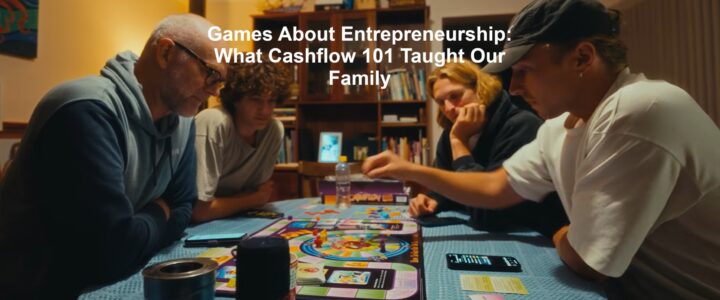
Games about entrepreneurship can make money, investing and business ideas easier for children to understand because they turn abstract concepts into decisions, consequences and family conversations.
I bet many of us have played a game of Monopoly. As a child, it was one of my favourite board games. I did not realise it at the time, but it was probably teaching me early lessons about real estate, rent, development, passive income and the power of owning assets.
Years later, another board game became a favourite in our family. This one went much deeper: Robert Kiyosaki’s Cashflow 101.
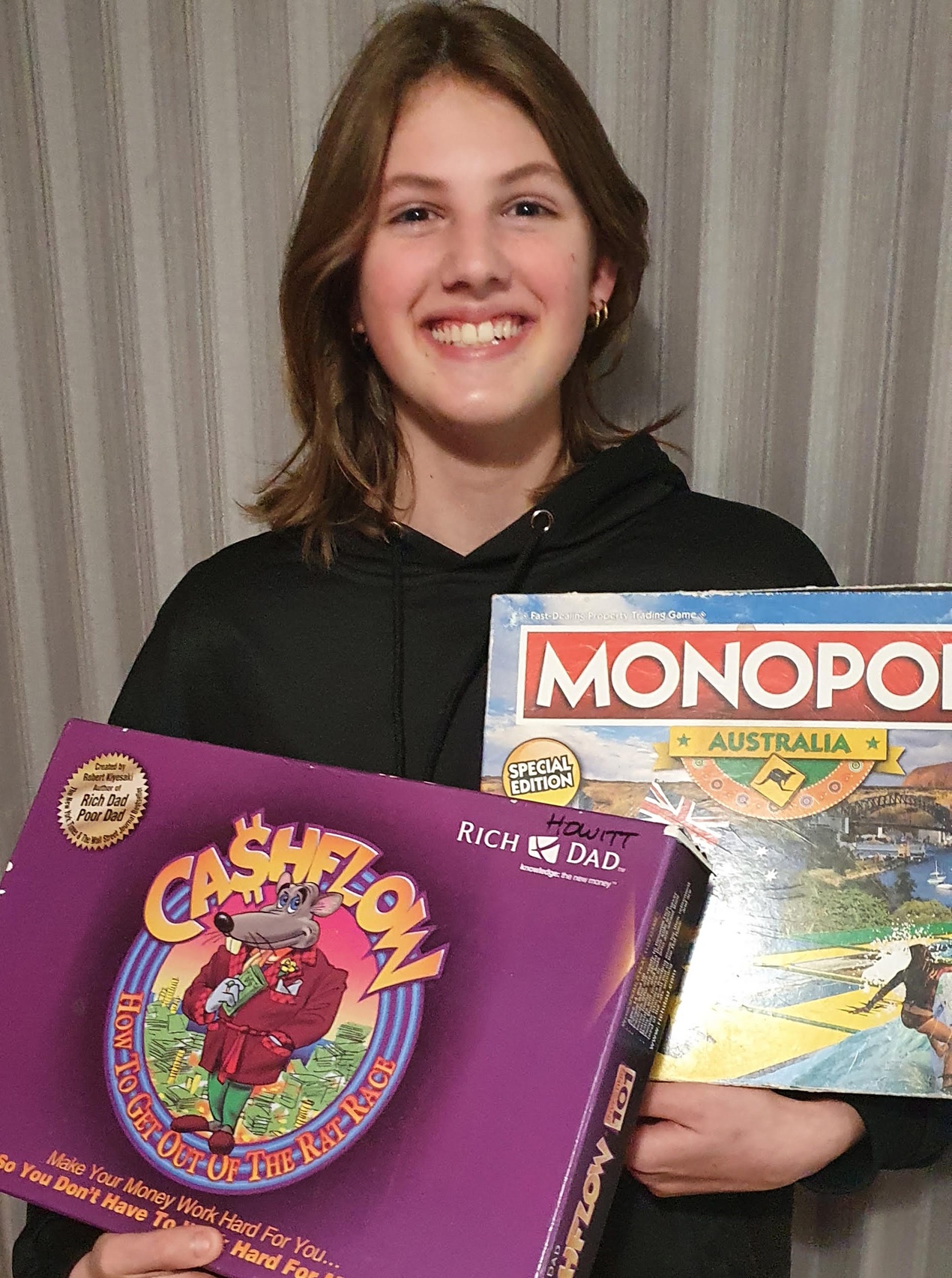
When people talk about games about entrepreneurship, they often imagine something that teaches business in a neat, classroom-style way. Cashflow 101 was different. It did not just tell our children about money. It placed them inside a money story. They had to make decisions, keep records, take risks, miss opportunities, make mistakes and try again.
For around 20 years, our family has had many conversations about business, investing, work, risk, assets, liabilities and entrepreneurship. Some were planned, but many happened naturally around the dinner table, in the car, through small family projects, while travelling, or while following our children’s different enterprise journeys.
One of the most useful tools we used as a family was not a formal curriculum. It was a board game.
The photographs and video in this article are recent. Our children are now teenagers and adults, but Cashflow 101 still brings us back to the table. That continuing interest is one reason I believe games about entrepreneurship can have a lasting influence.
Important note: This article shares our family and teaching experiences for general education. It is not personal financial advice. Children should not operate real trading, investment or cryptocurrency accounts without appropriate adult supervision and professional guidance where needed.
Why Games About Entrepreneurship Matter
I was reminded of Cashflow 101 recently when I saw a mother in a homeschooling group ask how to support her 12-year-old son. He wanted to start learning about trading, including traditional markets and crypto. Her question was also a reminder that games about entrepreneurship can provide a safer first step than rushing a child towards real markets.
She made it clear that he would not be in charge of operating any real trading accounts, but she wanted to know what apps, platforms or resources might help him learn. She also asked to hear from other families whose children were learning about investing as part of their homeschooling.
I thought it was an excellent question.
Children today are growing up in a world full of investing apps, crypto, online business, influencers, financial headlines and constant money talk. It can be difficult for parents to know what is legitimate, what is hype, and what may even be a scam.
It is easy to fall into one of two extremes.
We can shut the conversation down completely because it feels too risky or too adult. Or we can rush too quickly into real markets before a child understands risk, emotion, research, patience or consequences.
I think there is a better middle path.
When children show interest in trading, crypto or investing, we do not need to shut the conversation down. But we also do not need to rush them into real markets.
The first step is to help them understand how money works, how risk works, how emotions affect decisions, and how investors think.
This is where games about entrepreneurship can be so valuable. They give children a way to practise financial thinking before real money is on the line.
Games About Entrepreneurship Can Teach Through Experience
Cashflow 101 is a board game designed by Robert Kiyosaki, the author of Rich Dad Poor Dad.
In the game, each player is given a career, a wage, expenses, assets and liabilities. Each person chooses a coloured rat and enters what the game calls the “Rat Race”.

That part of the game is very clever.
Players go around and around a circular track earning wages, paying expenses, buying doodads, dealing with unexpected costs, and looking for business or investment opportunities. Some opportunities are good. Some are not. Some carry more risk. Some need more cash. Some require patience. Some should be left alone.
The aim is to build enough passive income from assets so that your passive income becomes greater than your expenses. When that happens, you leave the Rat Race and move into the Fast Track, where bigger business and investment opportunities become available.
The game can take anywhere from one to three hours to play. In my view, it is suitable for older children, teenagers and adults. There is also a junior version for younger children.
As games about entrepreneurship go, Cashflow 101 asks a lot of its players. It expects them to read, calculate, keep records, weigh up risk and understand the difference between assets and liabilities.
Learning Through Decisions and Financial Records
What I loved about the game was that it taught financial concepts through experience, not just explanation.
Our children learnt about assets and liabilities, income and expenses, cashflow, record keeping, passive income, risk, debt, business opportunities, investing, negotiation, patience and knowing when to walk away.

Each player had to keep their own financial records. That alone was a powerful exercise. They had to track income, expenses, assets, liabilities and cashflow. They had to work out whether they could afford an opportunity, whether it was worth the risk, and whether it would actually move them closer to getting out of the Rat Race.
At the end of a game, we would often stop and talk about how everyone played. We would look at what worked, what did not work, what risks paid off, and which opportunities probably should have been left alone.
Those conversations were often just as valuable as the game itself. This is where games about entrepreneurship become more than entertainment: the choices made during play create genuine discussion afterwards.
Watch Cashflow 101 Being Played
In this recent video, Jai explains how Cashflow 101 works while Chayse, Flizzy and I play alongside him. The short sequence shows the game progressing, the financial decisions being discussed and the family conversation happening around the table.
Cashflow 101 Was More Than a Money Management Board Game
Cashflow 101 taught financial concepts, but for our family, I think the deeper lesson was about identity.
It helped our children see themselves as people who could understand money. They could read a basic financial statement. They could think about assets and liabilities. They could weigh up risk. They could look at an opportunity and ask whether it made sense.
That inner belief matters.

Building the Identity of a Business Builder
As a school teacher, I have often felt that the curriculum does not properly expose students to the career pathway of the entrepreneur. Children hear a lot about getting a job, choosing a career, going to university or learning a trade. All of those pathways can be valuable.
But many students do not hear enough about building something of their own.
They do not always learn that they can create value, solve problems, build assets, start small projects, develop business skills, or become investors and business builders over time.
That is something we wanted our own children to understand early.
We did not want them to grow up thinking money was mysterious, investing was only for wealthy people, or business was something other people did. We wanted them to feel that these ideas were learnable. They could have a go. They could make mistakes. They could build something. They could become more capable through experience.
Looking back now, with our children grown or growing into adulthood, it is interesting how often they still mention the Cashflow game. They remember the lessons. They remember the conversations. They remember the feeling of trying to get out of the Rat Race.
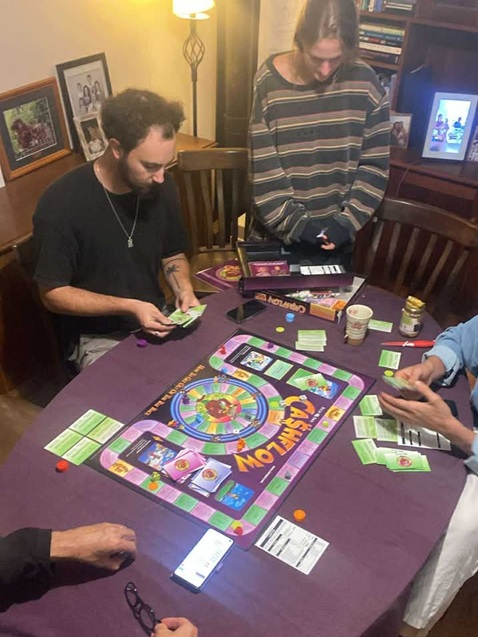
I believe those experiences helped shape their understanding of the fundamentals of being a business builder and investor. They also show that games about entrepreneurship can remain useful well beyond childhood.
Not because the game gave them every answer. It definitely did not. But it gave them a way of thinking.
That is why I think games about entrepreneurship can be so powerful. A good game does not just give information. It helps a child step into a role and practise thinking from that position.
Using Games About Entrepreneurship in the Classroom
I also used Cashflow 101 in a school setting. It showed me that games about entrepreneurship can reach students who may not respond to a conventional lesson about money or career pathways.

At the time, I was working with Year 9 and 10 students in a country high school. Many of the students were disengaged with school, and many had very little direction about their future career pathways.
I saw an opportunity to expose them to entrepreneurship in a practical way, so I ordered four Cashflow 101 games for the school.
We set the games up and grouped the students to play. The games ran over several weeks, with students playing twice a week.
The response was remarkable.
The students embraced it. The game was fun, competitive and strategic. It required focus, thinking, record keeping and decision-making. Students who were often disengaged began to light up as they discovered the world of business, investing and entrepreneurship.
The game opened up questions and discussions about money, risk, work, income, opportunity and business. It also gave students a practical introduction to the kind of entrepreneurial thinking that is often difficult to teach through explanation alone.
I do not know what seeds were planted in those students, but I do know that many of them were exposed to ideas they may not have encountered otherwise.
Sometimes one experience, one conversation, one game or one idea can open a door.
Games About Entrepreneurship and Real-World Exposure
Board games were not the only way we exposed our children to business and investing ideas. The foundation created by games about entrepreneurship was strengthened through real people, real places and real learning experiences.
Over the years, we also took them to different seminars, courses and learning events. Some of these were probably well beyond what most people would consider normal for children, but I have always believed that exposure matters.
Exposure Can Shift What a Child Believes Is Possible
One example that stands out is Jai.
When he was only 12, he flew with me to the other side of Australia to attend a week-long program on trading using CFDs. CFDs, or Contracts for Difference, are leveraged derivatives that can be traded in Australia. They are complex and risky, and I am certainly not suggesting them as something children should trade.
But the learning experience itself was valuable.
Jai was the youngest participant in a room of more than 100 people. Did he understand the content? Yes, he did. Did he become a CFD trader? No, he did not.
But that was never really the point.
The experience opened his eyes to the world of finance. He saw adults learning serious financial skills. He saw that markets, trading, risk and investing were real areas of study. He also saw that there are opportunities available to people who build the confidence, discipline and know-how to understand them.
That kind of exposure can shift a child’s view of what is possible.
A child does not need to fully master every idea at 12 for the experience to matter. Sometimes the value is simply in being in the room, hearing the language, seeing people take learning seriously, and realising that these pathways exist.
That is why I see games, conversations, seminars, courses and real-world experiences as part of the same bigger picture. They all help build financial awareness and inner belief.
Should a 12-Year-Old Learn About Trading?
In answer to the mother’s question, I would say yes, but with care. I would begin with conversations, simulations and games about entrepreneurship before moving anywhere near a live trading account.

A 12-year-old who is interested in trading or investing does not necessarily need to start by placing trades. There is plenty to learn before real money is involved.
The first thing I would want a child to understand is the difference between investing, trading and speculating.
Investing usually means buying quality assets with a longer-term view. It involves research, patience and the ability to sit through ups and downs without being ruled by emotion.
Trading is more active. It involves reading charts, choosing entries and exits, managing risk carefully and making decisions under pressure. That can be exciting, but it can also become emotional very quickly.
Speculating is different again. It usually means taking a risk on something that may rise in value, but where the outcome is much less certain. Sometimes speculation pays off. Sometimes it does not.
These are not easy distinctions for many adults, let alone children. But a child can begin to understand the basics through games, conversations, simulations and simple examples.
They can learn what an asset is. They can learn what a liability is. They can learn why compound interest matters. They can watch how markets move. They can learn about scams, hype and emotional decision-making. They can practise making decisions without the pressure of real money.
To me, that is the best starting point.
What Other Parents Suggested
The discussion that followed the mother’s question was very interesting. There were many thoughtful suggestions from other parents.
One strong theme was to honour the child’s interest but keep it age-appropriate. If a child is curious about money, markets or investing, that interest can become a powerful learning pathway. It can connect with maths, research, economics, technology, psychology, current events and even writing.
Simulated Investing and Compound Interest
Several people suggested simulated investing or paper trading. Dummy accounts, pretend portfolios and the ASX Schools Sharemarket Game were mentioned as ways for children to practise making decisions without real financial consequences.
That principle fits perfectly with Cashflow 101. Let children practise decision-making before real money is on the line. Both simulations and games about entrepreneurship allow mistakes to become lessons rather than financial losses.
Some parents also talked about teaching the language of markets. Terms like candlesticks, bullish, bearish, trends and technical analysis were mentioned. I do not think children need to become traders immediately, but they can certainly begin learning how markets move and how people interpret that movement.
Compound interest was another important idea raised. One person pointed out that children have a huge advantage when it comes to investing because they have time. A compound interest calculator can help children see how small regular amounts can grow over many years.
That is a powerful lesson because it shifts the conversation away from quick wins and towards patience, consistency and long-term thinking.
Other resources mentioned included books, podcasts, budgeting systems, investment apps, dummy trading accounts, cybersecurity resources and financial education websites. The Australian Government’s MoneySmart guide to teaching kids about money is also a useful starting point for everyday family conversations.
I do not think the main question is simply, “Which app should we use?” A better question might be, “What kind of thinking does this tool teach?”
Some tools encourage patience, research and responsibility. Others can make investing feel like a fast-moving game of excitement and reward. Parents need to be aware of that difference.
Why Crypto Needs Careful but Serious Attention
Crypto came up a lot in the discussion, and understandably so. Games about entrepreneurship can teach broad financial principles, but crypto introduces additional questions about technology, custody, volatility, scams and speculation.
Some parents were enthusiastic about children learning about crypto, blockchain, decentralised finance and digital assets. Others were much more cautious and warned about volatility, scams, tax issues, hype and the risk of children being pulled into something they do not fully understand.
I can see both sides.

Understanding Both the Potential and the Risk
Personally, I do believe crypto is a very real asset class, and I think blockchain technology is likely to become more integrated into our world over time. It already appears that more and more assets, systems and services may eventually be tokenised or connected to blockchain in some way.
For that reason, I think families benefit from understanding it.
However, crypto is not one thing.
There are strong projects and weak projects. There are serious technologies and hype coins. Some projects are trying to solve real problems. Others are built almost entirely on attention, speculation and emotion.
The volatility can also be extreme. A coin can fall dramatically and later recover strongly. Another coin can fall and never come back. This is why I do not think it is helpful to say, “crypto is good” or “crypto is bad”.
The better question is: what exactly are we looking at?
A proper discussion should include the problem the project is trying to solve, the team behind it, the technology or service it provides, whether it has genuine use, and whether the long-term case makes sense. Families also need to understand the risks, including scams, hype cycles, security, tax and emotional decision-making.
The Ethereum Christmas Present
I exposed all of my children to crypto when they were younger in a very simple way.

For Christmas one year, I gave each of them $100 worth of Ethereum.
This was back in December 2020, before the crypto bull run. At the time, they had very little understanding of crypto and, to be honest, they were not particularly interested in it. The Ethereum sat in my crypto wallet, with a promise to each of them that it was actually theirs.
Over the next 12 months, that Ethereum grew significantly in value.
When the children saw their $100 worth of ETH grow to around $500, they suddenly became much more interested. They wanted to know what had happened. They wanted to understand crypto. Some wanted custody of their Ethereum in their own wallets.
That small Christmas gift created a real-life learning moment.
For Flynn in particular, it became much more than a passing interest. He took crypto seriously, grew his learning, built his crypto portfolio and became both a crypto investor and trader.
Would he have gone down that path if I had not given him Ethereum back in 2020?
I do not know.
But I do know that a small, real experience opened the door to curiosity. And curiosity is often where deep learning begins.
Learning About Crypto as a Family
For families who want to explore crypto, I would not suggest rushing in through social media tips, influencers or random online advice. I would be far more comfortable learning through a professional crypto education organisation with a good track record, proper support, and personalised coaching or mentoring.
That is the path I chose myself through Digital Wealth Group, headed up by Sydel Sierra. For me, having structured education and support was important because crypto can be confusing, fast-moving and risky if you do not understand what you are doing. That experience also connects with our earlier reflections on money mindset and financial education.
I am not a supporter of trading crypto with leverage. That is a very different level of risk.
But I do believe carefully chosen crypto assets may have a place in a broader portfolio alongside other asset classes, provided people understand the risks, do proper research, and seek appropriate advice for their own circumstances.
For children and teenagers, I would treat crypto first as an education topic. It can open up valuable conversations about technology, digital assets, risk, research, scams, hype and the difference between genuine innovation and speculation.
But it should never be presented as easy money.
Financial Education Should Include Danger Literacy
One of the strongest cautions in the discussion was around scams, hype and gambling-like behaviour.
I think this is essential.
If we only teach children about opportunity, we leave them exposed. Financial education should also include danger literacy.
Children need to learn that not every confident person online knows what they are talking about. Not every exciting opportunity is wise. Not every investment story is honest. Not every fast-moving asset is worth chasing.
The Emotional Side of Financial Decisions
They also need to understand the emotional side of money.
Fear of missing out can make people rush in. Greed can make people overcommit. Pride can stop people from admitting they were wrong. Hope can make people hold onto something long after the evidence has changed.
These are not just investing lessons. They are life lessons.
A child or teenager can start with simple questions. What problem does this solve? Where does the value come from? Who benefits if I buy this? What could go wrong? Is this investing, trading, speculating or gambling? What would make me enter, and what would make me exit?
Those questions are valuable for children, teenagers and adults.
It Is Okay to Be Cautious
Not every parent in the discussion agreed that trading was appropriate for a 12-year-old.
That is a fair concern.
Trading involves risk, emotion, probability, psychology, economics, statistics, current events and sometimes complex financial products. A child may not be ready to understand all of that.
But even if a child never places a real trade, their interest can still become a doorway into valuable learning.
A curiosity about trading can lead into maths, research, patience, emotional control, business, technology, economics, cybersecurity, world events and financial literacy.
That is the opportunity.
The aim is not necessarily to create a child trader. The aim is to raise a young person who can think clearly about money, risk, opportunity and value.
Where I Would Start with Games About Entrepreneurship
If a child showed interest in trading or investing, I would probably begin with family learning before real money.
I would start with conversations and games about entrepreneurship such as Cashflow 101. From there, a simulated investing account or sharemarket game could be useful. Compound interest calculators are also excellent because they help children see the power of time, consistency and patience.
I would also encourage a simple journal. Nothing complicated. Just a place to write down why they chose something, what they thought might happen, what actually happened, and what they learnt from the result.
Over time, that journal would reveal a lot.
Did they follow their plan? Did they act on emotion? Did they chase something because it was exciting? Did they ignore risk? Did they become impatient? Did they learn from mistakes?
Those reflections matter.
I would also talk openly about scams, hype, influencers, tax, risk, volatility and the danger of thinking you are smarter than the market.
Not to scare them, but to prepare them.
Games About Entrepreneurship Can Build Inner Belief
For our family, Cashflow 101 was never just a game.
It was a way to practise thinking.
It taught our children that money can be understood. Assets and liabilities matter. Cashflow matters. Opportunities need to be assessed. Risk is part of the game, but not every risk is worth taking.
Most importantly, it helped build an inner belief.
Our children grew up with the idea that business and investing were not mysterious worlds reserved for other people. They were things that could be learned. They could ask questions, make mistakes, read the numbers, assess an opportunity, and build their confidence over time.
That belief has mattered far more than any single financial lesson.
So, when a child asks about trading, investing or crypto, perhaps the best response is not to rush straight to an app or platform.
Maybe the better response is to start learning together.
Play the game. Ask the questions. Practise without real money. Talk about opportunity and danger. Build the understanding first. Used thoughtfully, games about entrepreneurship can become one practical part of a much broader family education.
Because if children learn how to think about money before they start risking money, they will be far better prepared for whatever financial world they step into as adults.
Key takeaway: Games about entrepreneurship such as Cashflow 101 can help families teach children about money, investing, assets, liabilities, risk and business thinking before real money is involved.
Games are only one part of the journey. Family conversations, real-world exposure, seminars, courses and small lived experiences can all help children build the inner belief that they can learn, create value and become capable financial decision-makers.