Coding for Kids: Jai’s Apple App Enterprise Idea

Coding for kids with Jai’s Apple app enterprise idea

Coding for kids can be more than screen time. For a child who loves technology, gaming, social media and the internet, coding can become a way to create, solve problems and even explore enterprise ideas.

“`

Jai’s interest in technology became the starting point for his Apple app enterprise idea. Rather than only seeing his screen time as a problem, we wanted to help him channel that passion into something creative and entrepreneurial.

“`

Jai using technology as part of coding for kids and his Apple app enterprise idea
Jai loved technology, gaming and the internet — and we wanted to help him channel that interest into enterprise.

Coding for Kids: Jai’s Apple App Enterprise Idea

Jai, like many teenage kids, is fascinated by the internet, social media and gaming.

If you allowed him, he would spend day and night on his computer, iPod or mobile phone chatting to his friends, playing games or searching the net.

We are careful that he is well-rounded, with a balance of activities such as kicking the footy and playing with his family, while at the same time allowing him the opportunity to immerse himself in his passion.

Jai balancing exercise and technology while exploring coding for kids
Jai leads a balanced life.

That balance matters.

Technology can easily become passive entertainment, but it can also become a pathway into creativity, learning and enterprise. This is where coding for kids becomes so interesting.

A child who loves screens may also love designing, building, experimenting, creating games, solving problems or developing apps.

Turning Screen Time Into Enterprise

When we introduced the Family Project to Jai, he knew exactly what he wanted to do.

His very grand idea was inspired by a family friend who had developed a hugely successful company based around building iPhone apps.

Let me tell you, in a nutshell, his inspiring self-taught success story.

A friend of ours was originally from Switzerland and had worked most of his life in a newsagency. He also had a passion for windsurfing and would take every opportunity to visit the West Coast of Australia in pursuit of the consistent strong summer winds that make the WA coastline a windsurfer’s heaven.

In Perth, the capital city of Western Australia, the wind is named the Fremantle Doctor because it appears to come from the nearby coastal city of Fremantle and brings welcome relief from the summertime high temperatures.

Our friend then decided to leave his Switzerland home to follow his passion, and the Fremantle Doctor, and set up home permanently in Geraldton, a small coastal city north of Perth.

He literally became a beach bum who spent his afternoons windsurfing and kite surfing. In his spare time, he would play around on his computer.

A Self-Taught App Developer Story

He taught himself how to program apps for Apple iPhones and was able to make a few simple applications which he tried to sell online.

This is where his enterprise kicked off.

From the comfort of his backyard hammock, one of his apps began selling. Sales exploded, and millions of people from all around the world downloaded it. For each download, he received a payment.

His success seemed to happen almost overnight.

This entrepreneur went on to build a multi-million-dollar company with three other partners, all from Switzerland, who incidentally had also followed the Fremantle Doctor to Geraldton.

What this man, with no formal qualifications in the beginning, managed to do in only a few years was mind-blowing.

His story inspired my fourteen-year-old son.

Jai’s Apple App Enterprise Idea

Jai’s enterprise plan was to build an Apple app and sell it online.

How he would manage to do that was not known yet.

All he needed at the beginning was a goal and a rough plan. Then he could focus on and tackle each of the steps one by one.

Maybe Jai too would become an overnight success like our friend!

Jai with hair-raising ideas while exploring coding for kids and app development
Jai often has hair-raising ideas.

The wonderful thing about this kind of enterprise idea is that it starts with a child’s natural interest.

Jai already loved technology. The challenge was to help him move from consuming technology to creating with technology.

That is the opportunity parents can look for.

When a child spends hours on a device, the question is not only, “How do we stop this?”

Sometimes the better question is, “How could this passion become useful, creative or enterprising?”

Why Coding for Kids Matters

Coding for kids can teach much more than computer skills.

It can help children learn:

  • problem solving,
  • creative thinking,
  • logic,
  • design,
  • persistence,
  • testing and improving,
  • and how to turn an idea into something real.

For Jai, coding and app development also connected with enterprise.

An app is not just a piece of technology. It can be a product. It can solve a problem. It can be sold. It can reach people far beyond your own town.

That was the part that excited him.

Learning to Code and Build Apps

Today, there are many more resources available for children and teenagers who want to explore coding and app development.

Apple’s Swift Playground is one example of a tool that helps beginners learn to code and build apps using Swift.

Apple’s education resources also show how students can move from their first line of code through to building their first app with Swift Playground.

For families, the key is not necessarily to know exactly how the whole pathway will unfold.

The key is to help a child start.

From Passion to Pathway

This post preludes Jai’s enterprise pathway.

He began with a passion for technology, a story that inspired him and a big idea that felt exciting.

He did not yet know every step.

But he had a direction.

That is often how enterprise begins.

A child sees something, hears a story, connects it with their own interests and thinks, “Maybe I could do that too.”

That moment is worth encouraging.

Jai’s Enterprise Pathway

This article is part of Jai’s enterprise journey.

In our next blog, we revisit Amber and see how she is going with her New From Old enterprise.

Key Takeaway: Coding for Kids Can Build Enterprise Thinking

Key takeaway: coding for kids can turn a child’s interest in technology into creativity, problem solving and enterprise. Jai’s Apple app idea showed us that screen time can become more meaningful when children are encouraged to create, build and follow a pathway from passion to possibility.

Where to Next?

What technology interest could your child turn into a creative or enterprising pathway?
Resale Business Ideas: Amber’s New From Old Enterprise

Resale business ideas with Amber’s New From Old enterprise

Resale business ideas can begin with something as simple as learning how to spot a bargain. For Amber, that lesson began with her Gran, who knew how to find value in second-hand items long before “upcycling” became a popular word.

“`

This short post begins Amber’s New From Old series. It is the starting point for her resale enterprise, where she learns to find old or unwanted items, improve them and sell them for profit.

“`

Gran helping Amber discover resale business ideas through bargain hunting
Gran is a great bargain hunter.

Resale Business Ideas: Amber’s New From Old Enterprise

My family immigrated here to Australia from Kenya back when I was just a kid in 1970.

They came out with little qualifications, money or possessions and were supporting a young family. In order to make ends meet, my mother became very good at hunting down a bargain at a variety of places, including op shops, lawn sales, second-hand shops and markets.

Years later, she opened her own second-hand goods shop and did exceptionally well out of it as a small business.

So, when Amber was looking for an enterprise idea, she knew exactly who to speak to.

Learning Resale Business Ideas from Gran

Amber knew her Grandmother was an expert at finding bargains and then on-selling them for a profit.

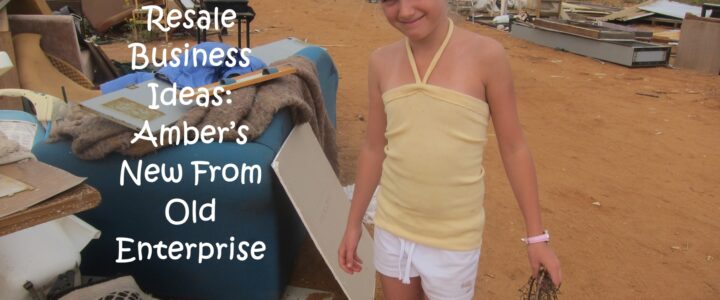
Her Gran suggested that Amber start her search at the local tip’s recycling centre, a place where thrown-away items are put aside, then sold to the public for next to nothing.

Here was a wonderful opportunity to buy something, fix it up and resell it.

For families in the area today, the Shire of Dardanup Waste Transfer Station and Recycling Centre is a useful reminder that recycling, reuse and waste recovery can create opportunities for families to think differently about what gets thrown away.

One Man’s Trash Is Another Man’s Treasure

The old saying, “One man’s trash is another man’s treasure,” was to ring very true here.

So that is the basis of Amber’s new business.

To create something new from something old.

That is why resale business ideas can be so powerful for kids. A child does not always need a huge amount of money, a shopfront or a complicated business plan.

Sometimes they simply need:

  • someone who can teach them how to spot value,
  • a place to search for bargains,
  • a small amount of starting money,
  • a practical eye for what can be cleaned, repaired or improved,
  • and the confidence to try.

Amber’s New From Old Business Plan

Amber’s business plan was simple and sound.

Find something old.

Look for the hidden value.

Buy it for a low price.

Clean it, repair it or improve it.

Then resell it for a profit.

She was definitely onto a winner.

More importantly, she was proud of what she had come up with.

That pride matters. When children own their enterprise idea, they are much more likely to take action and follow it through.

Why Resale Business Ideas Are Great for Kids

Resale business ideas are wonderful for kids because they teach practical business skills in a very hands-on way.

Children can learn how to:

  • notice opportunities,
  • compare prices,
  • think about what other people might want,
  • clean or improve an item,
  • take a good photo,
  • advertise clearly,
  • talk with buyers,
  • and understand profit.

They also learn that value is not always obvious.

Some people see rubbish.

Others see opportunity.

Amber was beginning to learn how to see opportunity.

Amber’s New From Old Series

Follow Amber’s New From Old journey: This article begins the series. The next posts show Amber putting the idea into action and learning how to buy, improve and sell for profit.

Next we will share Flynn’s business plan for his new enterprise.

It is really a honey pot of gold!

Key Takeaway: Resale Business Ideas Can Start Small

Key takeaway: resale business ideas can help children learn how to spot value, buy carefully, improve second-hand items and sell for profit. Amber’s New From Old enterprise began with Gran’s bargain-hunting wisdom and a simple idea: create something new from something old.

Where to Next?

What old item could your child turn into a new opportunity?

Business Ideas for Kids: Finding Enterprise Ideas

kids entrepreneur ideas inspired by real family enterprise experiences

Business ideas for kids often begin with everyday problems, useful skills and a little creative thinking.

Coming up with an enterprise idea that makes money, solves a real problem and keeps a child motivated is a tall order for an adult, let alone a kid.

Children do not need a perfect idea to get started. In fact, many of the best ideas come from noticing what people need, thinking creatively and using the skills children already have.

business ideas for kids through real family enterprise experiences
Looking for enterprise ideas as a family.

Business Ideas for Kids: Finding Enterprise Ideas

Business ideas for kids are often found by looking closely at everyday life. Coming up with an enterprise idea that makes money, solves a real problem and keeps a child motivated can be a tall order for an adult, let alone a kid.

The trick is to spend time brainstorming ideas together and helping children notice the small problems around them.

What I explained to my entrepreneurial kids was that they needed to think about the problems in our small community town, then look for possible solutions.

By solving people’s problems, children begin to create real opportunities for enterprise.

Business Ideas for Kids Start with Solving Problems

In the original video for this post, I gave the kids a simple example. Winter was drawing near and people were chopping wood ready to fuel their fires.

Problem: No one likes scrambling around outside on a cold and rainy day gathering kindling to get their fire started.

Solution: Collect bundles of gum tree sticks, tie them up and sell them to people who need kindling ready to go.

Step one was finding the problem. Step two was finding the solution. Putting the idea into action would be step three.

What a great and simple enterprise idea.

After hearing this example, the kids had no trouble finding enterprise ideas of their own.

Using Skills to Create Kids Entrepreneur Ideas

Our mentor, Paul Counsel, often shares a great educational basis behind what it means to be entrepreneurial.

He encourages us to consider how we are an asset to others. What skills and knowledge do we have that could be of service to others? What are we good at?

For example, Kaitlin and Amber are very good with toddlers and babies. Every day they were helping with their baby sister Akaisha. They fed her, changed her nappy, bathed her and took her for walks.

Both girls were very skilled and had a natural ease with babies. Knowing when Akaisha was tired and how to soothe her when she was upset became second nature. These abilities could easily lead to real enterprise opportunities.

Everyday skills can become enterprise ideas:

kids helping younger siblings read as part of business ideas for kids
Reading with siblings
kids caring for younger siblings and developing enterprise skills
Looking after Akaisha

Turning Everyday Skills into Enterprise Ideas

The obvious enterprise would be babysitting, but other ideas include:

  • Homework Support — busy parents may need someone to listen to younger children read, practise spelling words or help with writing.
  • Toddler Playmate — after school, some parents may appreciate an older child entertaining and playing with their toddler or baby.
  • Walking Younger Children Home from School — busy parents may appreciate a responsible older child helping with the school run.
  • Sports, Dance, Music or Art Coaching — Amber and Kaitlin could teach other kids how to throw, catch, draw, dance or play music.
child who enjoys helping younger kids as a business idea for kids
Kaitlin loves kids.

These are not complicated ideas, but they are valuable and practical. Children can easily miss this point. Often, they do not realise that skills they use every day may be helpful to someone else.

Finding Business Ideas for Kids Through Imagination

All it requires, when finding enterprise ideas for kids, is a little imagination.

Take the time to identify problems and look at what assets you have that could help people. Helping people is the key to enterprise.

Many ideas are not new. However, children often need guidance to look at their existing skills and realise how valuable they already are.

young musician developing skills that could become business ideas for kids
Budding young musician

A tip for everyone: you can increase your value by up-skilling and becoming an expert in an area.

As your skill increases, your value increases too. Over time, people are more likely to seek your help and pay for your time and knowledge.

How Kids Can Start a Business by Increasing Their Value

For example, being a whiz at sorting computer glitches would make you valuable to people who have computer problems. Being an expert pianist could create opportunities to teach others how to play piano.

Many of these ideas are simple. The real lesson is helping children notice what they are already good at, then think about how those skills could help others.

For older children who are ready to take an idea further, Business.gov.au has helpful information for young people starting a business.

Business Ideas for Kids Are Everywhere

Finding enterprise ideas can be fun, and it isn’t that hard if you do a little thinking and brainstorming first.

Amber will reveal her enterprise idea in the next blog as she begins her quest to reach her goals, so stay tuned.

Key takeaway: Business ideas for kids often begin with simple problem-solving. When children learn to notice problems, use their skills and think about how they can help others, they begin to see enterprise opportunities everywhere.

Where to Next?

If you enjoyed this post about finding business ideas for kids, you may also like:

We would love to hear from you, so please leave a comment.

Learning by Doing: The $100 Family Enterprise Project

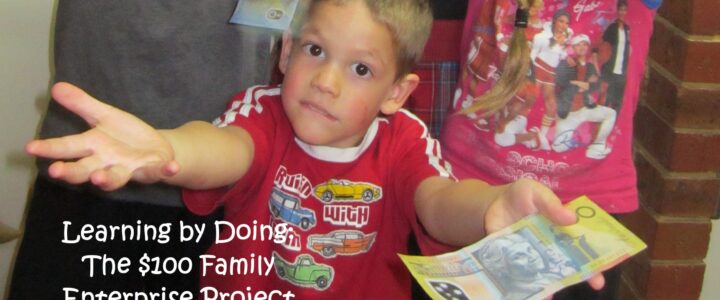
Chayse holding a fifty dollar note for the $100 Family Enterprise Project

Learning by doing is one of the best ways for children to develop enterprise skills. At some point, they need to stop only talking about ideas and begin testing them in the real world.

“`

For our family, that beginning became the $100 Family Enterprise Project. We gave each of the kids start-up capital, asked them to choose an enterprise idea, and decided we would refine the process as we went.

“`

Goal setting for the $100 Family Enterprise Project and learning by doing
Goal setting for Enterprise for Kids.

Learning by Doing: The $100 Family Enterprise Project

For our kids to develop the skills and habits of an entrepreneur, they needed to begin somewhere.

But where?

The beauty of Cathy and I having a wealth creation mentor at our disposal was that we could take the invaluable information we had been learning and apply it in small pieces to developing the mindset of our kids.

This process also involved us having a good, hard look at how we operate in our own lives in regards to planning, organising and taking action.

Cathy loves to plan things out in her head and on paper before starting a task. Once satisfied, she will start when all structures are in place.

I, on the other hand, like to dive in and see where it leads.

So a happy compromise was met.

We decided that the kids just needed to come up with an enterprise idea and get started. We could refine the process later.

Learning by Doing Instead of Waiting for Perfect Conditions

Getting the kids to kick off with an enterprise project, when they had little idea where to even start, was easier said than done.

But I knew that one of the things that had held us back over the years was waiting until all conditions were right.

Waiting had seen us miss many great opportunities that were out there.

So we just started.

Admittedly, it was a bit like the blind leading the blind, but we went in with an open mind and decided to see what would happen and where it would lead.

That is the heart of learning by doing. You do not need to know every step before you begin. You need enough of a plan to start, and then the courage to learn from what happens next.

Chayse and Kit drawing their goals as part of learning by doing
Chayse and Kit drawing their goals.

The First Step in Our Kids Enterprise Project

Check out our very first videos.

The filming is pretty rough, as we had our 15-year-old daughter using her creative licence while filming, but you’ll get the gist of what our project is all about if you watch them.

For those of you who would prefer to read, I’ll give you the rundown.

I presented each of the kids with $100 each, except the baby… as all she would do is try and eat it!

Kids receiving start-up capital for learning by doing through enterprise
The $100 Family Enterprise Project begins.
Kids catching fifty dollar notes as part of the $100 Family Enterprise Project
Raining $50 notes.
Children receiving start-up money for learning by doing through enterprise projects
And more start-up money for the family enterprise project.

“Wow!” was their first response.

An early Christmas present!

“Ohhhh,” was the next response. They were more sedate now that there seemed to be a catch.

But they listened to my proposal.

$100 Start-Up Capital for Kids

The kids were to use the money as start-up capital for an enterprise.

Much to their disappointment, they were not to spend it on themselves.

In fact, they were to pay me back once they had attained their business goal.

I was a bit soft on them though.

I also said that I would take the risk. If they were unsuccessful and were not able to pay back the $100, then I would accept that and absorb the loss.

I did this because I wanted them to give their enterprise a go.

I was conscious that if they were too hung up about having to pay me back, then they might worry about their loss and, as a consequence, not find the courage to even start to play the game.

Loaning the $100 was the first step in our elaborate plan to give our kids a shot at being entrepreneurial with their kids enterprise project.

Why Learning by Doing Matters for Kids

Giving the children $100 did not magically make them entrepreneurs.

What it did was make the project real.

Suddenly they had money in their hands, a challenge in front of them and a reason to think differently.

They needed to ask:

  • What could I do with this money?
  • What could I buy, make or sell?
  • Who might want what I offer?
  • How could I pay the money back?
  • What would make the project worthwhile?
  • What would I learn if it did not work?

These are real business questions.

The Australian Government’s MoneySmart guide to teaching kids about money is a useful reminder that parents can start early and make money part of everyday life.

For us, the $100 Family Enterprise Project became exactly that — an everyday, real-world way to teach money, initiative, risk, responsibility and action.

From Goal Setting to Enterprise Action

This article sits at the beginning of our early Enterprise for Kids journey.

First, the children needed goals they cared about.

Then they needed a reason to act.

Then they needed the courage to try.

The goal-setting process helped them imagine what they wanted. The $100 start-up money helped them move into action.

That is why learning by doing became such an important part of the family project.

Follow the $100 Family Enterprise Project

Follow the early Enterprise for Kids journey: This article shows how the $100 Family Enterprise Project began. The next posts show how the children set goals, chose ideas and started learning through real enterprise projects.

The Biggest Lesson: Just Start

Check out our next blog for the subsequent steps in our entrepreneurial quest.

At this stage, we did not know exactly where it would all lead.

But that was the point.

The children were going to learn by doing.

And so were we.

Key Takeaway: Learning by Doing Builds Enterprise Skills

Key takeaway: learning by doing helped our kids begin their first enterprise projects. The $100 Family Enterprise Project gave them start-up capital, a real challenge, and the chance to develop money skills, confidence and entrepreneurial thinking through action. This is a great project to give kids a financial education.

Where to Next?

What could your child learn by doing if they were given a small enterprise challenge?