Pocket money ideas can become much more than a way for children to earn a few dollars. When a child has to plan, speak to a customer, negotiate a price and deliver a service, they are learning real enterprise skills.
“`
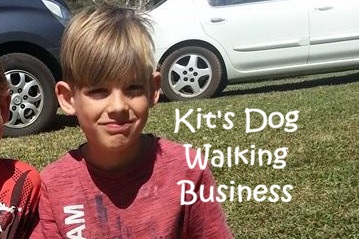
In this post, we revisit Kit and his enterprising dog walking business. This is part of our Dog Whisperer series, where Kit moved from having an idea to actually getting started.
“`

Pocket Money Ideas: Kit Starts His Dog Walking Business
Our kids are becoming enterprising children!
In this post, we revisit Kit and his enterprising dog walking business. He was now ready to implement his carefully thought out dog walking enterprise plan.
It was the school holidays and we were all staying with Kit’s Gran and Grandad in Geraldton.
His first client was a family friend, Pam, who owned a small scruffy dog called Elly. Pam had been prepped with a phone call that Kit would be arriving with his Grandad to ask if she would be interested in hiring his services.
She was delighted to support Kit with his new enterprise and awaited their arrival.
Kit’s First Customer
Kit explained to Pam what his business entailed and the benefits that she and her dog would get if she hired his services.
Pam agreed that his service looked to be very good, and then she asked what his rate was.
Kit said five dollars.
Pam negotiated with him, and they agreed on four dollars for the half-hour walk.


What Kit Learnt from Negotiating
This simple conversation with Pam became a very real business lesson.
Kit had to explain his service, talk about the benefits, name his price and then handle a small negotiation. For a young child, that is a big step.
This is why practical pocket money ideas are so useful. Children are not only earning money. They are learning how to communicate, listen, solve problems and build confidence.
Kit was pleased, but he was not completely sure how he was going to handle Pam’s little energetic dog.
Grandad was an excellent coach. He helped Kit attach the lead, offer Elly a treat and practise giving commands to the dog.
We also believe that children need adult support and supervision when working with animals. The RSPCA WA safety around dogs information is a useful reminder that children should be supervised around dogs and should learn how to behave calmly and safely.
A Pocket Money Idea That Became Real


The walk went very well with no dramas.
Kit returned Pam’s dog and then arrived back at his Gran and Grandad’s house very keen to tell his family all about his business.
That excitement matters.
It is one thing for a child to talk about a business idea. It is another thing entirely for that child to walk up to a real customer, offer a real service, do the job and come back with a story to tell.
Kit Gets Paid for a Job Well Done

Kit continued his dog walking enterprise for the next two days while we were on holidays in Geraldton.
He managed to make twelve dollars!
Kit was now on his way to attaining his goal.
As parents, we felt that more important than attaining his goal was the fact that Kit got started on his idea.
The Biggest Lesson: Getting Started
What holds many people back from achieving their dreams is the inability to actually start.
And of course, there will always be a myriad of reasons why not to start.
The time isn’t right.
There isn’t enough money.
There isn’t enough time.
My family won’t approve.
Not all conditions are right yet.
The list goes on.
These are the “buts” that stop people attaining their goals all the time, so it was refreshing to see one so young as Kit just do it.
That is why this story belongs in more than just a cute family memory. Kit’s dog walking job became one of those practical pocket money ideas that taught him about service, action, confidence, negotiation and follow-through.
Dog Whisperer Series: From Planning to Action
This article is part of Kit’s Dog Whisperer series.
- Part 1: Kit Plans His Dog Walking Enterprise — Kit thinks through the idea, roadblocks, safety and value of his dog walking service.
- Part 2: Kit Starts His Dog Walking Business — Kit gets his first client, negotiates a price, completes the job and earns his first money.
Small enterprises like this can teach children lessons that are difficult to learn from theory alone. Kit learnt by doing.
What Pocket Money Ideas Can Teach Children
When children are given the chance to explore safe and realistic pocket money ideas, they can learn much more than how to make a few dollars.
They can learn:
- how to spot a need,
- how to offer a service,
- how to speak with a customer,
- how to negotiate a price,
- how to follow through,
- how to handle responsibility,
- and how good it feels to earn money from their own effort.
Our enterprising children are now all busy with their individual kid’s enterprises.
It will be time to check in with Jai and see whether his enterprise plan eventuated.
Until then……….
Key Takeaway: Pocket Money Ideas Build Confidence
Key takeaway: pocket money ideas can become powerful real-world learning experiences. Kit’s dog walking business taught him to speak to a customer, negotiate a price, work safely with support, complete the job and get started on his goal.
Where to Next?
- Read Part 1: Kit Plans His Dog Walking Enterprise
- Read RSPCA WA’s safety around dogs guide
- Read Chayse the Candy Man
- Read Amber’s New From Old resale enterprise story
- Explore more Kids Business Ideas
- Explore more Money Lessons for Kids
What simple pocket money idea could help your child build confidence and get started?