
A million dollar business plan sounds like something created in a boardroom, but this one unfolded during a ten-hour road trip to Geraldton in Jai’s much-loved Land Rover.
Jai was travelling with his younger brother Chayse and their friend Flizzy to visit the boys’ grandparents. Along the way, Jai began coaching Chayse through a practical question: what would a realistic million dollar business plan look like for someone starting with limited money and experience?
It became much more than a business conversation. One brother’s experiences, successes and mistakes became a guide for another brother who is just beginning his own entrepreneurial journey.
The purpose of this million dollar business plan was not to promise overnight wealth. It was to help Chayse make better decisions, test ideas carefully and build evidence before investing too much time or money.

Editor’s note: This article shares Jai’s personal business framework and our family’s reflections on his journey. It is educational rather than financial advice, and no business plan can guarantee a particular result.
A Road Trip, Two Brothers and a Million Dollar Business Plan
Jai is nine years older than Chayse. He remembers clearly what it felt like to be Chayse’s age: ambitious, curious and convinced that there had to be a way to create a life on his own terms.
Chayse is now at that same stage. He has taught himself how to build websites and apps, work with artificial intelligence, create digital products, run marketing campaigns and pitch his skills to online businesses. He has experimented with NFTs and cryptocurrency, completed paid work for clients and recently secured an internship in digital content and user-generated content marketing.
He looks up to Jai, not because everything Jai has tried has worked, but because Jai has built, failed, adapted and built again.
That made the Geraldton trip an ideal opportunity for a longer conversation. There were no formal desks, presentation slides or classrooms. There was a long road, plenty of time and a younger brother ready to listen.
Jai’s Early Enterprise Lessons Began Long Before the Million Dollar Businesses

For us, one of the most meaningful parts of this story is seeing how Jai’s current business thinking connects with the small enterprise experiences he had as a child.
Readers who followed Enterprise for Kids in the early years may remember Jai exploring technology, vlogging, media creation and app development. At around thirteen, he was already fascinated by the idea that technology could be used to create something valuable. His early Apple app enterprise idea did not become an instant success, but it taught him to think in terms of problems, products, technology and possibility.
Those childhood ideas were not wasted just because they did not immediately become profitable businesses. They were rehearsals. Jai was learning how to imagine an outcome, find information, ask for help, deal with roadblocks and keep moving.
This is one of the recurring themes in our family enterprise stories. The small experiments children try today may become the foundations of the work they do years later.
How Jai Learned the Lessons Behind His Million Dollar Business Plan
One of Jai’s most valuable early opportunities came when a successful businessman employed him to follow his work and family life with a camera.
Jai travelled with him, filmed his daily activities and recorded the business courses he delivered to clients in places including Bali and the Hunter Valley. He then spent hours editing the footage for social media and online course content.
On the surface, Jai was being paid to film and edit. In reality, he was receiving an unusually close education in business.
That kind of exposure is one reason we believe young entrepreneurs and business mentors can have such a powerful influence on children. Seeing how someone thinks, works and makes decisions can expand what a young person believes is possible.
He observed how the businessman communicated, taught, made decisions, served clients, structured offers and presented ideas. Jai was learning through proximity. He could see what business looked like from the inside rather than only reading about it from the outside.
Years later, the pattern came full circle. Flizzy was working with Jai, filming and creating content during the Geraldton trip, much as Jai had once done for his own mentor. Flizzy then shaped that footage into the YouTube video embedded below.
One young person had once learnt by carrying the camera. Now another young creator was doing the same while Jai passed his lessons to Chayse.
Watch Jai Coach Chayse Through His Million Dollar Business Plan
You can also watch Jai’s full video on YouTube.
What the Million Dollar Business Plan Teaches About Success and Failure
Jai’s advice did not come from theory alone. By the time of this conversation, he had already experienced several very different businesses.
One of his early ventures was a media agency called Brand Boostr. It grew quickly and, at one point, employed more than a dozen people. The business generated significant revenue, but rapid growth also exposed weaknesses. Jai discovered that sales and profit are not the same thing, and that poor cashflow management can place even a busy, successful-looking business under pressure.
These experiences also reinforce why financial education for kids needs to include more than earning money. Young people also need to understand value, expenses, assets, liabilities and the consequences of financial decisions.

That experience was painful, but it became one of his most important lessons.
Jai later built Naming This Later with a business partner. They designed a versatile woven throw that could be used at the beach or in the home, had it manufactured in India and marketed it internationally through Facebook advertising. The business achieved more than one million dollars in sales. Jai eventually gifted his share to his business partner after recognising that his enthusiasm had moved elsewhere.
He also helped build Founder Sports Club, a membership community designed to help active entrepreneurs meet other founders through sport and real conversation. It now operates as part of Art of Mondays’ Founder Sports Club.
Today, Jai is building Art of Mondays with his business partner Evan. The business creates spaces and communities for ambitious people who want to build meaningful work while also creating a life they enjoy.
Across these businesses, Jai has experienced growth, pressure, excitement, loss of motivation, mistakes, reinvention and the consequences of moving too quickly. That is why his advice to Chayse is practical. He knows a good idea is not enough. A business must solve a meaningful problem, attract paying customers, manage money, deliver value and fit the life of the person building it.
Jai’s One-Page Million Dollar Business Plan
Jai describes this as the one-page playbook he has used when taking businesses from an idea towards the one-million-dollar-a-year level. His million dollar business plan is designed to keep the founder focused on evidence, customers and practical action rather than complicated forecasts or guesswork.
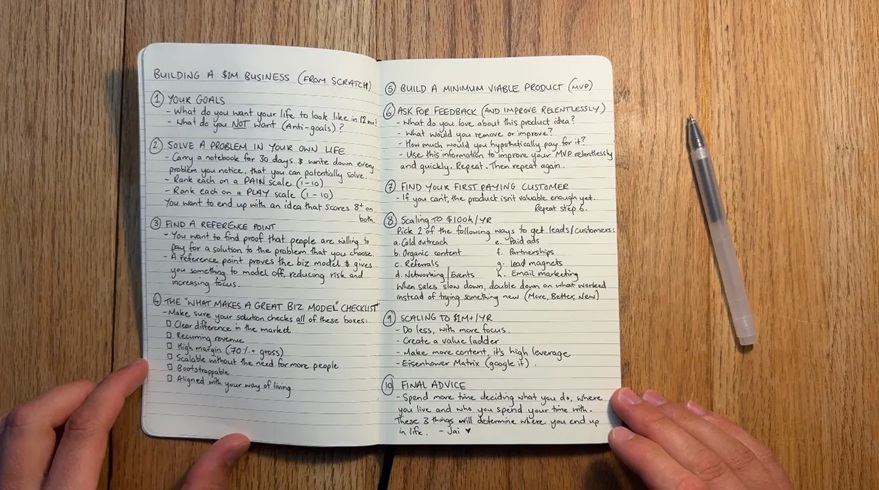
It is not a traditional business plan filled with lengthy forecasts and formal documents. It is a decision-making framework. It helps a founder choose a worthwhile problem, test a solution quickly and build evidence before investing too much time or money.
For a simpler introduction suitable for younger students, our article on business plan ideas for students explores how training, tools, teamwork, time and clear goals can help turn an idea into action.
The strength of this million dollar business plan is that it begins with decisions and evidence rather than complicated forecasts or guesswork.
1. Begin With the Life You Want
Before choosing a business, Jai asks a bigger question:
What do you want your life to look like twelve months from now?
The answer should include more than an income target. It might include where you want to live, how you want to work, the people you want around you, the amount of freedom you want and the experiences you hope to create.
Jai also encourages Chayse to identify his anti-goals: the things he does not want his success to cost him.
- I do not want to work twelve-hour days indefinitely.
- I do not want to sacrifice my physical or mental health.
- I do not want to build a business that makes travel impossible.
- I do not want success to leave me isolated or lonely.
This is an important distinction. A business can look successful from the outside while creating a life the founder does not enjoy.
2. Solve a Problem You Understand
Jai’s next step is to carry a notebook for thirty days and record problems as they appear in everyday life.
Each problem can then be scored using two scales:
- PAIN: How frustrating, expensive or difficult is this problem for the person experiencing it?
- PLAY: How enjoyable and natural would solving this problem feel to you?
The most promising opportunities score highly on both. The customer genuinely wants relief from the problem, and the founder is interested enough in the solution to remain engaged when the work becomes difficult.
This is excellent advice for young entrepreneurs. Instead of beginning with, “How can I make money?”, begin with, “What problem can I solve well?”
This connects closely with our lesson on entrepreneurship for students, where we explore how young people can learn to notice opportunities, solve problems, create value and take action.
3. Find a Reference Point
A completely original idea is not always an advantage.
Jai advises looking for another business that is already solving a similar problem. Its existence can provide evidence that customers recognise the problem and are willing to pay for a solution.
The goal is not to copy someone else. It is to understand the market, learn what customers already value and then create a clear difference.
4. Test the Business Model Before Falling in Love With the Idea

Jai uses a simple checklist when assessing a possible business model:
- Does it have a clear difference in the market?
- Can it produce recurring revenue?
- Can it achieve strong margins?
- Can it scale without requiring an equally large increase in staff?
- Can it be started without raising a large amount of outside capital?
- Does it suit the founder’s desired way of living?
Not every worthwhile small business will meet every item perfectly. However, the checklist forces a young founder to think beyond whether the idea sounds exciting.
A strong business must work for both the customer and the person building it.
5. Build a Minimum Viable Product Quickly
Instead of spending months making a polished product in private, Jai encourages Chayse to build a minimum viable product, or MVP, within about three days.
The first version only needs to solve the central problem well enough for real people to try it.
His advice is:
- Use the 80/20 rule.
- Focus on the few features that create most of the value.
- Aim to be meaningfully different rather than marginally better.
- Offer the early version free when useful so people will test it.
This reduces the cost of being wrong. A founder learns from users before investing heavily in a product people may not want.
Within Jai’s million dollar business plan, speed matters because early testing can prevent months of work being invested in the wrong solution.
6. Ask for Feedback and Improve Relentlessly
Once people begin using the product, Jai recommends asking direct questions:
- What do you love about this idea?
- What would you change or improve?
- What is confusing or unnecessary?
- How much would you realistically pay for it?
He suggests watching customers use the product, creating a simple group chat for suggestions and studying competitors’ one-star reviews. Complaints often reveal gaps that a new business can solve better.
At the same time, Jai warns against adding every requested feature. More does not always mean better. If removing a feature does not break the core solution, it may be noise rather than value.
7. Find the First Paying Customer
A compliment is encouraging, but a paying customer is evidence.
This is a crucial point in the million dollar business plan: interest is useful, but a real sale provides much stronger evidence that the business is solving something valuable.
The first sale proves that someone values the solution enough to exchange real money for it. If people like the idea but will not pay, the founder may need to improve the product, solve a more painful problem or communicate the value more clearly.
This stage is not failure. It is information.
8. Build a Predictable Path to $100,000 a Year
Once the product works and customers are willing to pay, the next challenge is creating a repeatable way to attract more of them.

Jai encourages choosing two lead-generation methods rather than trying everything at once. Options include:
- direct outreach through email, messages or calls;
- organic content across social media platforms;
- referrals from happy customers;
- networking and events;
- paid advertising;
- partnerships;
- lead magnets, webinars and workshops; and
- email marketing and customer retention.
His advice when growth slows is often to do more of what has already worked before abandoning it for a completely new strategy.
More volume, better execution, then something new.
9. Scale Towards One Million Dollars With More Focus, Not More Chaos
At this stage, Jai’s advice becomes surprisingly simple: do less, but do it with greater focus.
He encourages founders to increase the value they provide and create a logical pathway for customers:
- give away something genuinely useful to attract the right people;
- offer an affordable first paid product;
- develop a recurring product or membership;
- create a higher-value offer for customers who need deeper support.
He also emphasises content. Strong businesses need demand, and useful content can educate customers, build trust and show people why the solution matters.
Finally, founders need to decide what should be automated, delegated or eliminated. Growth becomes difficult when the founder remains responsible for every small task.
This stage of the million dollar business plan is about creating focused, repeatable growth rather than simply adding more work for the founder.
10. Choose Your Work, Environment and People Carefully
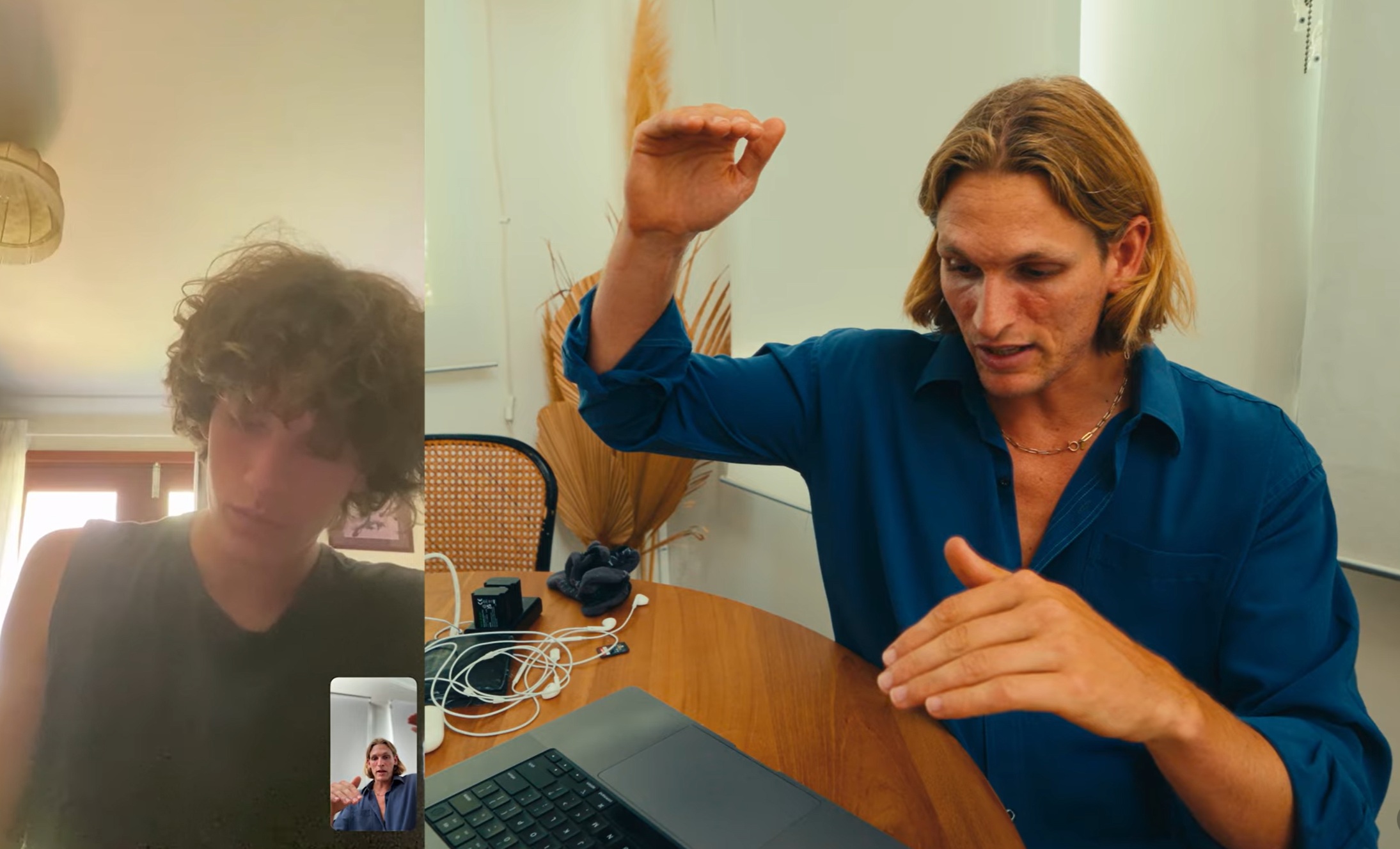
Jai’s final lesson is not really about revenue.
He tells Chayse to spend more time deciding:
- what he wants to do;
- where he wants to live; and
- who he wants to spend his time with.
Those three choices shape far more than a business. They shape a life.
“When I was young, a few people believed in me, and it changed what I believed was possible.”
This also connects with our article on limiting beliefs in children. Encouragement does not guarantee success, but it can help a young person believe they are capable of learning, trying and recovering when an idea does not work.
That belief is something Jai now wants to pass on.
Chayse Is Not Starting From Nothing
Although the video frames the challenge as building a business from scratch, Chayse is not beginning empty-handed.

He already has years of self-directed learning behind him. He has built and sold digital assets, developed websites and apps, completed projects for paying clients and invested his own money in learning marketing skills. He understands online communities, content, artificial intelligence and the speed at which digital opportunities change.
Just as importantly, he has older siblings who can show him what success and failure actually look like.
When Chayse was four, we wrote about his little lolly business and the excitement of turning a small amount of start-up money into something more. Today, the products and platforms are different, but the foundation is familiar: notice an opportunity, make a plan, test the idea and learn through action.
You can follow more of his earlier and current journey through our Chayse Howitt stories.
The Mentorship Circle Comes Back Around
There is something especially powerful about the way this story connects three young men.
Jai once learnt by filming a businessman, listening to his teaching and observing how he worked. Flizzy was now working with Jai in a similar creative role. At the same time, Jai was mentoring Chayse and turning his own difficult business lessons into a clearer pathway for his younger brother.
This is how practical knowledge often moves between generations and peers. Someone opens a door, shares what they know and gives another person the confidence to begin.
It also reinforces why we continue to believe in raising entrepreneurial kids through real-world learning. We cannot predict which childhood project, family conversation, mentor or early failure will matter most. We can only create opportunities, encourage curiosity and help young people learn how to think.
Key Takeaway: A Million Dollar Business Plan Begins With Better Decisions
Key takeaway: Jai’s million dollar business plan is not a promise of quick wealth. It is a framework for making better decisions: choose the life you want, solve a painful problem, test the solution quickly, listen to customers, find a repeatable path to growth and stay focused on what creates real value.
For Chayse, the greatest advantage may not be the plan itself. It may be having a brother willing to share the wins, mistakes and hard-earned lessons behind it.

What is one problem you notice in your own life that could become the beginning of a useful business idea? Share your thoughts in the comments below.