How Bad Do You Want It?

Kids jumping off a sand dune on a USA family trip with the words How Bad Do You Want It

How bad do you want it? That question became a powerful student motivation lesson in our family after Kaitlin shared a short video about success, focus and wanting something badly enough to keep going.

“`

We were originally going to write about Kit and Chayse’s enterprise goals, but this video made us pause. It challenged us to think about what real commitment looks like — not just for business, but for study, sport, family, financial freedom and life.

“`

How Bad Do You Want It video clip used as a student motivation lesson about focus and goals
How Bad Do You Want It? Click the image to watch the video that sparked this lesson on focus, goals and success.

How Bad Do You Want It? A Student Motivation Lesson

Our daughter Kaitlin saw the How Bad Do You Want It? video on YouTube and sent us the link. We thought it was awesome. It does not go for very long, but the message is strong enough to stay with you.

The video tells the story of a young man who wanted to be successful. He went to a guru and said he wanted to be on the same level. The guru took him into the water and eventually held his head under until the young man desperately wanted air.

“When you want to succeed as bad as you want to breathe, then you’ll be successful.”

That is a confronting image, but it makes the point. Many of us say we want success, but we also want comfort, convenience, distraction and easy results at the same time.

After watching the video, it made us ask ourselves honestly: do we really want it, or do we only kind of want it?
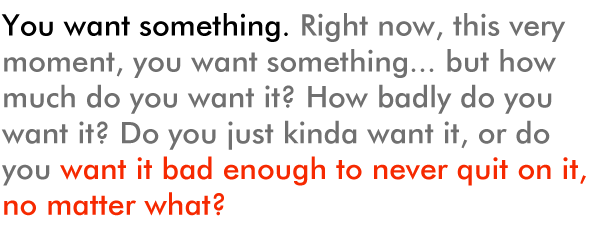
Intense desire quote from How Bad Do You Want It student motivation lesson

How Bad Do You Want It When Life Gets Busy?

Want what, you may ask?

Well, anything really.

How much do we want our fitness levels to be at their best? How much do we want to be financially free? How much do we want a happy and loving family life? How much do we want time with friends, unique experiences and a life that feels meaningful?

For us, it is a little bit of everything.

But one of the things we realised while completing Paul Counsel’s Money Mastery course was this: when we split our attention between everything, we often get a medium result from everything.

There is nothing wrong with that. It can make life comfortable, and that is fine for many people.

But for us, we were ready to challenge ourselves. We were ready to step up and make a difference in those areas in a big way, not an average way.
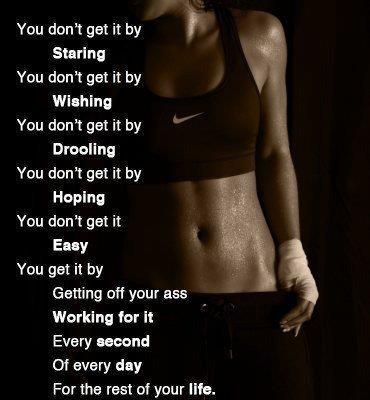
How Bad Do You Want It quote about wanting success and staying committed
Wanting success is easy. Staying focused long enough to earn it is the challenge.

Student Motivation Starts With Focus

This is where the video becomes such a useful student motivation lesson.

Students often say they want strong results. They want good marks, sporting success, creative achievement, friendships, confidence or future opportunities. But the real question is whether their daily actions match what they say they want.

That is not a criticism. It is a life lesson.

Focus is difficult. Life is noisy. Friends, phones, family, sport, school, work, hobbies and distractions all pull at our attention. Even adults struggle with this.

But if a teenager wants a result badly enough, they need to learn how to protect their focus. That might mean:

  • doing the study before the distraction,
  • finishing the task before moving on,
  • training when they do not feel like training,
  • asking for help instead of giving up,
  • and remembering why the goal matters.

This is not only about school. The same lesson applies to young entrepreneurs, young athletes, musicians, writers and children with business ideas.

How Bad Do You Want It as a Family?

As parents, we also had to ask ourselves the same question.

So, while we may not exist on three hours of sleep a night — although that has been debatable at times with an eighteen-month-old in the house — we do put in long hours.

We stay up late, long after the kids have gone to bed, working on our internet business, studies, trading and health and wellbeing business. We are not doing this because we want to be busy for the sake of being busy. We are doing it because we are trying to build a future with more freedom, more choice and more meaningful experiences for our family.

Focus your mind and energy on what you want as a student motivation lesson
Where your attention goes, your results often follow.

We know we are already successful in some parts of our lives. We have a wonderful family and supportive friends, and we know that came through dedication and focus.

Now we are working to transfer that same focus into other areas of life.

Financial Freedom and Determined Focus

Financial freedom has always been one of the bigger goals behind Enterprise for Kids. Not because money is the only measure of success, but because freedom gives families options.

When we are financially free, we can create more time with our kids. We can hire help for some of the mundane things in life. We can create awesome experiences beyond what we have already had. We can take time to enrich our relationships without constantly worrying about the next bill.

That takes determined focus.

It may take us longer to achieve our goals than it will for Giavanni Ruffin, the athlete in the video. He has major, unstoppable focus and he will achieve. It is not a matter of if. It is a matter of when.

But even if we used just a tenth of that energy and commitment, it would still be better than having no focus at all.

Commitment quote about focus and how bad do you want it
Clear intention and determined focus help turn goals into action.

How to Stay Focused on Your Goals

One of the strongest lessons from this video is that attention matters.

Where your attention is held is what tends to show up in your life. You need to attend to your intention. A clear intention, backed by determined focus, can set you on the right path to success.

For children and teenagers, this can be made very practical.

1. Name the goal clearly

A vague goal is easy to ignore. A clear goal gives the mind something to aim at.

2. Ask why it matters

Children need to know why the goal matters to them, not just why it matters to the adults around them.

3. Remove one distraction

Focus does not always require a complete life overhaul. Sometimes it starts by removing one distraction for one hour.

4. Take one action today

The best motivation for students often comes after action, not before it. Start small, then build momentum.

5. Review the result

After the action, ask: what worked, what did not work, and what is the next step?

Goal Setting for Teenagers and Enterprising Kids

This lesson on focus can be applied by anyone. It applies to teenagers studying at high school, kids with big sporting ambitions, parents developing a business, and young people building an enterprise.

Kaitlin was challenged with maintaining focus in her studies. We were glad she discovered this video, thought about its excellent message, and decided to share it with us.

That is exactly what we want for our children. We want them to notice ideas that challenge them. We want them to question themselves. We want them to think about what they want and whether their habits are helping them get there.

For enterprising kids, this is especially important. Business ideas are exciting at the start, but results usually come after the boring, repetitive, uncomfortable parts: following up, finishing the job, practising the skill, serving the customer, improving the offer and trying again after disappointment.

How Bad Do You Want It? Part 2

If you enjoyed the first video clip and thought that was all there was, you may also like the second part.

How Bad Do You Want It Part 2 video for student motivation and focus
How Bad Do You Want It? Part 2 — click the image to view.

Key Takeaway: How Bad Do You Want It?

Key takeaway: How bad do you want it? Success is not only about wanting a result. It is about focus, commitment and taking repeated action when the goal matters enough.

Where to Next?

How badly do you want the goal you say matters to you? And what is one action you can take today to move closer to it?


Financial Literacy for Teens: Jai and Kaitlin’s Enterprise Journey

Jai and Kaitlin as young teens learning financial literacy through enterprise goals

Financial literacy for teens often becomes most powerful when it is connected to a real goal. For Jai, that goal was finding the money he needed for Country Week Soccer. For Kaitlin, it was learning how to manage her creative enterprise alongside study, sport, friends and teenage life.

“`

In this part of our family enterprise journey, Jai and Kaitlin remind us that teenagers do not always need another lecture about money. Sometimes they need a meaningful reason to take action.

“`

Akaisha as a toddler in a dog walking photo introducing financial literacy for teens through family enterprise stories
Enterprise lessons begin early in family life, but teenagers often need real goals before financial literacy truly comes alive.

Financial Literacy for Teens: Jai and Kaitlin’s Enterprise Journey

So far in our family enterprise journey, we have seen Flynn build a great honey enterprise and actually achieve his goal. Kit had a go at dog walking, but quickly realised that Chayse was making more money selling lollies at the local soccer fields, so he began pursuing that with his brother.

Kit and Chayse made quite a team, and we will revisit them again in another blog post. Amber also reached her goal with her “New from Old” endeavours, and we will celebrate her achievement separately too.

That leaves our creative artist, Kaitlin, and our budding app developer, Jai.

What has been interesting to notice on the children’s journeys is that it can be easier to introduce a different mindset around money to younger children than it is to teenagers or older children.

Why would financial literacy for teens be more challenging?

In our case, Kaitlin and Jai had already been around longer with us as their major source of education. That meant our own money thoughts, objections and subconscious beliefs had been absorbed by them for longer. It was now more of a process to help them question and reshape those beliefs.

Teenagers, Money Beliefs and Real-Life Goals

Kaitlin and Jai learning financial literacy for teens through youth enterprise goals
Kaitlin and Jai were learning that money goals need time, action and follow-through.

Luckily for us, Kaitlin and Jai are both quick learners and they understood the concepts we were trying to teach.

The main obstacle was finding the time to put this new knowledge into action.

Being teenagers, their lives were already full of homework, study, sporting commitments, social life and social media. All of these are things we wanted to encourage in our children, so our challenge was finding a way to include financial education without making it feel like one more burden.

In the end, as with many things, life became the best teacher of all.

Jai’s Teen Money Goal for Country Week Soccer

Jai setting teen money goals as part of financial literacy for teens
Jai’s focus changed when he had a real money goal to reach.

Jai had not had much urgency to pursue his app development because there was no clear timeline attached to his goal. His app idea was exciting, but it was also a long-term project.

Then his goal changed.

Jai was accepted into the Country Week Soccer team and would be competing in Perth during the holidays. He had to pay for a good portion of the trip himself.

Suddenly, he had a renewed vision and a very real money goal to aim for.

He spent countless hours researching ways to make the money in a short amount of time. This is where his youth enterprise thinking kicked into action.

Jai using enterprise ideas to help pay for his Country Week Soccer goal
Jai loves being active, and Country Week gave him a goal worth working for.

He came up with different ways to make the money, including some ideas he had not been interested in before.

The opportunities Jai looked at included:

  • mowing lawns in the neighbourhood,
  • finding good-quality items to sell,
  • hiring out exercise equipment,
  • negotiating paid jobs around the house that were above and beyond normal chores.

Together, Jai and Trevor worked out that he needed to find about $10 a day to afford his portion of the trip. That made the goal feel clearer and more achievable.

He began negotiating with us over jobs that needed doing around the house, and then he got on with them.

He also went through many of his good-quality items that had once been “must haves” when he bought them. He realised that perhaps he did not need them as much as he first thought, so he posted them on Facebook to sell.

What Jai Learnt About Financial Literacy for Teens

Jai’s Country Week goal became a practical financial literacy lesson. Instead of simply asking for money, he had to think about earning, selling, negotiating, time, effort and priorities.

He also had to work out the difference between a long-term enterprise idea and a short-term money need.

Although Jai’s app development journey had taken a back seat, it had not been forgotten. He simply recognised that app development was a longer-term project, while his Country Week Soccer goal needed faster action.

That is an important financial literacy lesson for teenagers. Not every money-making idea suits every goal. Sometimes a teen needs quick cash flow. Other times, they need patience, skill-building and a longer timeline.

We were proud of Jai’s efforts and were confident he would reach his goal in time.

Kaitlin’s Creative Enterprise and Time Management

Kaitlin painting as part of her creative enterprise and financial literacy for teens journey
Kaitlin doing what she loves — using her creative skill as a possible enterprise.

Kaitlin, our artist in residence, was also learning an important financial literacy lesson.

Her lesson was not only about how to make money. It was about how to manage her energy, time and priorities around study, social life, sport and her youth enterprise ventures.

Kaitlin had already explored the idea of turning her artistic skill into a student enterprise. You can read more about that earlier stage in Kaitlin’s portrait drawing enterprise.

Now she had a timeline in place and was receiving more requests for artwork. That meant she had to begin each piece early enough to finish it before Christmas for some customers, and earlier for others.

This was a different kind of money lesson. Kaitlin had to connect creativity with responsibility. If people were asking her to create artwork, she needed to protect the time and energy required to deliver it properly.

Teenage Distractions and Self-Efficacy

Kaitlin learning time management and self efficacy as a teenager with enterprise goals
Kaitlin and Lachlan.

Having a boyfriend actually increased Kaitlin’s self-efficacy because she needed to complete certain things before socialising.

Luckily, Lachlan encouraged Kaitlin to do that, because he actually wanted to have a social life too!

This connects beautifully with the lesson we explored later in Kaitlin’s article about avoiding distractions and following through on her enterprise goals.

For teenagers, financial literacy is not only about budgets and bank accounts. It is also about self-management. It is about learning that if you want to earn money through your skills, you need to manage your time, energy, focus and commitments.

Creative Enterprise with Kaitlin and Georgia

Kaitlin and Georgia exploring creative enterprise and real-world learning as teenagers
Kaitlin and Georgia exploring ideas, creativity and enterprise.

Kaitlin and her friend Georgia were also realising the power of leveraging their time.

They had come up with some great enterprise ideas and had put steps in place to pursue them. These were longer-term goals, but in the end they could reap more rewards than simply working a job.

At the same time, they still saw the need to pursue their jobs in the meantime, so they could have money to put towards their enterprise when it was up and running.

This is another important financial literacy lesson for teens: sometimes a job and an enterprise can work together.

A job can create cash flow. An enterprise can create ownership, learning, creativity and possibility. Both can play a role while a teenager is learning how money, work and opportunity connect.

Financial Literacy for Teens Happens Through Real Life

The journey towards financial freedom is always a rocky one, but it is one worth following regardless of what else is going on in life.

Our kids are teaching us so much along the way. Not all of their efforts are successful, but they are learning from each experience and moving forward.

That is what makes real-world learning so powerful.

Jai’s story shows how a clear money goal can turn a teenager into a problem-solver. Kaitlin’s story shows how creativity, customers and deadlines can teach responsibility and time management.

Neither of those lessons can be fully taught from a worksheet.

They are lived.

Where Jai and Kaitlin Are Today

Looking back 14 years later, it is beautiful to see how these early enterprise lessons continued to show up in Jai and Kaitlin’s lives.

Jai’s early interest in app development, problem-solving and online enterprise has grown into his current business, Art of Mondays. It is a wonderful example of how early exposure to enterprise, technology and financial literacy can keep developing over time.

Kaitlin’s creativity and interest in bringing ideas to life has also continued. You can see a glimpse of what she is creating now through Kaitlin’s Golden Days Club.

At the time, these teenage money goals may have looked like small family lessons. But years later, they remind us that children and teenagers are often building foundations long before we can see the full picture.

Key Takeaway: Financial Literacy for Teens Needs Real Goals

Key takeaway: financial literacy for teens becomes more meaningful when teenagers have real goals. Jai needed money for Country Week Soccer, while Kaitlin needed to manage creative requests and deadlines. Through youth enterprise, they learnt money skills, focus, responsibility and real-world problem-solving.

Where to Next?

What real goal could help your teenager learn more about money, responsibility and enterprise?

Young Australian Entrepreneurs: Lessons from Dale Beaumont

Dale Beaumont presenting at Business Blueprint as an example of young Australian entrepreneurs

Young Australian entrepreneurs can be powerful role models for children. When kids see real people building businesses, creating freedom and using their success with purpose, enterprise becomes much more than an idea in a book.

“`

Dale Beaumont is one of those examples. His story reminded us that who we spend time with, who we learn from and who we allow to influence our thinking can shape what we believe is possible.

“`

Dale Beaumont as a young entrepreneur inspiring enterprising kids
Dale Beaumont began his entrepreneurial journey young, making his story a powerful example for enterprising kids.

Young Australian Entrepreneurs: Lessons from Dale Beaumont

Part of what we love about this blog is that we get to share the success of young entrepreneurs with not only our readers, but also our kids.

As we have been learning through Paul Counsel’s course, and as Dale Beaumont also reinforced for us, who you “hang with” is often who you become like.

That can be a scary thought, or it can be an inspiring thought, depending on your peers and the people you spend the most time with.

Luckily, we have wonderful family and friends. But for us, it is also important to include people who have achieved success in areas where we are still learning and growing.

Some of our family and friends fulfil those needs, but a sure way of increasing self-efficacy for us and our kids is to mix with other successful entrepreneurs, business owners and people who think differently.

Dale Beaumont as a Young Australian Entrepreneur

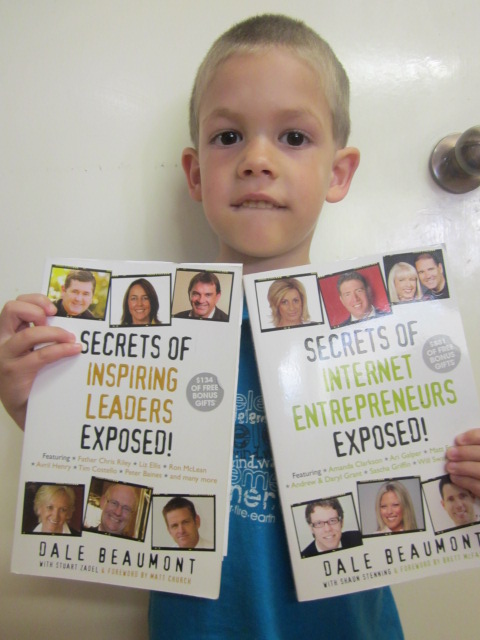
Dale Beaumont Secrets Exposed Series as an example of young Australian entrepreneurs creating books and business education
Dale Beaumont wrote the Secrets Exposed series.

Dale Beaumont is one such inspiring young Australian entrepreneur. He may not see himself as “young” anymore, but his success started at the tender age of 19.

Before developing his entrepreneurial skills, Dale was an accomplished gymnast and probably what many people would call an overachiever.

When Dale was 19, he co-authored a book called The World at Your Feet, which became the basis of his successful program, Tomorrow’s Youth. Through that program, he taught young people essential life skills.

From there, Dale went on to publish books, build relationships with other successful entrepreneurs, business owners and thought leaders, and eventually develop Business Blueprint.

His journey is a wonderful example for children because it shows that enterprise can begin young. It also shows that success is rarely about one single moment. It is built through learning, relationships, systems, action and persistence.

What Young Australian Entrepreneurs Teach Our Kids

One of the biggest lessons Dale Beaumont’s story teaches our children is that entrepreneurship is not just about making money.

It is about learning how to think. It is about developing skills, building useful systems, creating value, managing time, solving problems and making choices that can lead to more freedom.

Dale Beaumont with his family showing family freedom through entrepreneurship
Dale with one of his children.
Dale Beaumont and his wife travelling as a result of business systems and financial freedom
Inside the Sistine Chapel.

Dale is married and has two boys, and one of the things that really appealed to Trevor and me was that his focus was not only on business growth. It was also on creating time and freedom to travel with his young family.

He was able to do this because he had built systems within his business so that everything could keep ticking along with or without him.

You can imagine how appealing that was to us.

We did not want business success that simply created another job. We wanted to learn how business could create choice, flexibility and meaningful family experiences.

Lessons from Business Blueprint

I will not go through the whole workshop that my good friend Sally and I attended in Perth, but I do want to share a few highlights that really stuck with me as Dale spoke.

Dale Beaumont presenting at Business Blueprint as an example of young Australian entrepreneurs
Presenting at Business Blueprint.

Two sayings that stood out were:

“Empty bank accounts don’t feed the people.”

“The poor can’t help the poor.”

Those two sayings alone say a lot.

Some people want money purely for money’s sake — to have nice things and show others how well they are doing. Others want money so they can enjoy wonderful experiences, support their family, do good things in the world and make a difference in the lives of others.

We fall into that second category.

Dale’s example helped reinforce something important for our family: money with purpose can become a tool for freedom, contribution and service.

Money, Purpose and Making a Difference

One thing we found inspiring was Dale’s support for Hands Across the Water in Thailand. It was powerful to see an entrepreneur using his success and influence to make a difference in the lives of children.

This is an important message for enterprising kids.

We do not want our children to think that business is only about making money. We want them to understand that business can also create choices, opportunities and the ability to contribute.

That idea connects beautifully with our own reflections on whether having a money mindset can also be charitable.

The Internet Changed Business Forever

New Rules of Business seminar showing how the internet changed business for young Australian entrepreneurs
New Rules of Business seminar.

The internet has changed business forever.

If we do not embrace that change, our businesses can get left behind. A classic example was the way physical bookstores were challenged as online bookselling grew rapidly.

The point for our children is clear: the business world they are growing into is very different from the business world we grew up in.

Today’s young people need to understand technology, online marketing, digital systems, automation, websites, customer service, communication and content.

They do not need to master all of these skills as children, but they do need to grow up with the mindset that learning never stops.

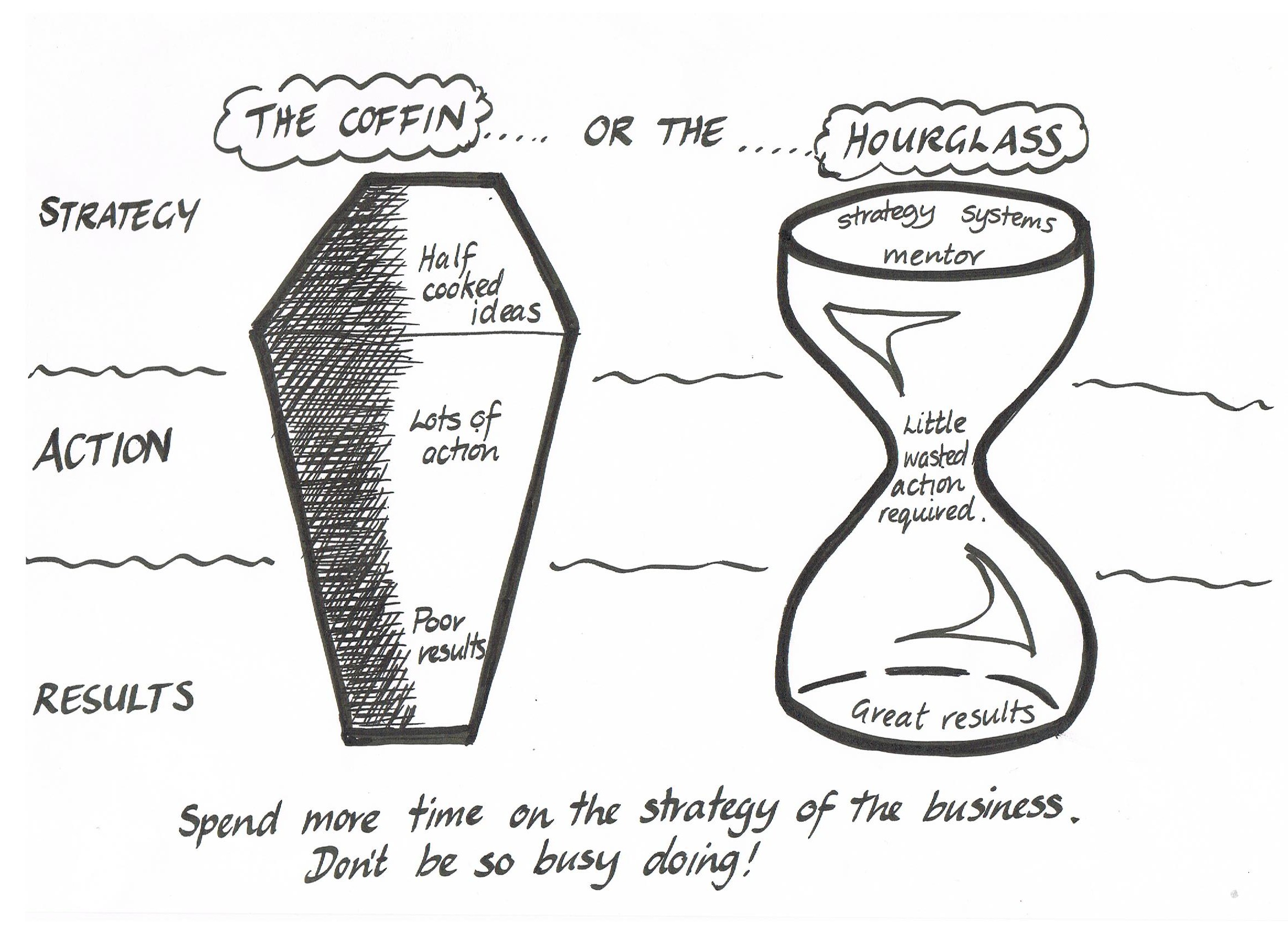
The Coffin or the Hourglass

Dale shared something he learnt when he was just starting out in business.

He called it the coffin or the hourglass.

The coffin or the hourglass business planning model taught by Dale Beaumont
The Coffin or the Hourglass.

Many people starting in business spend more time taking action than they do strategising or planning where they want their business to end up.

Taking action is important, of course. But you do not want your business to be like a coffin, where little time is spent thinking, planning and designing the right direction, while heaps of time is spent taking action that may not be very fruitful.

The hourglass, on the other hand, is about putting time into planning, strategising and thinking first.

With well thought-out plans in place, the action you take becomes more focused and the results are more fruitful.

So what would you prefer? A business with the coffin model, or one with the hourglass model?

Young Australian Entrepreneurs Need Systems

I think one of the reasons Dale became successful in a relatively short period of time was his ability to let go of things that could be done by someone else and focus on the things he needed to do to be effective within his business.

That is a major lesson for young Australian entrepreneurs.

Hard work matters, but systems matter too.

Business owners who try to do absolutely everything themselves can quickly become exhausted. Systems help free up time, improve consistency and allow business owners to focus on the areas where they can create the most value.

In the original version of this article, we talked in detail about a particular automation and CRM system we had started using at the time. Years later, the exact tools have changed, but the lesson remains the same.

Business systems can help with:

  • email follow-up,
  • customer records,
  • online payments,
  • memberships or subscriptions,
  • event management,
  • task management,
  • marketing follow-up,
  • and website processes.

The specific software will keep changing, but the mindset is timeless: build systems that help your business run more smoothly.

You can learn more about Dale Beaumont and his business education work through Business Blueprint.

What This Means for Enterprising Kids

So, how does all of this relate to enterprising kids?

For any business our kids choose to start, using the internet will be a given, especially as they grow into young adults.

If we want our kids to be competitive in today’s markets, we need to show them the way by continuing to learn ourselves.

They will follow our lead. They will absorb whether we are curious, whether we keep improving, whether we look for better systems and whether we are willing to adapt.

We want our children to have a mindset that says:

Get savvy. Learn. Improve. Keep going.

Bedtime Reading for Enterprising Kids

Chayse holding business books as bedtime reading for enterprising kids
Bedtime reading for enterprising kids.

Generation Y and the generations after them are already building and creating things that improve efficiency in their lives.

Why spend six hours on something if you can learn how to streamline it and do it in one?

That is the world our children are growing into.

We agree completely that life is not meant to be all about work. We want to work to live, not live to work, and we want our kids to understand that concept too.

At the same time, we want them to know that learning from successful entrepreneurs can expand their thinking.

Books, mentors, workshops, conversations and real-world examples can all help children see what is possible.

We no longer need a long list of affiliate-linked books here. The bigger message is simply this: expose children to inspiring people and ideas, then help them apply those ideas in age-appropriate ways.

Key Takeaway: Young Australian Entrepreneurs Can Inspire Kids

Key takeaway: young Australian entrepreneurs like Dale Beaumont can help children see what is possible. When kids are exposed to mentors, business systems, purpose-driven money lessons and real-world learning, they begin to understand that enterprise can create freedom, contribution and choice.

Where to Next?

Who are your children learning from, and what kind of thinking are those influences helping them develop?