Business Ideas for Teens: Jai’s App Developer Enterprise

Business ideas for teens shown through Jai planning his app developer enterprise

Business ideas for teens often grow from the things they are already interested in. For Jai, that interest was technology, gaming and the idea of designing, making and selling an app.

At 13 years old, Jai was full of energy for his new enterprise idea. But as he quickly discovered, turning a tech idea into a real business can come with plenty of roadblocks.

Business ideas for teens with Jai thinking through his app development enterprise
What will Jai’s next move be?

Business Ideas for Teens: Jai’s App Developer Enterprise

Jai was super motivated and was like a bull at a gate with his new enterprising idea, which was to design, make and sell an app.

For those of you who are not geeks and are unfamiliar with the terminology, an app basically means application software for a device such as an iPhone, iPad or computer.

Jai’s idea was exciting because it connected directly with something he already loved — technology and gaming. At 13 years old, he could see that apps were becoming a huge part of the world, and he wanted to learn how to create one himself.

Turning a Tech Interest into a Teen Business Idea

Jai bought an Apple App developer licence under his Mum’s name and downloaded all the software onto his school’s Apple computer. This was a computer he was able to loan on a permanent basis until he left school. Lucky boy!

He then poured through the various emails and instructions and did whatever was required to get himself underway.

This is one of the exciting things about business ideas for teens. As children get older, their ideas often become more complex. Instead of selling a simple product or offering a basic service, they may begin exploring technology, design, online tools, digital products and more advanced enterprise ideas.

Apple’s own Developer Program gives developers access to tools and resources for creating and distributing apps and games, so Jai was stepping into a very real-world learning space.

There Are Ups and Downs

Jai experiencing ups and downs while developing his app business idea
There are ups… and downs!

The process proved to be very challenging and it wasn’t long before Jai was faced with a huge roadblock.

He was stumped!

The information and requirements were very complicated and technical, and Jai really needed professional help to get him through it.

I could see his spirits dropping fast, so we sat down for a chat about roadblocks.

Business Ideas for Teens Need Roadblock Thinking

Jai learning about apps and games for his teen business idea
To know about apps, you have to play the games!!

When you are building up an enterprise idea, it is important not to get bogged down by all the “what ifs”. If we all did that, we wouldn’t get past first base.

Whatever enterprise you choose to do will have roadblocks, and you will need to troubleshoot a way to get around them.

Firstly, it is important to come up with an idea and build it up. Then the next step is to work out a general plan for developing the idea into an enterprise. This means identifying each of the development stages.

From there, you can think about the detail and consider the roadblocks for Stage One.

Jai’s Stage One App Developer Plan

So Jai and I considered his Stage One plan.

The plan was to become registered as an app developer, download the software, then become familiar with the software.

Jai’s roadblocks were:

  • the software was not loading correctly onto his computer;
  • the software was difficult to understand;
  • he didn’t know how to get started with using it.

So we planned a simple strategy to deal with these roadblocks.

We were going to be in Geraldton for a holiday in a few days. Jai’s strategy was to pay a visit to our successful app developer friend and ask him to help him get started.

Finding a Mentor

Jai climbing to new heights while learning from a mentor for his app idea
It’s exciting to climb to new heights…

That he did, and when I saw Jai next I could see the spring back in his step.

He now had new understanding and some direction. He had also opened a line of communication with an expert, who could possibly become a mentor down the track.

Having a mentor is one of the proven best ways to a successful business.

This is an important lesson for raising entrepreneurial kids. Children and teens do not need to know everything before they begin. But they do need to learn how to ask for help, find people who know more than they do, and keep going when the first roadblock appears.

When One Problem Creates Another Problem

What Jai learnt was that, for the software to work properly, he needed to download another program onto his Apple computer.

So when he arrived back to Burekup, he downloaded the program, which seemed to sort the software issues. It looked like he was now finally ready to get going with it all.

He headed off to school that Monday, only to arrive home later that day without his computer and looking very frustrated.

Apparently, when he went about his online school work, he found that all the school programs he used were no longer compatible with his computer.

He paid a visit to the school’s computer tech, who identified what had caused the problem: Jai downloading this new program!

He wasn’t very happy with Jai.

He said that the computer would need to be wiped clean and completely reconfigured, then reloaded with all the school’s programs again. To top it off, Jai was told that it might take a few days to get it sorted.

Not good news at all!

More roadblocks!

What Jai’s App Idea Teaches About Teen Enterprise

Jai’s app developer idea is a great example of how business ideas for teens can stretch them into real-world problem-solving.

He had to deal with:

  • technical language;
  • software requirements;
  • computer compatibility problems;
  • needing expert help;
  • frustration and disappointment;
  • the reality that a good idea is only the beginning.

That is the real value of these experiences. Teen enterprise is not just about the end product. It is about the thinking, troubleshooting, persistence and maturity that develop along the way.

Those are powerful mindset, confidence and leadership lessons.

Key Takeaway: Business Ideas for Teens Need Persistence

Key takeaway: Business ideas for teens can be more complex than simple childhood enterprises, but they also teach deeper lessons. Jai’s app developer journey shows that roadblocks, mentors, technical problems and persistence are all part of turning an idea into something real.

What will Jai do next with his enterprising idea? We will revisit his journey as an app developer in a later blog. It will make interesting reading with some hard lessons learnt!

Next up, we will touch base with Kaitlin and see how she is progressing with her enterprising idea.

We would love to hear from you, so please leave a comment.

Flynn’s Honey Investment Continued……

Money lessons for kids shown through Flynn pouring honey for his business

Money lessons for kids become much more powerful when children experience them in real life. For Flynn, that meant negotiating with his Grandad, harvesting raw honey, making an investment and learning what it really takes to grow a small business.

This is Part 2 of Flynn’s honey business story, where his idea moved from plan to action — complete with bee suits, honey frames, sticky hands and a very serious investment for a twelve-year-old.

Money lessons for kids with Flynn and Grandad collecting honey frames for a business project
Flynn with Grandad collecting honey frames for his honey business.

Money Lessons for Kids: Flynn’s Honey Investment Continued

You may remember from a previous blog that Flynn’s Enterprise for Kids plan was to buy honey at wholesale and sell it at retail. All he needed was a good source of cheap, quality honey that he could buy in bulk.

If you missed the beginning of the story, you can read Part 1: Honey Pot of Gold, where Flynn first explained his honey business idea.

Finding a Product for Flynn’s Honey Business

Flynn’s Grandad has kept bees for over twenty years and had a number of hives which he regularly harvested honey from. The honey produced from his bees is very light in colour and tasty, as the bees forage over the Mid West fields of Paterson’s Curse and coastal gums.

Flynn knew that he had a good quality product.

His plan was to pay a visit and strike up a deal with his Grandad.

Flynn’s Grandad saw that Flynn had thought through his plan. He was more than willing to support Flynn with his new honey enterprise. Flynn negotiated a good price per kilogram, however, the deal included Flynn having to help his Grandad rob the honey from the hives.

You can listen to Flynn explaining the deal he made with his Grandad in his own words.

Money Lessons for Kids Through Real Work

Flynn putting on bee protective gear for money lessons for kids through real work
Flynn donning his gear.

Flynn was up for the challenge. He donned a pair of overalls, gloves, boots and bee veil. Then he and his Grandad disappeared for the morning, returning later in the day with a heavy load of honey supers in the back of the ute.

They were carted around to the rear of the house and quickly stacked in the garage. Already the local bees were honing in on the honey, hoping to pinch it for their own hives. The garage door was closed to keep the bees out.

This is where money lessons for kids become very real. Flynn was not just talking about business. He was helping collect the product, understanding the effort behind it and learning that profit starts long before anything is sold.

For families in Western Australia interested in bees and beekeeping, the Department of Primary Industries and Regional Development has useful information about beekeeping in Western Australia.

Extracting the Raw Honey

Flynn slotting honey combs into the extractor for his honey business
Flynn slotting the honey combs into the honey extractor.
Extracting honey from the honey combs for Flynn's honey business
Extracting the honey from the honey combs.

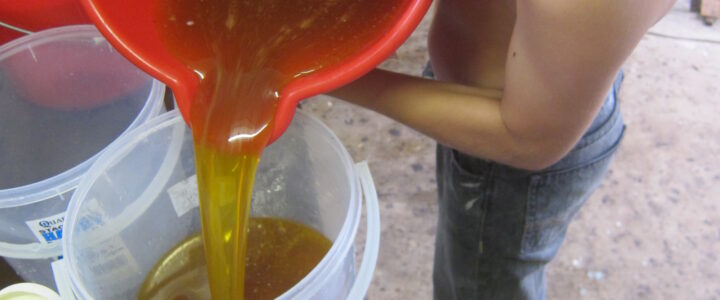
Grandad sliced the caps off the honey combs with a hot, special-purpose electric knife and Flynn slotted them into a honey extractor.

The extractor uses centrifugal force to extract the honey from the combs. It was Flynn’s job to spin the extractor, which proved to be a lot of fun. Although everything nearby became sticky with escaping honey, including Flynn!

Preparing the Honey for Sale

Checking the temperature of raw honey for Flynn's business project
Checking the temperature of the honey.
Raw honey prepared for Flynn's honey enterprise and money lessons for kids
Yummy raw honey — a great enterprise venture.

Flynn’s brother Jai, and a family friend Jack, stopped by to lend a hand. Many hands made light work and before long, after warming and sieving the honey, it was sealed into 10kg buckets.

Angry bees do not take too kindly to people robbing their hives. It was pretty amazing that Flynn managed to do all this work without getting stung. His Grandad and Dad were not so fortunate though!

A Big Investment and Money Lessons for Kids

Enterprising Flynn paid cash for 80kg of honey from his Grandad. He loaded it all up in our car to take it back to his home.

It was a large investment for a twelve-year-old and Flynn, knowing its value, took great care to ensure that the honey was well sealed and cushioned for the long trip home. He did not want it spilling, nor did he want any ants finding their way into his containers.

This was one of the most important money lessons for kids in the whole project. Flynn had to understand cost, risk, value and responsibility before he even made his first sale.

Flynn filling honey tubs with Grandad as part of money lessons for kids
Filling tubs with Grandad.

Flynn wanted to sell his honey at retail. He had done his research and found that honey generally sold in shops for around $12 or $13 a kilogram.

He had a unique product. It was tasty, raw and full of enzymes, which are generally destroyed during commercial pasteurisation processes.

Learning About Presentation and Retail Value

Flynn had also searched online for plastic honey pots. We discussed with him that people would pay a premium for his product if it looked professionally bottled and was not sold in recycled jam jars.

New plastic honey pots were not cheap. The larger the order, the better the price.

Flynn made his order over the phone and bought five hundred 500ml pots. These were delivered by mail within a few days, arriving in a massive cardboard box.

Flynn ordered honey jars and lids for his honey business
Flynn ordered honey jars and lids.
Honey jars ready to be filled for Flynn's honey enterprise
…ready to be filled.

So now he was all set to go with his Enterprise for Kids project. He had his honey and honey pots and had spent every cent that he had.

It was a huge investment and Flynn had no choice but to make it work. He had overcome fear and had taken a calculated risk with his business. All he had to do now was bottle, market and sell his honey.

And this will all be revealed in a later blog!

Flynn’s Honey Business Series

This article is Part 2 in Flynn’s honey business series, a family enterprise story about money lessons for kids, family business ideas, product value and learning by doing.

These posts show how family enterprise stories can teach children lessons that are hard to learn from theory alone.

Key Takeaway: Money Lessons for Kids Need Real Experience

Key takeaway: Money lessons for kids become much more meaningful when children handle real products, make real decisions and take real responsibility. Flynn’s honey investment gave him practical experience with cost, risk, quality, presentation and enterprise.

Where to Next?

If you enjoyed this part of Flynn’s honey business story, you may also like:

In our next Enterprise for Kids blog, we check back with Candy Man Chayse and see how his enterprise has been progressing.

Pulling the Money Bunny Out of the Hat!

Amber contemplating her enterprise.

Amber didn’t waste any time jumping into her New From Old money making enterprise. She bugged me to take her to the Dardanup Tip to see what she could find. So after her Saturday soccer game we paid a visit.

At the tip there is a salvage area where anything that could be recycled is put aside and sold.

Almost immediately Amber spotted an opportunity! She saw a damaged rabbit hutch. We looked over it and could see that it was generally in good structural condition and could easily be repaired. However, it did need a paint job. So Amber went up to the Tip man and struck up a deal. She bought the cage for $10.

Ten Dollars was a real bargain! We looked up the exact same cage sold online in kit form and saw that people were paying $180 for them.

Chayse helping Amber repair the rabbit hutch.
Amber fixing the door latch.


Arriving home there was a buzz of interest as the neighbouring kids headed around to see Amber’s rabbit hutch. They were really curious to see what she was up to. Amber bought a couple of paint brushes for $5, then using some old house paint she found in the shed, she and her friends, Darcy and Lauren, set to work painting. She also employed her brother Flynn and his mate Dan for $2 each to fix the broken part of the cage. They thought that would be awesome! Enterprise for Kids was now becoming infectious in the neighbourhood.

Amber employing Flynn to help her fix her rabbit hutch.
Darcy lends a helping hand.


It was all great fun and in no time at all the cage was ready to be sold. Amber continued her research into what to sell the cage for. She spoke with Darcy’s Mum about cages and also to Nicolette from next door. Both had owned rabbit cages and understood their value. Finally Amber decided that she would ask $90 for the bunny hutch.

Her next job was to put a free advert on the local Buy and Sell Bunbury Facebook page. She put her ad up with a photo and waited for a response.

You wouldn’t believe it! Within ten minutes the cage was sold for the full $90. In fact two other people had their hand up to buy the cage if the first deal fell through. Amber met and thanked the man who came round to pick the cage up and eagerly took the cash payment. She really did pull the money bunny out of the hat!

Now for the picture for Amber's Face Book advert
Amber's finished enterprise idea


All up, an outstanding result! In only a few days, Amber’s profit was $71 after costs. She is well on the way to attaining her goal. With her money jar now looking very full, she was rearing to go for another visit to the tip! She has already begun developing an enterprise mindset around business and money and her financial IQ is growing!

We will let you know how Amber goes with her next “New From Old Project”.

Next up we will pay a visit to Flynn and see how his buzzing honey enterprise is going!

Honey Pot of Gold!

Flynn as a budding young entrepreneur with one of our family business ideas

Family business ideas can start with something simple, practical and close to home. For Flynn, that opportunity came through raw honey, a family connection and a very enterprising plan that helped him learn real money lessons.

This is the beginning of Flynn’s honey business story — a family enterprise project where he learnt about opportunity, product value, buying wholesale, selling retail, confidence and taking action.

Flynn as a budding young entrepreneur with one of our family business ideas
Flynn — a budding young entrepreneur with a family business idea.

Family Business Ideas: Flynn’s Honey Enterprise Begins

Flynn is a natural budding young entrepreneur and he is never afraid to chase an opportunity. He often comes up with brilliant enterprising ideas, and the idea he planned to take on with Enterprise for Kids was a definite money spinner.

Before I tell you all about Flynn’s awesome enterprising idea, I want to introduce some food for thought.

Why Family Business Ideas Need a Different Money Mindset

Prior to us starting Enterprise for Kids, our children were following the same conditioning around money that we had: earn money, spend money, borrow money. Society encourages this greatly.

Whilst many people may not see anything wrong with this, many of us actually spend far more than we have coming in. The cycle never gets broken, and by the time we reach retirement age, we have very little to show for the many years of hard work we have put in.

That is why building an entrepreneurial mindset is so important. Breaking old conditioned habits is even more important. The younger you are, the less conditioning you have.

So while we want to develop in our children a great work ethos — working hard and with integrity — we also want to help them move beyond that. We want them to learn how to spot an opportunity, take action and then help others achieve success as well.

This system moves a person from being the worker, to seeing an enterprising opportunity, to switching on their entrepreneurial self, to finally becoming the expert in their field.

This is exactly why we care so much about raising entrepreneurial kids and helping them learn through real-life projects. Family business ideas give children a safe, practical way to begin that learning at home.

Entrepreneurial Thinking Behind Family Business Ideas

An entrepreneur’s focus is in the development of a great system and finding great people to run it. They use other people’s time and other people’s money to do the work for them.

Their systems can continue even after they pass from this world. A classic example is Thomas Edison’s formula for General Electric. He is no longer with us, but his empire continues.

That is one of the powerful lessons behind family business ideas. Children can begin to see that a business is not just a product. It is also a system, a process and a way of creating value for other people.

A Queen Bee Is Entrepreneurial

Akaisha dressed as an enterprising queen bee showing how systems support family business ideas
Enterprising Queen Bee.

A Queen Bee most definitely comes under the bracket of entrepreneur. She controls her entire empire from within her hive.

Thousands of honey bees — the workers — head out of her hive each morning collecting nectar, pollen and other resources for the hive, such as water. The worker bees will risk life and limb and literally work themselves to death. A worker bee only lives a few weeks.

The Queen Bee will have employees whose main job is to guard the hive from danger. Others clean the hive and many fan the hive to keep the temperature controlled. The queen will have workers who care for the nursery and for her own needs.

All she has to do is eat and lay eggs!

A beehive is a unique system consisting of many specialised individuals that each have a job to do. The system performs like it is one large living organism. If the Queen dies, then she will be replaced by another Queen Bee, the workers keep working and the hive goes on.

Not a lot different to General Electric, Apple or Ford Motor Company!

Flynn’s Honey Family Business Idea

Flynn negotiating a honey deal with his Grandad for a family business idea
Flynn negotiating a honey deal with his Grandad.

So what has Flynn’s idea got to do with a Queen Bee?

Flynn’s enterprising idea has everything to do with our Queen Bee and her empire.

In fact, his plan was to use her company’s product: honey.

Flynn intended to buy raw, unprocessed honey at wholesale in bulk and sell it in smaller jars at retail. He worked out his figures and could see excellent profit potential.

Once his business got underway, he could also see the potential for it to grow quite substantially.

I won’t tell you any more about his plans here, but if you missed the link above, you can listen to Flynn himself in this short video of Flynn explaining his awesome enterprise idea and business plan.

This is one of those kids business ideas that starts small, but teaches a lot: product value, buying wholesale, selling retail, confidence, negotiation and understanding profit.

Why Raw Honey Was a Clever Family Business Product

Seeing as we are on the topic of honey, I thought I would share a few facts about honey, and in particular raw, unprocessed honey.

Raw, unprocessed honey is pure, natural, unpasteurised and unadulterated. It is extracted from the beehive in its natural form and bottled. It is not filtered or heated.

Unlike many processed honeys, raw honey can retain more of its natural qualities from the hive, including pollen, propolis, minerals and flavour.

Mmmm… appears to be a fantastic product!

For Flynn, the clever part was not just that honey was useful and delicious. The clever part was that he could understand the product, buy it in bulk, bottle it in smaller jars and sell it in a way that made sense to customers.

That is why this became such a useful example of family business ideas in action. It was simple enough for a child to understand, but rich enough to teach real lessons about value, pricing, supply, confidence and profit.

Flynn’s Honey Business Series

This article is Part 1 in Flynn’s honey business series, a family enterprise story about family business ideas, product value, money lessons and learning by doing.

These family enterprise stories show how children can learn by doing, rather than just being told about business, money and opportunity.

Key Takeaway: Family Business Ideas Can Start Small

Key takeaway: Family business ideas do not need to be complicated. A simple product, a real opportunity and a child willing to take action can become a powerful lesson in entrepreneurship, confidence and money.

Where to Next?

If you enjoyed Flynn’s honey business story, you may also like:

So, what do you think? Is Flynn onto a real Enterprise for Kids success story? Follow along with the blog to see how he goes.

In our next blog, you’ll be inspired by another budding entrepreneur, four-year-old Chayse, as he showcases his business idea. It is as sweet as Flynn’s enterprising ideas!

Business Ideas for Kids: Finding Enterprise Ideas

kids entrepreneur ideas inspired by real family enterprise experiences

Business ideas for kids often begin with everyday problems, useful skills and a little creative thinking.

Coming up with an enterprise idea that makes money, solves a real problem and keeps a child motivated is a tall order for an adult, let alone a kid.

Children do not need a perfect idea to get started. In fact, many of the best ideas come from noticing what people need, thinking creatively and using the skills children already have.

business ideas for kids through real family enterprise experiences
Looking for enterprise ideas as a family.

Business Ideas for Kids: Finding Enterprise Ideas

Business ideas for kids are often found by looking closely at everyday life. Coming up with an enterprise idea that makes money, solves a real problem and keeps a child motivated can be a tall order for an adult, let alone a kid.

The trick is to spend time brainstorming ideas together and helping children notice the small problems around them.

What I explained to my entrepreneurial kids was that they needed to think about the problems in our small community town, then look for possible solutions.

By solving people’s problems, children begin to create real opportunities for enterprise.

Business Ideas for Kids Start with Solving Problems

In the original video for this post, I gave the kids a simple example. Winter was drawing near and people were chopping wood ready to fuel their fires.

Problem: No one likes scrambling around outside on a cold and rainy day gathering kindling to get their fire started.

Solution: Collect bundles of gum tree sticks, tie them up and sell them to people who need kindling ready to go.

Step one was finding the problem. Step two was finding the solution. Putting the idea into action would be step three.

What a great and simple enterprise idea.

After hearing this example, the kids had no trouble finding enterprise ideas of their own.

Using Skills to Create Kids Entrepreneur Ideas

Our mentor, Paul Counsel, often shares a great educational basis behind what it means to be entrepreneurial.

He encourages us to consider how we are an asset to others. What skills and knowledge do we have that could be of service to others? What are we good at?

For example, Kaitlin and Amber are very good with toddlers and babies. Every day they were helping with their baby sister Akaisha. They fed her, changed her nappy, bathed her and took her for walks.

Both girls were very skilled and had a natural ease with babies. Knowing when Akaisha was tired and how to soothe her when she was upset became second nature. These abilities could easily lead to real enterprise opportunities.

Everyday skills can become enterprise ideas:

kids helping younger siblings read as part of business ideas for kids
Reading with siblings
kids caring for younger siblings and developing enterprise skills
Looking after Akaisha

Turning Everyday Skills into Enterprise Ideas

The obvious enterprise would be babysitting, but other ideas include:

  • Homework Support — busy parents may need someone to listen to younger children read, practise spelling words or help with writing.
  • Toddler Playmate — after school, some parents may appreciate an older child entertaining and playing with their toddler or baby.
  • Walking Younger Children Home from School — busy parents may appreciate a responsible older child helping with the school run.
  • Sports, Dance, Music or Art Coaching — Amber and Kaitlin could teach other kids how to throw, catch, draw, dance or play music.
child who enjoys helping younger kids as a business idea for kids
Kaitlin loves kids.

These are not complicated ideas, but they are valuable and practical. Children can easily miss this point. Often, they do not realise that skills they use every day may be helpful to someone else.

Finding Business Ideas for Kids Through Imagination

All it requires, when finding enterprise ideas for kids, is a little imagination.

Take the time to identify problems and look at what assets you have that could help people. Helping people is the key to enterprise.

Many ideas are not new. However, children often need guidance to look at their existing skills and realise how valuable they already are.

young musician developing skills that could become business ideas for kids
Budding young musician

A tip for everyone: you can increase your value by up-skilling and becoming an expert in an area.

As your skill increases, your value increases too. Over time, people are more likely to seek your help and pay for your time and knowledge.

How Kids Can Start a Business by Increasing Their Value

For example, being a whiz at sorting computer glitches would make you valuable to people who have computer problems. Being an expert pianist could create opportunities to teach others how to play piano.

Many of these ideas are simple. The real lesson is helping children notice what they are already good at, then think about how those skills could help others.

For older children who are ready to take an idea further, Business.gov.au has helpful information for young people starting a business.

Business Ideas for Kids Are Everywhere

Finding enterprise ideas can be fun, and it isn’t that hard if you do a little thinking and brainstorming first.

Amber will reveal her enterprise idea in the next blog as she begins her quest to reach her goals, so stay tuned.

Key takeaway: Business ideas for kids often begin with simple problem-solving. When children learn to notice problems, use their skills and think about how they can help others, they begin to see enterprise opportunities everywhere.

Where to Next?

If you enjoyed this post about finding business ideas for kids, you may also like:

We would love to hear from you, so please leave a comment.