Flynn’s Honey Investment Continued……

Money lessons for kids shown through Flynn pouring honey for his business

Money lessons for kids become much more powerful when children experience them in real life. For Flynn, that meant negotiating with his Grandad, harvesting raw honey, making an investment and learning what it really takes to grow a small business.

This is Part 2 of Flynn’s honey business story, where his idea moved from plan to action — complete with bee suits, honey frames, sticky hands and a very serious investment for a twelve-year-old.

Money lessons for kids with Flynn and Grandad collecting honey frames for a business project
Flynn with Grandad collecting honey frames for his honey business.

Money Lessons for Kids: Flynn’s Honey Investment Continued

You may remember from a previous blog that Flynn’s Enterprise for Kids plan was to buy honey at wholesale and sell it at retail. All he needed was a good source of cheap, quality honey that he could buy in bulk.

If you missed the beginning of the story, you can read Part 1: Honey Pot of Gold, where Flynn first explained his honey business idea.

Finding a Product for Flynn’s Honey Business

Flynn’s Grandad has kept bees for over twenty years and had a number of hives which he regularly harvested honey from. The honey produced from his bees is very light in colour and tasty, as the bees forage over the Mid West fields of Paterson’s Curse and coastal gums.

Flynn knew that he had a good quality product.

His plan was to pay a visit and strike up a deal with his Grandad.

Flynn’s Grandad saw that Flynn had thought through his plan. He was more than willing to support Flynn with his new honey enterprise. Flynn negotiated a good price per kilogram, however, the deal included Flynn having to help his Grandad rob the honey from the hives.

You can listen to Flynn explaining the deal he made with his Grandad in his own words.

Money Lessons for Kids Through Real Work

Flynn putting on bee protective gear for money lessons for kids through real work
Flynn donning his gear.

Flynn was up for the challenge. He donned a pair of overalls, gloves, boots and bee veil. Then he and his Grandad disappeared for the morning, returning later in the day with a heavy load of honey supers in the back of the ute.

They were carted around to the rear of the house and quickly stacked in the garage. Already the local bees were honing in on the honey, hoping to pinch it for their own hives. The garage door was closed to keep the bees out.

This is where money lessons for kids become very real. Flynn was not just talking about business. He was helping collect the product, understanding the effort behind it and learning that profit starts long before anything is sold.

For families in Western Australia interested in bees and beekeeping, the Department of Primary Industries and Regional Development has useful information about beekeeping in Western Australia.

Extracting the Raw Honey

Flynn slotting honey combs into the extractor for his honey business
Flynn slotting the honey combs into the honey extractor.
Extracting honey from the honey combs for Flynn's honey business
Extracting the honey from the honey combs.

Grandad sliced the caps off the honey combs with a hot, special-purpose electric knife and Flynn slotted them into a honey extractor.

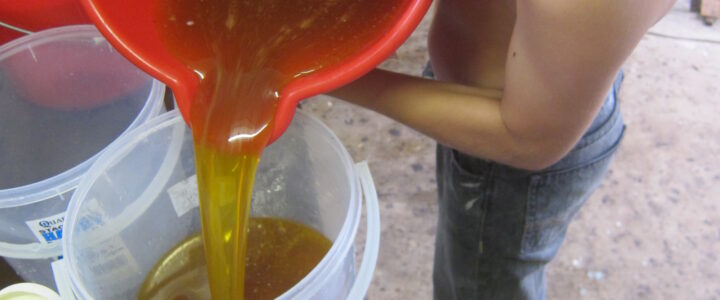
The extractor uses centrifugal force to extract the honey from the combs. It was Flynn’s job to spin the extractor, which proved to be a lot of fun. Although everything nearby became sticky with escaping honey, including Flynn!

Preparing the Honey for Sale

Checking the temperature of raw honey for Flynn's business project
Checking the temperature of the honey.
Raw honey prepared for Flynn's honey enterprise and money lessons for kids
Yummy raw honey — a great enterprise venture.

Flynn’s brother Jai, and a family friend Jack, stopped by to lend a hand. Many hands made light work and before long, after warming and sieving the honey, it was sealed into 10kg buckets.

Angry bees do not take too kindly to people robbing their hives. It was pretty amazing that Flynn managed to do all this work without getting stung. His Grandad and Dad were not so fortunate though!

A Big Investment and Money Lessons for Kids

Enterprising Flynn paid cash for 80kg of honey from his Grandad. He loaded it all up in our car to take it back to his home.

It was a large investment for a twelve-year-old and Flynn, knowing its value, took great care to ensure that the honey was well sealed and cushioned for the long trip home. He did not want it spilling, nor did he want any ants finding their way into his containers.

This was one of the most important money lessons for kids in the whole project. Flynn had to understand cost, risk, value and responsibility before he even made his first sale.

Flynn filling honey tubs with Grandad as part of money lessons for kids
Filling tubs with Grandad.

Flynn wanted to sell his honey at retail. He had done his research and found that honey generally sold in shops for around $12 or $13 a kilogram.

He had a unique product. It was tasty, raw and full of enzymes, which are generally destroyed during commercial pasteurisation processes.

Learning About Presentation and Retail Value

Flynn had also searched online for plastic honey pots. We discussed with him that people would pay a premium for his product if it looked professionally bottled and was not sold in recycled jam jars.

New plastic honey pots were not cheap. The larger the order, the better the price.

Flynn made his order over the phone and bought five hundred 500ml pots. These were delivered by mail within a few days, arriving in a massive cardboard box.

Flynn ordered honey jars and lids for his honey business
Flynn ordered honey jars and lids.
Honey jars ready to be filled for Flynn's honey enterprise
…ready to be filled.

So now he was all set to go with his Enterprise for Kids project. He had his honey and honey pots and had spent every cent that he had.

It was a huge investment and Flynn had no choice but to make it work. He had overcome fear and had taken a calculated risk with his business. All he had to do now was bottle, market and sell his honey.

And this will all be revealed in a later blog!

Flynn’s Honey Business Series

This article is Part 2 in Flynn’s honey business series, a family enterprise story about money lessons for kids, family business ideas, product value and learning by doing.

These posts show how family enterprise stories can teach children lessons that are hard to learn from theory alone.

Key Takeaway: Money Lessons for Kids Need Real Experience

Key takeaway: Money lessons for kids become much more meaningful when children handle real products, make real decisions and take real responsibility. Flynn’s honey investment gave him practical experience with cost, risk, quality, presentation and enterprise.

Where to Next?

If you enjoyed this part of Flynn’s honey business story, you may also like:

In our next Enterprise for Kids blog, we check back with Candy Man Chayse and see how his enterprise has been progressing.
Learning by Doing: The $100 Family Enterprise Project

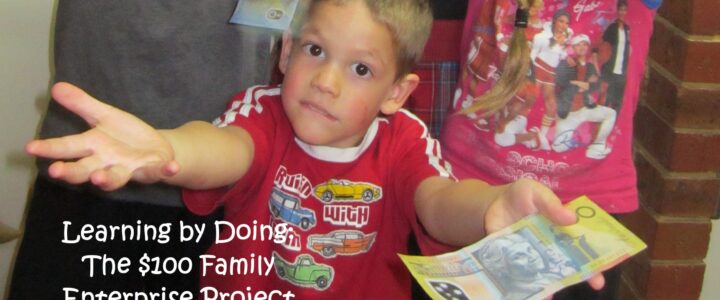
Chayse holding a fifty dollar note for the $100 Family Enterprise Project

Learning by doing is one of the best ways for children to develop enterprise skills. At some point, they need to stop only talking about ideas and begin testing them in the real world.

“`

For our family, that beginning became the $100 Family Enterprise Project. We gave each of the kids start-up capital, asked them to choose an enterprise idea, and decided we would refine the process as we went.

“`

Goal setting for the $100 Family Enterprise Project and learning by doing
Goal setting for Enterprise for Kids.

Learning by Doing: The $100 Family Enterprise Project

For our kids to develop the skills and habits of an entrepreneur, they needed to begin somewhere.

But where?

The beauty of Cathy and I having a wealth creation mentor at our disposal was that we could take the invaluable information we had been learning and apply it in small pieces to developing the mindset of our kids.

This process also involved us having a good, hard look at how we operate in our own lives in regards to planning, organising and taking action.

Cathy loves to plan things out in her head and on paper before starting a task. Once satisfied, she will start when all structures are in place.

I, on the other hand, like to dive in and see where it leads.

So a happy compromise was met.

We decided that the kids just needed to come up with an enterprise idea and get started. We could refine the process later.

Learning by Doing Instead of Waiting for Perfect Conditions

Getting the kids to kick off with an enterprise project, when they had little idea where to even start, was easier said than done.

But I knew that one of the things that had held us back over the years was waiting until all conditions were right.

Waiting had seen us miss many great opportunities that were out there.

So we just started.

Admittedly, it was a bit like the blind leading the blind, but we went in with an open mind and decided to see what would happen and where it would lead.

That is the heart of learning by doing. You do not need to know every step before you begin. You need enough of a plan to start, and then the courage to learn from what happens next.

Chayse and Kit drawing their goals as part of learning by doing
Chayse and Kit drawing their goals.

The First Step in Our Kids Enterprise Project

Check out our very first videos.

The filming is pretty rough, as we had our 15-year-old daughter using her creative licence while filming, but you’ll get the gist of what our project is all about if you watch them.

For those of you who would prefer to read, I’ll give you the rundown.

I presented each of the kids with $100 each, except the baby… as all she would do is try and eat it!

Kids receiving start-up capital for learning by doing through enterprise
The $100 Family Enterprise Project begins.
Kids catching fifty dollar notes as part of the $100 Family Enterprise Project
Raining $50 notes.
Children receiving start-up money for learning by doing through enterprise projects
And more start-up money for the family enterprise project.

“Wow!” was their first response.

An early Christmas present!

“Ohhhh,” was the next response. They were more sedate now that there seemed to be a catch.

But they listened to my proposal.

$100 Start-Up Capital for Kids

The kids were to use the money as start-up capital for an enterprise.

Much to their disappointment, they were not to spend it on themselves.

In fact, they were to pay me back once they had attained their business goal.

I was a bit soft on them though.

I also said that I would take the risk. If they were unsuccessful and were not able to pay back the $100, then I would accept that and absorb the loss.

I did this because I wanted them to give their enterprise a go.

I was conscious that if they were too hung up about having to pay me back, then they might worry about their loss and, as a consequence, not find the courage to even start to play the game.

Loaning the $100 was the first step in our elaborate plan to give our kids a shot at being entrepreneurial with their kids enterprise project.

Why Learning by Doing Matters for Kids

Giving the children $100 did not magically make them entrepreneurs.

What it did was make the project real.

Suddenly they had money in their hands, a challenge in front of them and a reason to think differently.

They needed to ask:

  • What could I do with this money?
  • What could I buy, make or sell?
  • Who might want what I offer?
  • How could I pay the money back?
  • What would make the project worthwhile?
  • What would I learn if it did not work?

These are real business questions.

The Australian Government’s MoneySmart guide to teaching kids about money is a useful reminder that parents can start early and make money part of everyday life.

For us, the $100 Family Enterprise Project became exactly that — an everyday, real-world way to teach money, initiative, risk, responsibility and action.

From Goal Setting to Enterprise Action

This article sits at the beginning of our early Enterprise for Kids journey.

First, the children needed goals they cared about.

Then they needed a reason to act.

Then they needed the courage to try.

The goal-setting process helped them imagine what they wanted. The $100 start-up money helped them move into action.

That is why learning by doing became such an important part of the family project.

Follow the $100 Family Enterprise Project

Follow the early Enterprise for Kids journey: This article shows how the $100 Family Enterprise Project began. The next posts show how the children set goals, chose ideas and started learning through real enterprise projects.

The Biggest Lesson: Just Start

Check out our next blog for the subsequent steps in our entrepreneurial quest.

At this stage, we did not know exactly where it would all lead.

But that was the point.

The children were going to learn by doing.

And so were we.

Key Takeaway: Learning by Doing Builds Enterprise Skills

Key takeaway: learning by doing helped our kids begin their first enterprise projects. The $100 Family Enterprise Project gave them start-up capital, a real challenge, and the chance to develop money skills, confidence and entrepreneurial thinking through action. This is a great project to give kids a financial education.

Where to Next?

What could your child learn by doing if they were given a small enterprise challenge?